Does SEO Semantic Markup Actually Improve Rankings?
At 9:12 on a Tuesday, your content team opens a page audit and freezes for a second. The article looks polished in the browser. The title is bold, the subheads read cleanly, and the body copy flows. Then your developer opens the source code beside it, and the illusion breaks: the “headline” is a styled container, section labels are just bold text, and the main article is buried in a stack of anonymous boxes.
That is usually when seo semantic markup stops sounding academic. You realize the page says one thing to humans and very little to the machine reading the HTML. The short answer is plain: yes, semantic markup can help rankings indirectly by making content easier to interpret, but no, it is not a magic ranking shortcut.
One more distinction before we go further. When people hear “markup,” they often jump straight to schema. That matters too, but this article focuses first on native HTML structure — headings, paragraphs, lists, sections, articles, headers, and footers — because that is the bedrock every crawler, browser, screen reader, and AI system meets first.
So, does SEO semantic markup improve rankings?
The short answer in one sentence
Watch This Helpful Video
To help you better understand seo semantic markup, we've included this informative video from ByteGrad. It provides valuable insights and visual demonstrations that complement the written content.
Seo semantic markup can support rankings by improving machine understanding, but it rarely moves positions on its own.
Barry Adams makes the underlying point well: HTML is the foundational language of the web, and semantic HTML markup on webpages can help machine systems better understand content and its value. If your page structure is clear, you give search engines better clues about what is primary, what is supporting detail, and what is just decoration.
Semantic markup is a clarity layer, not a ranking hack.
Why the effect is indirect
Google has long emphasized that semantic HTML improves accessibility, SEO, and maintainability. Notice the wording. That is not the same as “replace five generic containers and jump three spots.” Search visibility usually improves because clearer pages are easier to crawl, easier to parse, easier to navigate, and easier to reuse in other interfaces.
If you turn a fake heading into a real <h1>, Google does not hand you a trophy. What can happen, though, is that your page hierarchy becomes less ambiguous. Your list of steps may become easier to extract. Your content may work better with screen readers. Your template may become more consistent across 5,000 URLs. Those gains add up.
| Semantic Change | Direct Ranking Guarantee? | Typical Benefit |
|---|---|---|
| Use a real <h1> for the page title | No | Clearer topic hierarchy and page understanding |
| Mark steps with <ol> instead of plain paragraphs | No | Better sequence signals for summaries and extraction |
| Wrap content in <article>, <header>, and <footer> | No | Cleaner machine readability and easier template QA |
What SEO teams should realistically expect
You should expect semantic markup to behave like technical hygiene. It reduces confusion. It strengthens templates. It helps search engines, assistive tech, and AI systems read the page with fewer guesses. For publishers, SaaS brands, and agencies managing dozens of content types, that matters more than one-off ranking spikes.
- Do expect cleaner content hierarchy.
- Do expect better accessibility and more durable templates.
- Do expect some pages to become easier to quote, summarize, or classify.
- Do not expect semantic HTML to rescue weak intent matching, thin copy, or poor internal linking.
If your page misses the search intent for “best CRM for nonprofits,” semantics will not save it. If the page already answers the query well, semantic structure can make that answer easier for Google and AI systems to trust and reuse.
What is SEO semantic markup?
Meaningful tags vs. generic containers
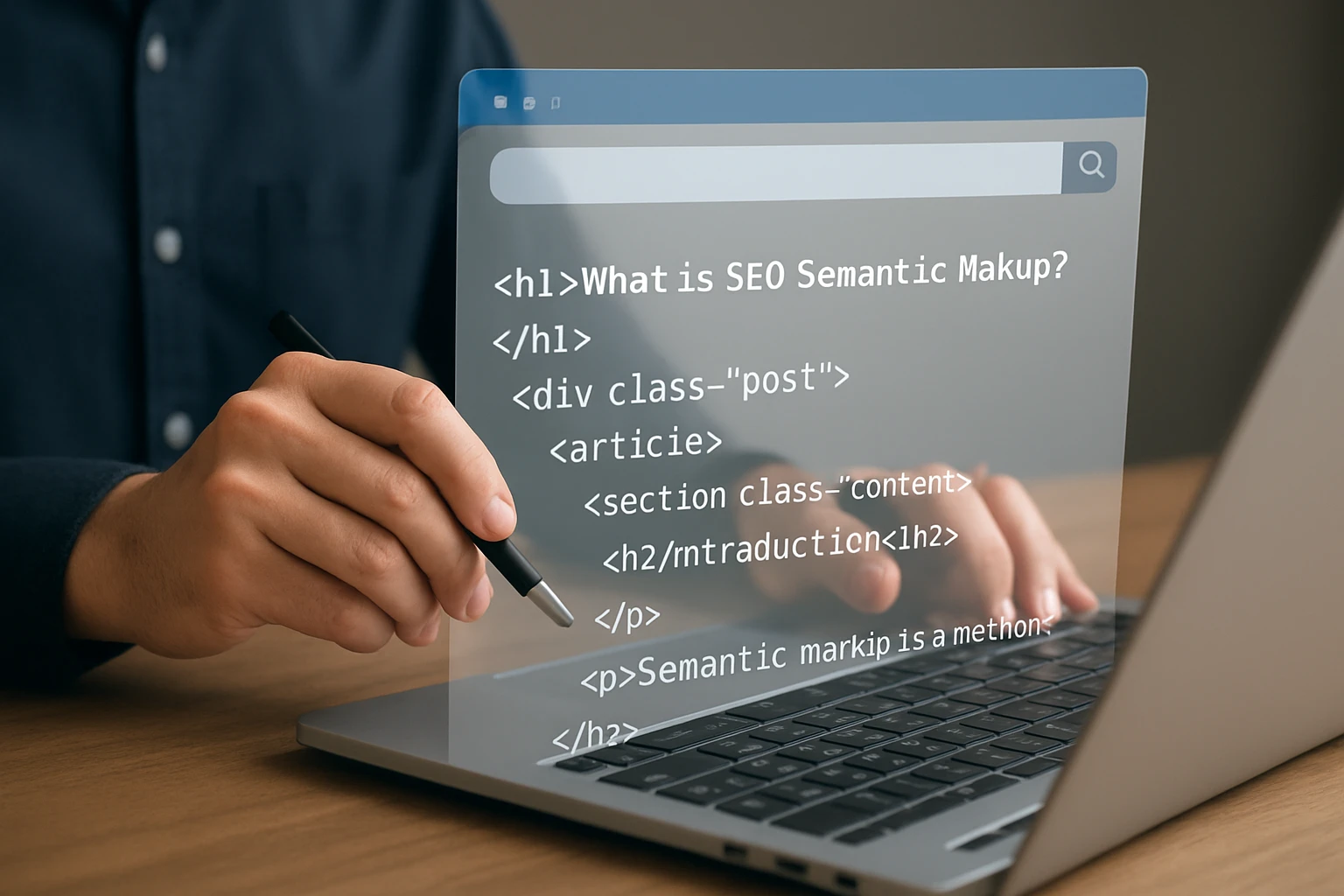
Semantic HTML uses tags that describe what the content is, not just how it should look. A generic container tells the browser, “here is a box.” A semantic element tells the browser and every machine reading the page, “this is a heading,” “this is a section,” “this is a paragraph,” or “this is an article.”
That sounds small until you audit a modern CMS template. I have seen plenty of pages where the visible title sits inside three nested generic wrappers because the design system cared more about spacing than meaning. Humans cope. Machines infer. Good markup removes that guesswork.
If the tag describes the content, it is semantic.
Examples of semantic elements
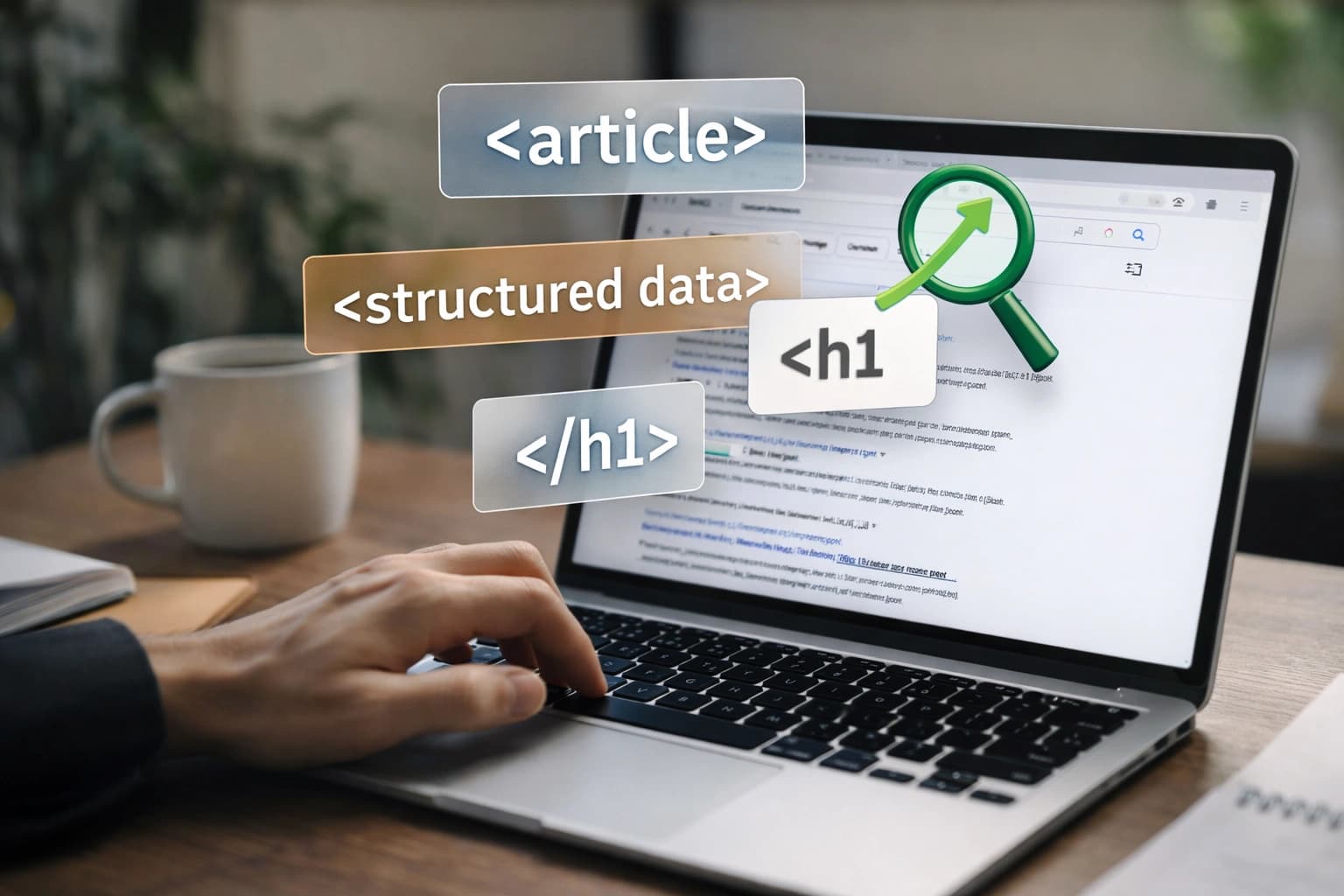
Semantic HTML uses descriptive tags such as <article>, <section>, <header>, and <footer> to structure web content. Barry Adams also highlights simpler elements that people overlook: <p>, <h1>, <ol>, and <img>, each of which indicates a specific kind of content.
- <h1>: the page’s main heading.
- <p>: a paragraph of text.
- <ol>: an ordered list, usually steps or ranked items.
- <img>: an image element.
- <article>: a self-contained piece of content, like a blog post.
- <section>: a grouped section of related content.
- <header> and <footer>: supporting page or content-region framing.
Those tags do not just help browsers render a page. They explain the role of each piece. That is the whole point.
What semantic markup already does by default
Semantic markup gives you useful meaning before you add any extra SEO layer. A real heading is already a heading. A real list is already a list. A real article already tells parsers that the enclosed content belongs together. You do not need a script or plugin to create that baseline signal.
This is why semantic HTML and schema markup are different tools. Schema can add detailed labels about entities, products, authors, reviews, or FAQs. Semantic HTML handles the native structure of the document itself. In practice, you want both — but you start with HTML because without that, the page foundation is shaky.
Why does semantic markup matter for SEO and AI?
Accessibility and inclusive experiences
The W3C says semantic markup plays a foundational role in creating inclusive digital experiences. That is not just an accessibility footnote. It affects how real people navigate your content. A screen reader user can jump through headings, identify lists, and understand page regions far faster when the HTML matches the visible design.
If your “subheads” are just bold text inside generic wrappers, that shortcut disappears. The page becomes harder to scan, harder to navigate, and easier to abandon. SEO teams sometimes treat accessibility as a parallel track. In practice, the same semantic fixes often improve both accessibility and crawl interpretation.
Good semantics serve users first; SEO benefits follow.
Why AI assistants care about structure
Today’s web is consumed in more places than a browser tab. Voice search, screen readers, smart devices, and AI assistants such as Google’s Search Generative Experience all rely on structure to interpret hierarchy, intent, and context. If a page clearly separates a question, its answer, the supporting evidence, and the step list, machines can work with it more confidently.
Think about a recipe, a help article, or a pricing explainer. If the steps appear as a proper ordered list, the summary becomes easier to generate. If the page title is a real heading and the subsections use real subheads, an AI system has a cleaner map of the content. That does not guarantee a citation or mention, but it absolutely improves the odds that the system understands what it is reading.
Maintainability for large content teams
Google’s long-running emphasis on maintainability gets less attention than accessibility, but for teams with scale, it is a huge win. If you manage 300 landing pages, 8 content writers, and 4 CMS templates, semantic structure becomes a governance tool. You can audit it, standardize it, and teach it.
A clean article template makes QA faster. An agency can spot heading misuse in minutes. A publisher can roll out one footer fix across 20,000 pages. Your future redesign also gets easier, because the meaning lives in the HTML instead of being smuggled into CSS class names and visual tricks.
That is why I usually frame semantic markup as a compounding advantage. One page benefit looks modest. One thousand pages later, it is operationally significant.
How does semantic markup work on a page?
Headings and document hierarchy
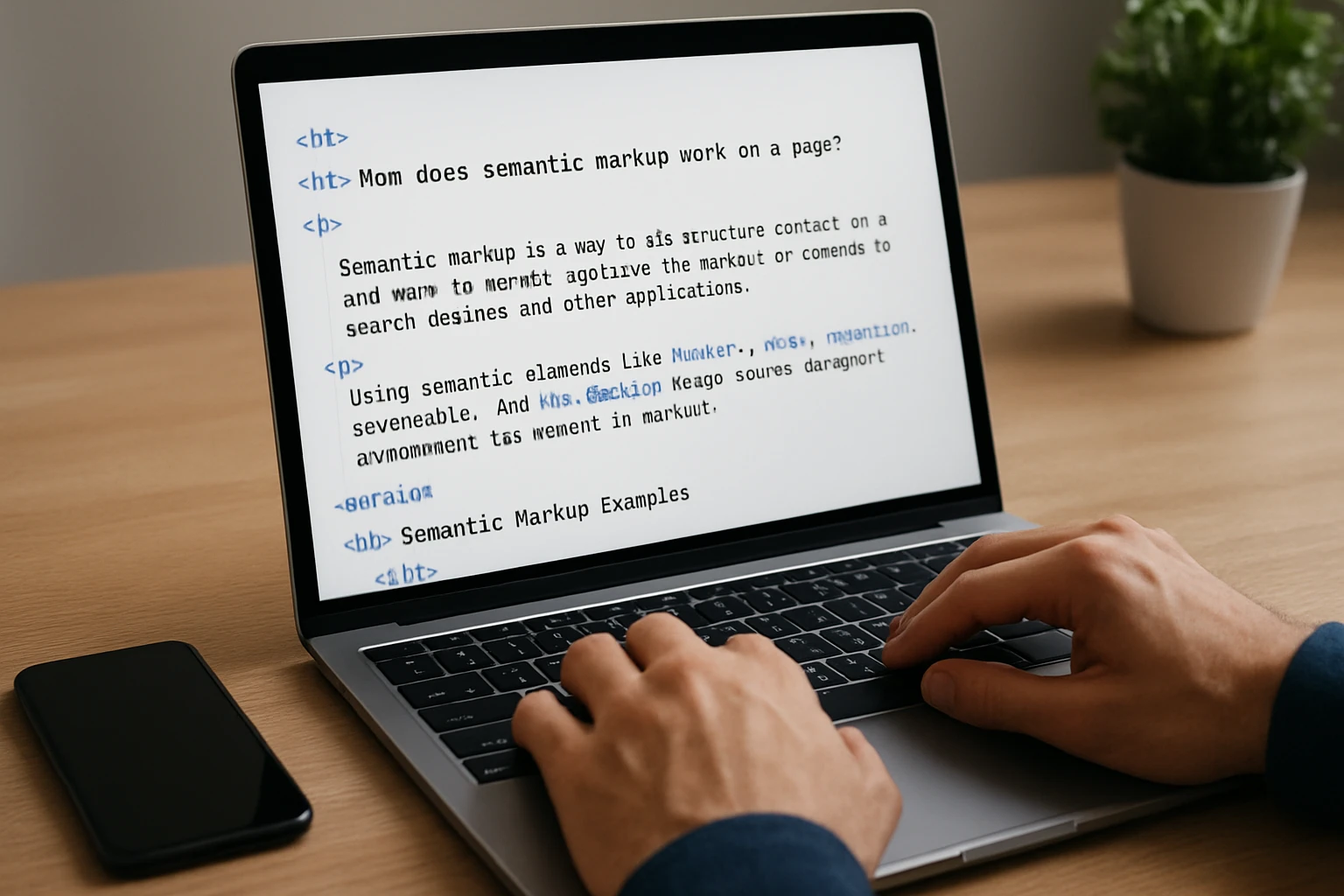
HTML surrounds text to provide structure, and each tag indicates what a piece of content is meant to be. Headings do the heavy lifting. Your <h1> signals the main topic. Your <h2> elements mark major sections. Your <h3> elements break those sections into supporting answers. That hierarchy helps humans skim and helps machines identify the shape of the argument.
- The page title sets the primary topic.
- Section headings divide major questions or themes.
- Subheadings organize supporting details under the right parent topic.
When that order is clear, the page reads like a well-built outline. When it is messy — say, three visual “headings” with no real heading tags — a crawler has to infer structure from surrounding clues.
How paragraphs, lists, and images signal meaning
The smaller elements matter too. The <p> tag marks a paragraph. The <img> tag indicates an image. The <ol> tag indicates an ordered list. Those are not ornamental decisions. A paragraph tells a parser, “this is continuous prose.” A list tells it, “these items belong together.” An image tells it, “there is visual content here, and supporting text may explain it.”
Take a software onboarding article with “5 setup steps.” If you present those steps as five styled paragraphs, the sequence is weaker. If you use a real ordered list, the sequence is explicit. The visible design may look identical. The source meaning does not.
Images fit the same pattern. A product diagram, chart, or screenshot becomes more useful when it appears in the right region of the page and is paired with meaningful surrounding text. Semantics do not replace good copy, but they give the copy a frame that machines can interpret.
Where semantic structure gets muddled
Most semantic problems come from convenience. Designers want layout freedom. Page builders wrap everything in generic blocks. Developers ship reusable components that look right but say very little in the source. Over time, the page becomes visually clean and structurally vague.
| Visible Element | Muddled Source | Better Semantic Source | Why It Helps |
|---|---|---|---|
| Main title | Styled generic wrapper | Real <h1> | Clarifies the page topic |
| Step-by-step instructions | Separate paragraphs | <ol> with list items | Makes sequence explicit |
| Standalone post | Nested generic blocks | <article> with <header> and sections | Groups related content clearly |
| Footer links | Loose links at page end | Real <footer> | Separates main content from supporting links |
You do not need theoretical purity. You need less ambiguity. Start with templates that drive revenue or traffic, such as blog posts, documentation pages, category pages, and comparison pages. Clean up those patterns first.
A page with clean structure is easier to extract, summarize, and repurpose.
What common questions do teams ask about semantic markup?
Is semantic HTML the same as schema markup?
No. Semantic HTML and schema markup are different tools, even though both help machines understand pages. Semantic HTML structures the page itself. Schema markup adds structured data that describes entities and attributes in a more explicit machine-readable format.
| Tool | What It Does | Where It Lives | Best Use |
|---|---|---|---|
| Semantic HTML | Defines the structure and meaning of visible page content | Native HTML elements | Headings, sections, lists, articles, footers |
| Schema Markup | Adds structured data about entities and content types | Usually JSON-LD or other structured data formats | Products, FAQs, reviews, organizations, authors |
If your page has perfect schema but poor HTML structure, you are still asking machines to work harder than necessary. If your HTML is strong but you skip schema where it fits, you may miss opportunities for richer interpretation. They complement each other. They do not replace each other.
Do you need perfect semantics everywhere?
No. Start with correct page structure, not perfectionism. A lot of teams stall because they treat semantics like a purity test. That wastes time. Fix the obvious issues first.
- Make sure each page has a clear main heading.
- Use real headings for sections instead of bold styling.
- Mark lists as lists.
- Wrap standalone content in meaningful containers like articles or sections.
- Standardize templates before chasing one-off page tweaks.
Don’t overengineer; start with correct page structure.
If you run a 10,000-URL site, the fastest win is usually template cleanup. Fix the article shell, not just one article. Fix the category layout, not just one category page. That is where semantic work pays back.
Can it help with SERP features or AI mentions?
Yes — indirectly. Semantic markup helps machine systems better understand content and its value, which can make a page easier to classify, summarize, and surface in different formats. Clear headings, tables, lists, and article structure can support featured snippets, AI summaries, and answer extraction because the page is easier to read programmatically.
But keep your skepticism. Some writers talk about semantic HTML as if it flips a ranking switch. The stronger, better-grounded claim is simpler: it improves interpretation. From there, search visibility may improve because the content is easier to trust, quote, reuse, and maintain.
That is also the sensible way to think about AI discovery. If a large language model or search assistant scans your page, clean structure increases the chance that it identifies the main claim, the supporting evidence, and the action steps correctly. It still will not save weak content, poor topical coverage, or a broken internal linking strategy.
Seo semantic markup will not catapult a weak page to page one, but it does make a strong page easier to parse, trust, and reuse.
That makes it a smart, low-risk habit for teams that care about accessibility, maintainability, and AI visibility as much as rankings. When you audit your next template, what would a crawler or language model understand from the source before it ever sees the design?
Advance Semantic SEO With SEOPro AI
LLM SEO tools for ChatGPT, Gemini, and other AI agents automate publishing, improve markup and schema, expand internal links, and track traffic drift.
See The Platform