How to Use Brand Visibility Synonyms

The cursor blinks. On the brief in front of you sit five near-duplicates: brand visibility, brand awareness, brand recognition, brand exposure, and brand recall. One belongs in the headline. One probably belongs in a subhead. One will send the whole page slightly off target if you treat it like an exact match.
If you work in SEO, content, or growth, you have seen this problem before. A thesaurus hands you dozens of options, but search intent does not work like a thesaurus. A tool may show 53 similar phrases for “brand visibility,” yet Google and AI systems will not reward you for dumping all 53 onto one URL.
What works is smaller and sharper. You build a semantic cluster, choose one canonical phrase, support it with a few close variants, and place each term where it makes sense. That gives you cleaner copy, better relevance, less cannibalization, and a page that is easier for search engines and LLMs to quote accurately.
Prerequisites and Tools: Gather the Right Inputs Before You Write
Define the Page Goal and Audience Stage
Start with a one-sentence goal before you touch a keyword list. Are you writing a glossary entry for junior marketers, a strategy post for a SaaS content team, or a landing page for executives who already know the category? Those are not the same job, and they should not use the same synonym mix.
I like to write the goal in plain language first: “Help an SEO manager understand which phrase to target on a top-of-funnel educational page.” That sentence immediately narrows the field. “Brand awareness” may fit a broad education page. “Brand recognition” may fit better if the reader cares about whether customers can identify the brand by name, logo, or message.
Collect Seed Terms From Synonym Lists and SERPs
Next, gather candidates from list-style pages and live search results. Synonym lists can surface terms such as brand awareness, brand recognition, brand exposure, top-of-mind awareness, brand recall, brand reputation, brand perception, and brand loyalty. Related dictionary and thesaurus pages are also a useful reminder that “visibility” can stand on its own as a precise term.
That overlap is helpful, but it also creates risk. Some terms are genuinely close. Others are only adjacent. “Brand loyalty” and “brand management,” for example, live in the same neighborhood, but they do not answer the same query as “brand visibility.”
- Your page brief with a stated goal
- A short SERP review for the target phrase
- Seed terms from synonym-style lists
- A dictionary or thesaurus source for core-word nuance
- Existing site pages that may overlap
Set Up Tracking for Rankings, Impressions, and Clicks
Before you draft, open the tools you will use to judge success later. For most teams, that means Google Search Console, a rank tracker, and a spreadsheet or doc where you record the chosen phrase cluster. If you skip this step, you will have no clean way to tell whether “brand exposure” helped or whether the page simply started ranking for the wrong variant.
| Input | Tool | What to Capture |
|---|---|---|
| Page goal | Brief or doc | Audience, funnel stage, primary action |
| Seed terms | SERP notes, thesaurus pages | 10-15 candidate phrases with notes on nuance |
| Baseline performance | Google Search Console, rank tracker | Impressions, clicks, CTR, average position |
| Existing overlap | Site search or CMS | Pages already targeting awareness, recognition, or exposure |
Start with one primary phrase and a small cluster of close variants; do not try to target every related term on one page.
Step 1: Choose the Right Synonym Family for Your Goal
Use Intent Buckets Instead of a Flat Synonym List
Do not look at “brand visibility synonyms” as a single pile. Break them into intent buckets. That changes your decisions fast. A searcher looking for “brand awareness” often wants a broader marketing concept. A searcher looking for “brand recall” may want memory-focused measurement or campaign outcomes. A searcher using “brand recognition” may care about identification, not just exposure.
| Phrase | Usually Signals | Best Fit | Watch-Out |
|---|---|---|---|
| Brand visibility | Presence and discoverability | SEO, media presence, general exposure pages | Can blur into awareness if you write too broadly |
| Brand awareness | Familiarity with the brand | Upper-funnel education and campaign strategy | Often broader than the page you intended |
| Brand recognition | Ability to identify the brand | Naming, logo, identity, memorability topics | Too narrow if your real topic is reach |
| Brand exposure | Frequency or breadth of appearances | PR, distribution, social, sponsorship coverage | Can sound tactical rather than strategic |
| Brand recall | Remembering the brand later | Research, surveys, post-campaign analysis | Not every awareness page needs it |
Match Each Term to the Buyer or Reader Stage
Map the phrase to the stage your audience is in. For a top-of-funnel glossary or educational guide, “brand visibility” and “brand awareness” can both work, but they still carry slightly different weight. For a mid-funnel page aimed at marketing leaders comparing tactics, “brand exposure” might fit a distribution discussion, while “brand recognition” might fit a creative-asset conversation.
The synonym lists overlap heavily. Both the brand visibility and brand awareness lists include brand recognition, brand exposure, brand recall, brand image, brand perception, and brand loyalty. That overlap does not mean all of those phrases should be treated as interchangeable. The same lists also include broader variations such as brand notoriety, brand identification, and brand acknowledgment, which shows how quickly a “synonym” can drift into a separate topic.
Pick One Canonical Phrase for the Page
Once you know the goal and stage, choose one phrase that will own the page. That is your canonical term. Everything else supports it. If your post explains wording choices for SEO writers, “brand visibility synonyms” is a strong primary target. If you are writing a page about measuring consumer familiarity after a paid campaign, “brand awareness” or “brand recall” may deserve the lead instead.
If a synonym changes the meaning, it is not a synonym for this page; it is a separate topic.
Step 2: Build a Brand Visibility Synonyms Map From Source Pages and Search Language
Mine List-Style Pages for Candidate Terms
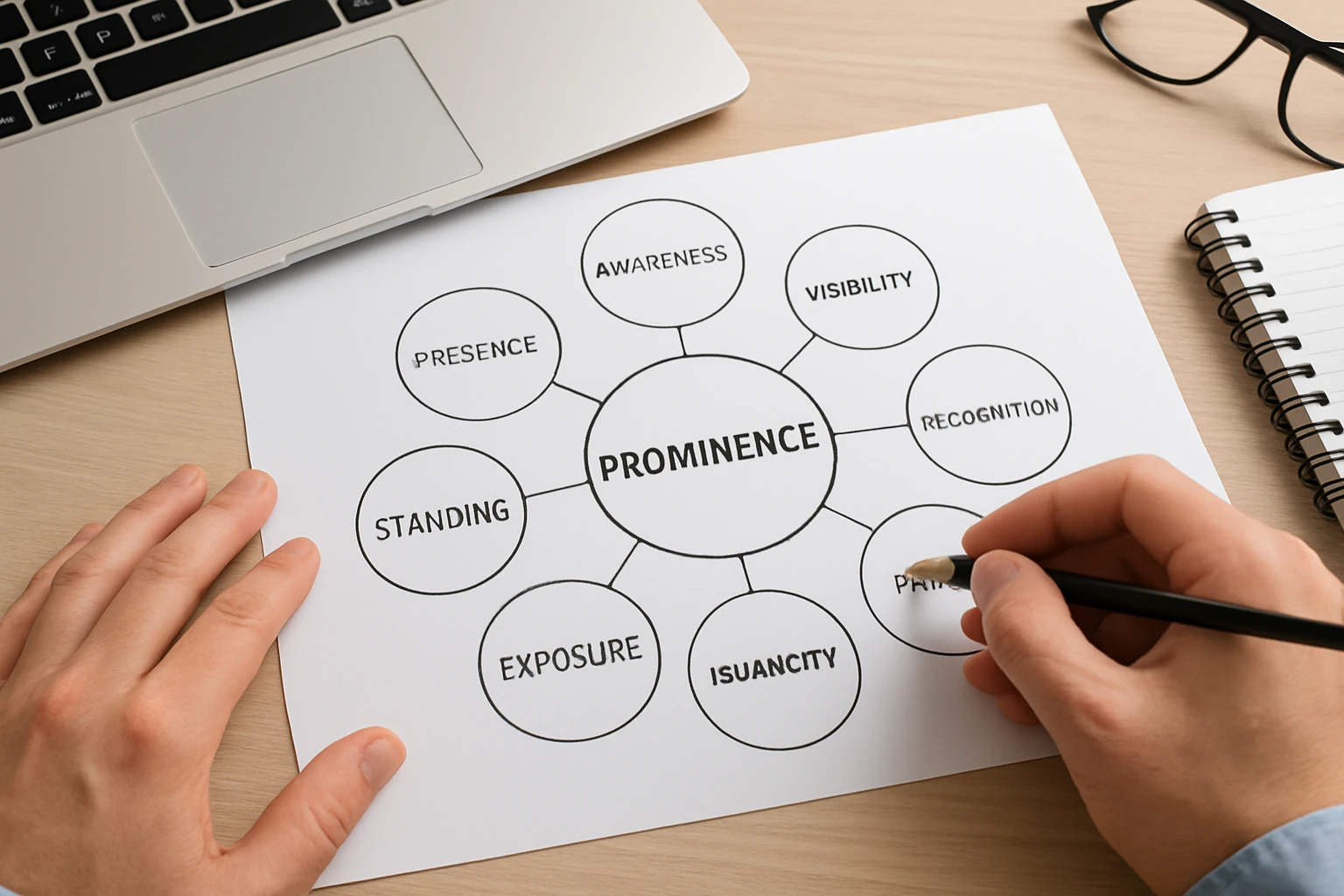
Now expand the cluster. List-style pages are useful for raw material, even when they are not useful for writing guidance. Search results can surface terms such as brand recognizability, visibility of the brand, identification of the brand, brand acknowledgment, commercial attention, and promotional value. Related results may also add phrases like brand management, maintain brand value, identity of the trade mark, brand strength, and brand image.
Pull these into a working sheet, then stop. Do not draft yet. You are still sorting signal from noise.
Group Phrases by Closeness and Nuance
I usually create three columns: close match, related term, and not a fit. That simple sort solves half the problem. For example, “brand awareness” may be a close match if your page is broad and educational. “Brand loyalty” is related, but it points to a later-stage relationship outcome. “Identity of the trade mark” is technically related to recognition, yet it reads like legal or dictionary wording, not natural live copy.
| Close Match | Related Term | Not a Fit for This Page |
|---|---|---|
| Brand awareness | Top-of-mind awareness | Brand management |
| Brand recognition | Brand image | Maintain brand value |
| Brand exposure | Brand perception | Identity of the trade mark |
| Visibility of the brand | Brand recall | Commercial attention |
Delete Duplicates, Jargon, and Unnatural Wording
This is where many drafts get better fast. Remove duplicates. Remove stiff wording. Remove phrases nobody would type or say. Many synonym lists include long descriptive variants such as “ability of consumers to recognize brand” and “consumer's ability to recognize the brand.” Those may describe the idea, but they will make your article sound like it was assembled from scraps.
Prefer phrases a reader would actually type or understand in one pass.
A tight map often beats a big one. For a working cluster, five to eight phrases is usually enough: one primary term, two or three close variants, and a few related ideas you may reference once in supporting copy.
Step 3: Place the Synonyms in the Page Structure
Use the Primary Phrase in the Title and H1
Your canonical term belongs in the title and H1. Put it there cleanly, without ornament. A precise thesaurus entry supports a precise use of the core word instead of turning the opening sentence into a synonym pile. If the page is about brand visibility synonyms, say that directly.
This matters because list-style SERP pages are not doing the practical work for the reader. They show options. Your job is to show placement. The title should tell the user, the crawler, and the AI summarizer exactly what the page solves.
Use Close Variants in H2s, FAQs, and Body Copy
After the title, spread the supporting phrases across the structure. Do not repeat them in a loop. Give each one a role. A heading can compare “brand visibility” with “brand awareness.” A short FAQ can explain where “brand recognition” fits. The body copy can mention “brand exposure” when you discuss channels and distribution.
| Page Element | Best Phrase Use | Example |
|---|---|---|
| Title / H1 | Primary phrase only | How to Use Brand Visibility Synonyms |
| H2s | Close variants with clear purpose | Choose the right synonym family for your goal |
| Body copy | Related terms where nuance matters | Explain the difference between awareness and recognition |
| FAQ or summary blocks | Short natural-language equivalents | Is brand exposure the same as brand visibility? |
Keep Meta Description and Internal Links Natural
Your meta description is not storage space for leftover keywords. It should read like a real promise. The same goes for internal links. If you link to a page about measuring recall, use anchor text that reflects recall. Do not force “brand visibility” into every anchor just because it is the target of the current URL.
For example, a site might link one article with “improve brand awareness,” another with “measure brand recall,” and a third with “increase brand visibility in search.” That spread helps readers and reduces ambiguity across the site.
Use one canonical phrase in the title, then support it with related terms in subheads and body copy.
Step 4: Write for SERP Features and AI/LLM Mentions
Answer the Core Question Early

The current results skew dictionary- and thesaurus-like, which tells you something valuable: searchers often want fast equivalence before they want deep theory. So answer the core question in the first few lines. A simple sentence such as “Brand visibility synonyms are close alternatives like brand awareness, brand recognition, and brand exposure, but each carries a slightly different marketing meaning” gives both humans and machines a clean starting point.
That does not mean your page should be thin. It means the first 75 to 100 words should earn the click and support extraction. If Google shows a featured snippet or an AI summary builds a quick answer, crisp language usually wins over sprawling intros.
Use Short, Natural-Language Variants
Write short answer blocks that sound like something a person would say on a call. “Brand visibility is about being seen.” “Brand awareness is about being known.” “Brand recognition is about being identified.” Those sentences are not the whole story, but they are easy to parse, easy to quote, and easy to place near the top of the page.
Short, definitional sentences are more likely to be excerpted than long brand essays.
This is one area where restraint pays off. Because brand visibility and brand awareness appear as overlapping synonym targets in the SERP excerpts, repetition adds less value than clarity does.
Add Concise Comparison Language Where Needed
When terms are close, compare them directly. That helps users, and it helps answer engines build accurate contrasts. Some SERP sources flatten the terms into mutual synonyms. In practice, you should acknowledge the overlap and still mark the distinction.
| Term | Plain-English Nuance | Useful Comparison Sentence |
|---|---|---|
| Brand visibility | How often and how easily people encounter the brand | Brand visibility focuses on presence; brand awareness focuses on familiarity. |
| Brand awareness | Whether the audience knows the brand exists | Awareness is broader than recognition because people can know a name before identifying visual cues. |
| Brand recognition | Whether people can identify the brand when they see or hear it | Recognition is a sharper test of identification than visibility alone. |
| Brand recall | Whether people remember the brand later without a prompt | Recall usually asks more of memory than awareness does. |
Step 5: Validate and Iterate Using Performance Data
Compare Rankings Across Term Variations
Once the page is live, do not just track the main term. Check variations in Search Console. Look at impressions and average position for brand visibility, brand awareness, brand recognition, brand exposure, and brand recall. If two pages begin competing for the same cluster, you may have cannibalization — especially if you already had separate content on awareness or recognition.
A common example: one article targets “brand awareness strategy,” another targets “brand visibility tips,” and six weeks later both begin ranking for the same mixed set of queries. That is your cue to sharpen intent, not celebrate extra keywords.
Review Impressions and Click-Through Rate
Rankings alone can hide bad wording choices. If impressions for “brand awareness” jump from 200 to 800, but clicks barely move, the title or snippet may be promising the wrong thing. You may be attracting a broader audience than the page actually serves.
CTR is especially useful when you are testing close variants. A page can sit in roughly the same position for two months and still improve meaningfully once the headline and meta description match the audience’s language better.
Refine the Cluster After Publishing
Update the page after you have real query data. Tighten a subhead. Swap an awkward phrase. Move “brand recall” lower if it is distracting the article. Add a comparison box if users keep arriving through “brand awareness vs brand visibility.” If you already use a platform such as SEOPro AI, this is also where monitoring query drift and AI-sourced mention patterns becomes useful, because you can spot when the language on the page starts attracting the wrong summarization.
Measure the page by relevance and click behavior, not by how many synonyms you managed to fit in.
Common Mistakes to Avoid
Stuffing Every Synonym Into One Paragraph
The fastest way to ruin a solid page is to write a paragraph that sounds like a thesaurus spill: “Brand visibility, brand awareness, brand recognition, brand exposure, brand recall, and brand acknowledgment all help...” A reader trips over it. A search engine gets a mushy signal. An AI summary has no clear line to quote.
When you feel that urge, separate the terms by function. Put one in the title, one in a comparison sentence, one in a supporting example. Structure does the work repetition cannot.
Treating Near-Duplicates as Exact Equivalents
The synonym lists mix close terms with broader ideas. Brand visibility and brand awareness are close enough to compare directly. Brand reputation, brand loyalty, and brand management are different. They matter, but they belong to different questions, different pages, or at least different sections.
Here is the simple test I use: if swapping the phrase would change what the reader expects to learn, do not treat it like a clean substitute. A page about brand loyalty belongs closer to retention and advocacy than to basic discoverability.
Ignoring the Language Your Audience Already Uses
Live language beats list language. Check your query reports, sales call notes, on-site search terms, and customer interviews. A B2B SaaS team may say “visibility in AI search.” An ecommerce brand may say “getting our name seen more often.” Both ideas can connect to visibility, but neither audience wants to read a paragraph stuffed with phrases like “consumer's ability to recognize the brand.”
If the phrase sounds like a thesaurus dump, cut it.
The sharpest pages usually sound obvious in hindsight. They use the words people already understand, then add just enough nuance to guide the decision.
Use brand visibility synonyms like a map, not a bucket.
Pick one primary phrase, support it with a few close variants, and place each term where it helps intent, structure, and extraction. When your brand visibility synonyms stay natural, the page gets easier to rank, easier to click, and easier for AI systems to quote. Which phrase in your cluster actually matches the audience you want next quarter?
Shape Smarter Search Signals With SEOPro AI
Streamline blog writing, clustering, schema, internal links, and monitoring for growing SEO teams with automated publishing and AI search optimization workflows.
Grow Visibility