What Is a Brand Visibility Questionnaire?

At 8:17 on a Tuesday, a growth lead opens a spreadsheet with 127 survey responses. She expects a tidy readout. Instead, the first open-ended answers sting: buyers name two competitors before they name her company. Traffic had climbed. Rankings looked healthier. Yet this brand visibility questionnaire says something harsher — the market is seeing the category without really seeing her.
If you work in SEO, content, or growth, you have probably felt that gap. Search Console shows impressions. Your rank tracker shows movement. A dashboard says the campaign is “working.” Then a sales call, a survey, or a lost deal reminds you that exposure is not memory. And memory is what shapes shortlist behavior.
That is why a brand visibility questionnaire matters. It gives you a repeatable way to measure whether people can recall your brand, describe what it stands for, trust it in the right context, and connect it to the channels where they first encountered it — including search results and AI-generated answers.
Why is brand visibility more than brand awareness?
Brand awareness asks whether people know you exist. Brand visibility asks a tougher set of questions: can they name you unprompted, place you in the right market context, trust what they think you do, and remember you when alternatives are in play?
Watch This Helpful Video
To help you better understand brand visibility questionnaire, we've included this informative video from WTVY News4. It provides valuable insights and visual demonstrations that complement the written content.
What teams miss when they only track traffic and rankings
Traffic, impressions, and rankings are useful signals. I rely on them every week. But they only show possible exposure. They do not show what a buyer retained after scanning a results page, hearing a podcast mention, or reading an AI summary.
That difference shows up fast in practice. You might rank in the top five for a category term like “project management software,” but when a prospect is asked to list brands in that space, they still say Asana, Monday.com, and Trello before they think of you. Common knowledge explains why: rankings and impressions are not the same as actual brand recall or preference.
| Metric | What You Learn | What You Still Do Not Know |
|---|---|---|
| Impressions | Your page appeared | Whether anyone remembered your name |
| Rankings | Your page is visible to search engines | Whether buyers trust or prefer you |
| Clicks | Your snippet won attention | Whether the brand message stuck |
| Questionnaire responses | Recall, trust, associations, competitor position | Less about raw exposure, more about market memory |
If people can’t name you unprompted, you’re not truly visible yet.
Why search and AI mentions change the visibility conversation
Five years ago, many teams treated visibility as a search ranking problem. Now the path is messier. A buyer may first meet your brand in Google AI Overviews, ChatGPT, Gemini, a Reddit thread, a partner roundup, or a LinkedIn carousel. Your homepage may never be the first touch.
That changes the measurement job. You need to know where people first encountered you, whether that encounter felt credible, and whether they remembered your brand or just the topic. SurveyMonkey’s Brand Awareness Survey Template has been used 9,000+ times, which tells you this kind of measurement is already familiar to the market. SurveyMonkey also describes the template as expert-certified, and the company is rated 4.5 out of 5 from 18,000+ G2 reviews. Those details do not prove your survey is good by default. They do show that structured brand measurement is not niche anymore.
In other words, visibility is now part search signal, part memory test, part trust audit.
What is a brand visibility questionnaire?
A brand visibility questionnaire is a structured research tool that measures how people recognize, perceive, and relate to your brand across channels and buying moments.
How it differs from a generic brand survey
A generic brand survey can be broad. It might ask about visual identity, tone, employer reputation, product satisfaction, and purchase intent all at once. That can be useful, but it often blurs the specific question you need answered: are people actually finding, recalling, and correctly placing your brand in the market?
A visibility-focused questionnaire is tighter. It centers on discoverability, memory, trust, and comparison. You are less concerned with whether someone likes your shade of blue and more concerned with whether they can say your name, describe your category, and explain why you are different from Brand X or Brand Y.
What it measures: recall, perception, trust, and association
Reference material on brand surveys describes them as structured research tools that measure how a target audience perceives, recognizes, and relates to a brand. It also notes that they use both closed-ended and open-ended questions to capture quantitative scores and qualitative insight. That combination is exactly what makes a brand visibility questionnaire useful in operations.
Recall: Can people name you without a prompt?
Recognition: Do they recognize you when shown a list?
Association: What words, categories, or use cases do they connect to your name?
Trust: Do they see you as credible, established, or worth shortlisting?
Competitive position: Do they place you above, below, or beside alternatives?
Use one questionnaire to measure memory, meaning, and market position—not just awareness.
Why it should include search and AI-touchpoint questions
A modern visibility questionnaire should also ask where people first encountered your brand. If you stop at “Have you heard of us?” you miss the channel context that shapes memory. That matters now because search results pages, featured snippets, review platforms, and AI answers all frame brands differently.
Simple prompts can reveal a lot:
Where did you first come across our brand?
Did you see us in a search result, AI-generated answer, review site, social post, podcast, event, or referral?
What did you think we offered when you first saw our name?
Which other brands appeared alongside us?
Those answers show whether your visibility is happening in the right places — and whether the market is learning the right lesson from those places.
Why does a brand visibility questionnaire matter for SEO and AI mentions?
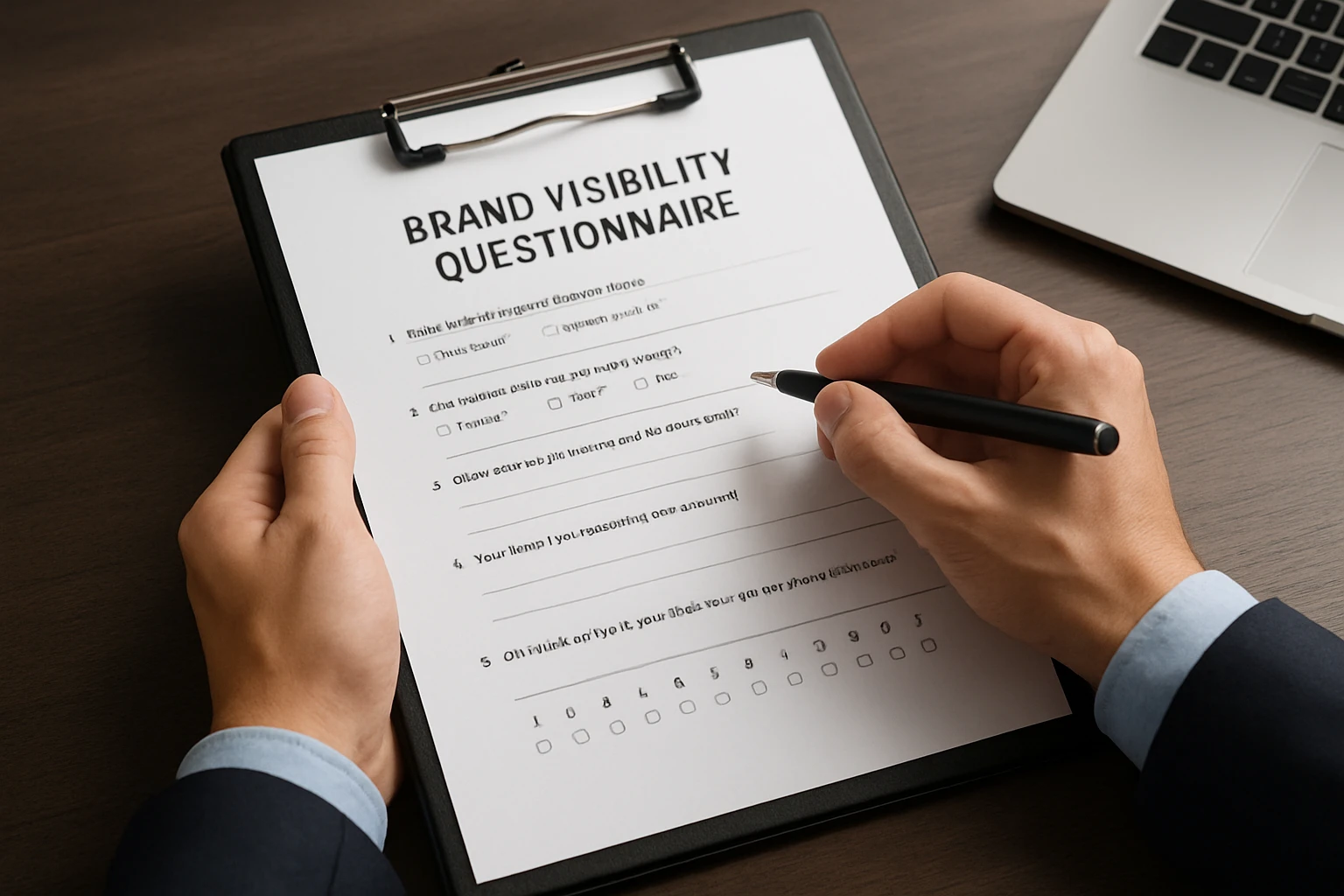
It matters because it closes the gap between what you publish, what search engines and AI systems surface, and what people actually remember or repeat.
How it benchmarks your brand before optimization
Before you adjust title tags, launch a content cluster, chase review coverage, or rewrite category pages, you need a baseline. A questionnaire gives you one. You learn whether people already recall your brand, which claims they repeat, and which channels appear in memory most often.
That baseline is what lets you judge progress honestly. Without it, a lift in impressions can feel like a win even when trust is flat and unaided awareness goes nowhere. Common knowledge applies here: a questionnaire gives you a starting point before you try to improve visibility through SEO, content, PR, or partner distribution.
How it shows whether you stand out from competitors
Reference guidance on brand surveys says they help you see whether people recognize your brand, what they associate it with, whether they trust it, and how it stacks up against competitors. That last part is where many SEO teams finally get useful air cover for positioning work.
Suppose your category has four familiar names. If buyers consistently list two rivals first and describe your brand with vague phrases like “maybe analytics” or “some AI tool,” you have a positioning problem, not just a traffic problem. If they name you but connect you to the wrong use case, you may need clearer SERP messaging, stronger comparison content, or tighter category framing on pages that win snippets.
| Search Signal | Questionnaire Signal | Likely Interpretation |
|---|---|---|
| Rankings up | Unaided recall flat | People are seeing you, but not storing you |
| CTR up | Trust low | Your snippet attracts attention, but the market doubts the brand |
| Brand mentioned in AI answers | Association wrong | You are visible in the wrong context |
| Branded search rising | Competitor recall still stronger | Awareness may be growing, but you are not owning the category story |
Rankings show exposure; questionnaires show recall, trust, and competitive position.
How it reveals gaps in SERPs, snippets, and AI answers
Some of the most useful survey answers are not flattering. A respondent says, “I saw your name in Google, but I thought you were an agency.” Another says, “ChatGPT mentioned you, though I could not tell what made you different.” That is gold. Painful gold, but gold.
It tells you the brand is present but underexplained. It tells you your category association is weak. It tells you that visibility inside AI answers or search features may be creating partial recognition without strong differentiation.
Typeform says its Research Flow can run AI-moderated research studies in hours. Speed like that can help teams move fast. Still, fast collection is only half the job. You need questions that reveal whether SERP features and AI answers are building the right memory, not just generating another mention.
How does a brand visibility questionnaire work?
It works as a repeatable workflow: define the audience, ask a balanced mix of scored and open-ended questions, then turn the answers into benchmarks you can track over time.
How to choose the right audience and sample
Start with the audience that maps to the decision you need to make. If you care about top-of-funnel visibility, survey in-market prospects or category buyers. If you care about sales friction, include late-stage prospects and recent lost deals. If you want to test internal consistency, survey employees separately.
Keep segments clean. Do not mix customers, prospects, and employees into one blob and pretend the average means something. In B2B, even a small split between ICP accounts, existing customers, and partner referrals can expose very different levels of recall and trust.
Why you need both scored and open-ended questions
Closed-ended and open-ended questions do different jobs, and you need both. The scored questions give you benchmarkable numbers. The open-ended questions explain the numbers. One tells you what happened. The other tells you why.
For example, a 1-to-5 trust score might show that your brand trails a competitor. An open response might explain that buyers see the competitor more often in analyst lists or AI answers. That is the bridge between market research and SEO action.
Use closed-ended questions for comparison, trend tracking, and segment cuts.
Use open-ended questions for wording, misperceptions, and unexpected associations.
Pair the two so each score has context.
How to turn responses into a repeatable reporting system
Once responses come in, organize them into a scorecard. Track a small set of core measures every cycle: unaided awareness, aided awareness, category accuracy, trust, first-touch channel, and competitor recall. Then add notes from open-ended responses that explain movement.
This is where familiar survey infrastructure helps. SurveyMonkey’s template usage — 9,000+ times — shows the format is repeatable. Typeform positions its platform around survey maker tools, analytics, integrations, and automated workflows for GTM teams. Those are useful mechanics. But the real discipline is in keeping your question set stable enough to benchmark and simple enough that teams will actually review it every month or quarter.
If you can’t benchmark it, you can’t prove it improved.
| Step | What You Do | Output |
|---|---|---|
| Define audience | Choose prospects, customers, employees, or a segment | Clean sample frame |
| Ask core questions | Mix recall, trust, association, and touchpoint items | Comparable response set |
| Collect context | Add open-ended follow-ups | Reasoning behind the scores |
| Benchmark | Create a simple scorecard | Baseline for future cycles |
| Act | Adjust SEO, messaging, distribution, and AI-surface copy | Testable next moves |
What questions should a brand visibility questionnaire include?
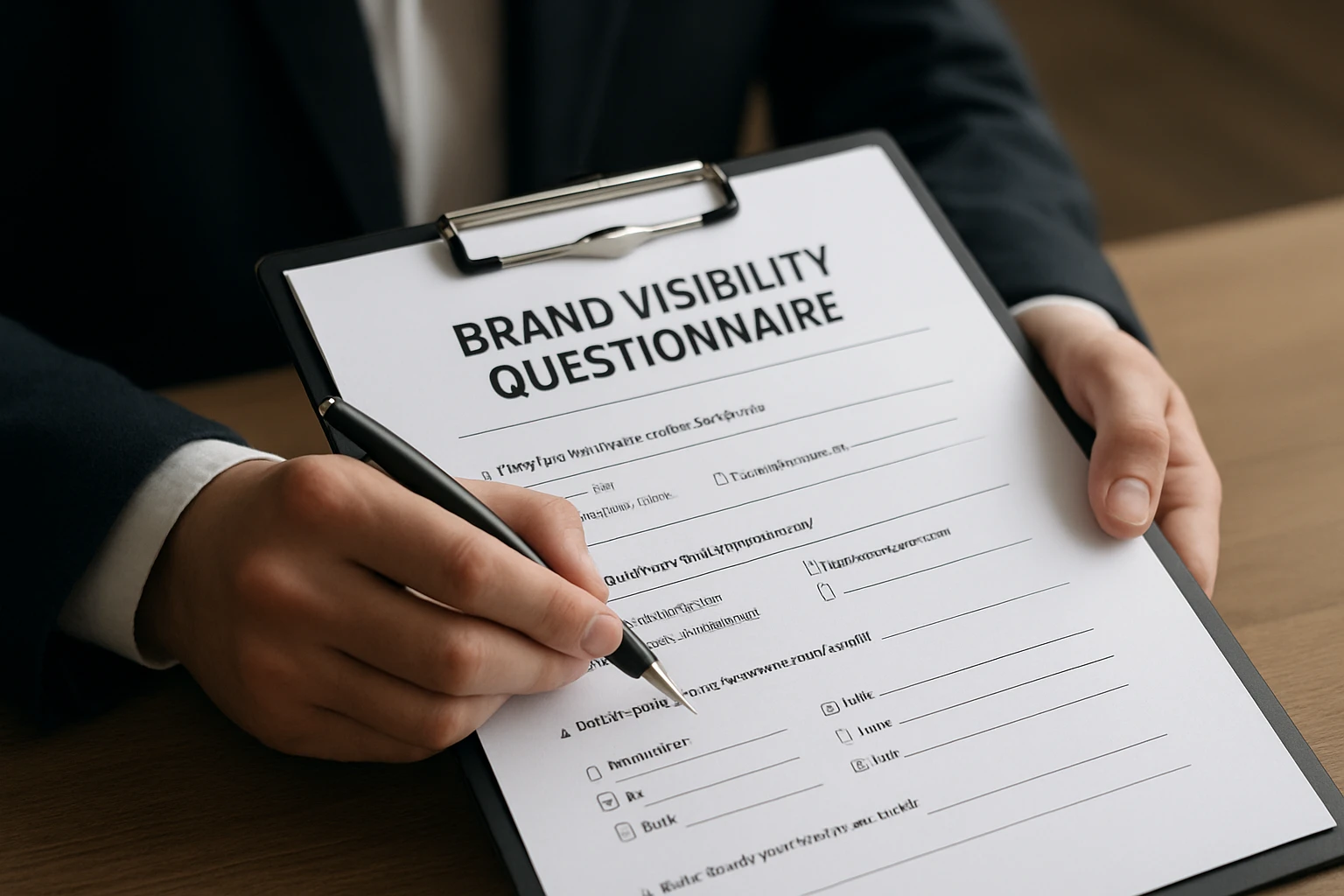
It should include the questions that help you make visibility decisions: awareness, association, trust, competitor recall, employee alignment, and touchpoint discovery.
One recent guide organizes 50+ brand survey questions across 7 categories, including employees, and spans objectives from unaided awareness through employee brand alignment. That breadth is helpful. In practice, though, most operating teams should start with a tighter core set and only add more when each question has a job.
Unaided and aided awareness questions
Start with memory. Ask what comes to mind before you prompt the respondent.
When you think of tools or brands in this category, which names come to mind first?
Which of these brands have you heard of? Select all that apply.
Have you seen our brand in the last 30 days?
Where do you remember seeing it?
Unaided questions test recall. Aided questions test recognition. You want both. A buyer may recognize your logo on a list yet never recall your name on their own. That gap matters.
Association, trust, and competitor-comparison questions
After awareness, move to meaning. Ask what your brand stands for in the respondent’s mind and how it compares to alternatives.
What products, services, or problems do you associate with our brand?
Which three words best describe us?
How much would you trust our brand for this use case?
Which competitor feels most similar to us?
Which brand would you shortlist first, and why?
These questions often expose the sharpest issues. You may find that your content wins traffic for one use case while the market still associates you with another. Or you may learn that a competitor owns the “safe choice” position while you own the “interesting but unclear” position. That is the sort of finding you can act on in messaging, landing pages, snippet copy, and editorial planning.
Employee alignment and touchpoint questions
External visibility breaks when internal alignment is sloppy. If your sales team, customer success team, and content team describe the brand three different ways, the market will reflect that confusion back to you.
How would you describe our brand to a first-time buyer?
What makes us different from Competitor A?
Where do prospects most often say they first heard about us?
Which channels seem to build the most trust: organic search, AI answers, referrals, events, or social?
| Question Group | Main Purpose | What It Helps You Decide |
|---|---|---|
| Unaided awareness | Test raw recall | Whether the brand enters the shortlist naturally |
| Aided awareness | Test recognition | Whether exposure is at least registering |
| Association | Test category fit and meaning | Whether messaging is landing correctly |
| Trust | Test credibility | Whether visibility is persuasive enough to matter |
| Competitor comparison | Test market position | Who owns the frame in buyers’ minds |
| Employee alignment | Test internal consistency | Whether teams are reinforcing one story |
| Touchpoint questions | Test channel memory | Which surfaces deserve more investment |
If a question won’t change a decision, remove it.
What are the most common questions people ask about it?
Most teams ask three practical things: how often to run it, who should answer it, and whether it can replace a broader brand audit.
How often should you run it?
Run it on a regular cadence. That matters more than choosing the “perfect” frequency. If your market moves quickly, a lighter pulse can help. If your buying cycle is slower, a broader quarterly or semiannual read may be enough. The point is consistency.
Keep the same core questions in each cycle so your trend line stays trustworthy. Then rotate a few supporting questions when you launch a new campaign, target a new channel, or want to test emerging surfaces like AI answers.
Repeat the same core questions every cycle so you can trust the trend, not just the snapshot.
Who should answer it?
Start with the audience tied to your goal. Prospects tell you about awareness and category memory. Customers tell you what actually made the brand credible. Lost deals tell you where competitors still dominate. Employees reveal whether your internal story is coherent enough to survive contact with the market.
Do not assume one survey fits all four groups. I usually recommend a shared core, then small wording changes by segment. A buyer and an employee should not see the exact same questionnaire.
Can it replace a full brand audit?
No. It is a measurement system, not a complete diagnosis. A full brand audit may also include messaging review, SERP analysis, sales-call listening, review mining, share-of-voice work, content gap analysis, and creative evaluation.
That said, a questionnaire is often the fastest way to stop guessing. One guide notes that a free brand survey template can be deployed in minutes. That speed is helpful. Just remember: launching fast is easy. Asking the right questions, segmenting the right audience, and reviewing the answers with discipline is where the value appears.
A brand visibility questionnaire turns vague brand talk into a repeatable measurement system.
When you track recall, trust, associations, competitor mentions, and search or AI touchpoints together, a brand visibility questionnaire gives you more than survey data — it gives you a clean baseline and a sharper next move.
If you ran your next round this month, which answer would force you to rethink your current visibility strategy?
Advance Search Presence With SEOPro AI
SEOPro AI pairs hidden prompts embedded in articles for LLM mentions with publishing, clustering, schema, and monitoring workflows so teams expand organic reach and automate SEO execution.
See The Platform