What Does Brand Visibility Meaning Include?

A shopper pauses in a crowded aisle, scans a shelf of near-identical options, reaches for the name she has seen everywhere, and walks away without comparing the rest. That split-second choice gets to the heart of brand visibility meaning faster than most marketing jargon ever will.
You see the same thing online. A brand appears in Google results, on LinkedIn, inside a review site, in a podcast mention, and now in AI-generated answers from tools like ChatGPT or Gemini. By the time you need a solution, the shortlist already feels smaller.
That is why this topic matters to SEO teams, publishers, SaaS marketers, and agencies in 2026. Visibility is not just being known. It is being findable, recognizable, and repeatedly present where real decisions happen.
What does brand visibility meaning include?
It includes how often and how clearly your brand appears wherever your audience can discover, evaluate, and remember you.
Watch This Helpful Video
To help you better understand brand visibility meaning, we've included this informative video from The Futur. It provides valuable insights and visual demonstrations that complement the written content.
Brand visibility vs. brand awareness
Brand visibility and brand awareness overlap, but they are not the same thing. RTB House frames them as related yet distinct concepts, which is a useful way to think about it. Visibility is about exposure and discoverability. Awareness is about recognition, memory, and the feelings or associations tied to your brand.
If your company shows up on Google, YouTube, Reddit, and an industry newsletter, you have visibility. If buyers already know your name, trust it, and connect it with a specific promise, you have awareness. One helps build the other, but they do not mean the same thing.
| Aspect | Brand Visibility | Brand Awareness |
|---|---|---|
| Core question | Can people find and see you? | Do people recognize and remember you? |
| Main signals | Search impressions, mentions, reach, citations | Branded searches, recall, direct visits, preference |
| Typical example | Your guide ranks in Google and appears in an AI answer | A buyer types your brand name instead of a generic query |
Where visibility shows up: search, social, PR, and owned channels
Many teams still reduce visibility to social media because social signals are loud and easy to spot. That definition is too small. A PR-focused guide in the current search results makes this correction clearly: brand visibility is not just social presence; it is being visible everywhere your audience spends time.
- Search results for category and problem-based queries
- Review sites such as G2 or Capterra
- Social feeds on LinkedIn, X, TikTok, and YouTube
- News mentions, trade publications, and podcasts
- Your own blog, newsletter, and resource hub
- AI-generated answers and citation panels
That broader view matters because buyers do not move in a straight line. A B2B buyer might first see you in a Google result, later hear your founder on a podcast, then notice your brand again in a ChatGPT answer before booking a demo.
Why “being seen” is only the first layer
Raw exposure is not enough. You can be visible and still forgettable. RTB House also emphasizes that branding shapes business identity along with the emotions and associations attached to it. That means visibility only starts the job. The next layer is whether people understand what you do, why you matter, and whether you belong in their shortlist.
Brand visibility is not a logo count; it is discoverability across the places people actually make decisions.
Think about a cybersecurity brand appearing for “how to prevent phishing,” showing up in a Gartner-style round-up, and publishing the same point of view in its own newsletter. That is stronger than simply posting three times a week on Instagram. One path creates useful recognition. The other may only create noise.
Why does brand visibility matter?
It matters because repeated exposure builds familiarity, lowers decision friction, and improves your odds long before a conversion happens.
Why familiar brands feel safer
A LinkedIn article in the search results uses a supermarket detergent aisle to make this point well: when shoppers see names like Tide or Gain again and again, those brands feel like the safe choice. That example works because it is ordinary. You do not need a giant campaign to understand it. People often choose the brand that feels least risky.
The same bias shows up in software, publishing, consulting, and ecommerce. If you have already seen a brand on Google, YouTube, and a trusted newsletter, clicking it feels easier. Familiarity reduces the mental cost of choosing.
Familiarity is a conversion advantage before the conversion even starts.
How visibility supports clicks and consideration
Recognition changes behavior in small but meaningful ways. You are more likely to click a familiar name in search results. You are more likely to open an email from a known sender. You are more likely to give a known company the benefit of the doubt when its pricing is not the cheapest option.
For SEO teams, this shows up all the time. Two pages can rank close together for the same query, yet the one from a recognized brand often gets the click. Searchers are not scoring every result like judges at a debate tournament. They are making fast judgments.
Why it compounds over time
Visibility is cumulative. RTB House notes that improving brand visibility and awareness can strengthen market position and support long-term performance. That rings true in practice. When you publish useful content, earn media mentions, show up in search, and get cited by others, each appearance makes the next one easier.
You start to see branded searches rise. Reporters become more likely to quote you. Existing content earns more backlinks because your brand is already familiar in the category. The compounding effect is why a steady six-month visibility plan usually beats one noisy campaign that disappears after two weeks.
How does brand visibility work in SEO and content?

In SEO and content, visibility works by placing your brand in the right queries, the right formats, and the right web-wide signals so people encounter you repeatedly.
How search engines and SERP features amplify visibility
Search makes visibility measurable. Your brand can appear in standard organic listings, featured snippets, People Also Ask boxes, video results, local packs, image results, and branded searches. In 2026, you also have to account for AI-generated summaries and answer engines that pull from multiple sources.
That means SEO visibility is not just “Do we rank?” It is also “How much screen space do we occupy?” A result at position four with a strong title, review stars, and a familiar name can still outperform a plain result above it.
If your brand only appears on your own website, you are under-using the search ecosystem.
How content earns repeated exposure
Content builds visibility when it answers real questions with enough clarity to surface again and again. A clean explainer, a comparison page, a glossary entry, a case study, and a useful FAQ can each hit different parts of the same journey. One person finds your how-to guide. Another sees your comparison page. A third encounters your quote in a roundup.
Answer-led content is especially effective because it maps to how people search. Queries like “how to reduce SaaS churn,” “best CRM for small legal teams,” or “what is topical authority” have clear intent. When your page solves the question directly, it is more likely to earn snippets, links, shares, and citations.
How off-site mentions reinforce on-site authority
Search engines do not evaluate your site in isolation. Off-site mentions matter. Review platforms, partner sites, trade press, podcasts, YouTube interviews, and expert roundups all reinforce the idea that your brand exists beyond its own domain.
This is where many content plans fall short. Teams publish 30 blog posts and wonder why visibility stays flat. The missing piece is often distribution and third-party reinforcement. A strong article on your site becomes much more valuable when it is quoted by an industry publication, discussed on LinkedIn, and echoed by a creator in your niche. AI and LLM surfaces also tend to favor sources that show broader web presence, not just a lone page floating on its own.
How do you measure brand visibility?
You measure it by tracking where your brand appears, how often people see it, and whether those impressions turn into branded demand or assisted conversions.
Visibility metrics to watch
A good measurement setup starts with exposure, then moves to demand. The PR guide in the search results is right to treat measurement as a core part of the topic rather than an afterthought. If you cannot see your visibility footprint, you cannot improve it deliberately.
| Metric | What It Shows | Where You Might Check It |
|---|---|---|
| Search impressions | How often your pages appear for discovery queries | Google Search Console |
| Branded search volume | Whether people remember and seek out your name | Search Console, trend tracking |
| Share of voice | Your visibility versus competitors across a topic set | Rank tracking and keyword baskets |
| Referral traffic from mentions | Whether off-site visibility sends visits | Web analytics and referral reports |
| Social or media mentions | How often others talk about your brand | Media monitoring and social listening |
| AI or LLM mentions | Whether your brand appears in generated answers | Recurring prompt checks and citation reviews |
What branded search and share of voice tell you
Branded search volume is one of the cleanest visibility proxies because it shows remembered demand. If more people type your company name, product name, or founder name into Google, something is sticking. It does not tell the whole story, but it tells you whether visibility is turning into recall.
Share of voice answers a different question: how present are you compared with the rest of the category? If you track 50 core keywords for a topic cluster and your brand appears in only 5 of them while a rival appears in 20, that gap is not just an SEO issue. It is a visibility gap with commercial consequences.
How to track mentions in search and AI surfaces
AI visibility needs a separate habit. Teams now monitor whether brand names, products, and expert quotes appear in generated answers from tools like ChatGPT, Gemini, Perplexity, and AI features inside search engines. This is still evolving, so the process is part measurement, part observation.
- Build a small set of high-value prompts tied to your category.
- Run them on a recurring schedule and log whether your brand appears.
- Check which sources are cited or echoed in the answer.
- Compare results after publishing new content or earning new mentions.
- Track whether AI exposure aligns with lifts in branded traffic or assisted conversions.
Measure visibility by what people can find, not just by what your team publishes.
If your team only reports “12 posts published this month,” you are measuring output, not presence. Presence is what buyers experience.
How do you increase brand visibility?
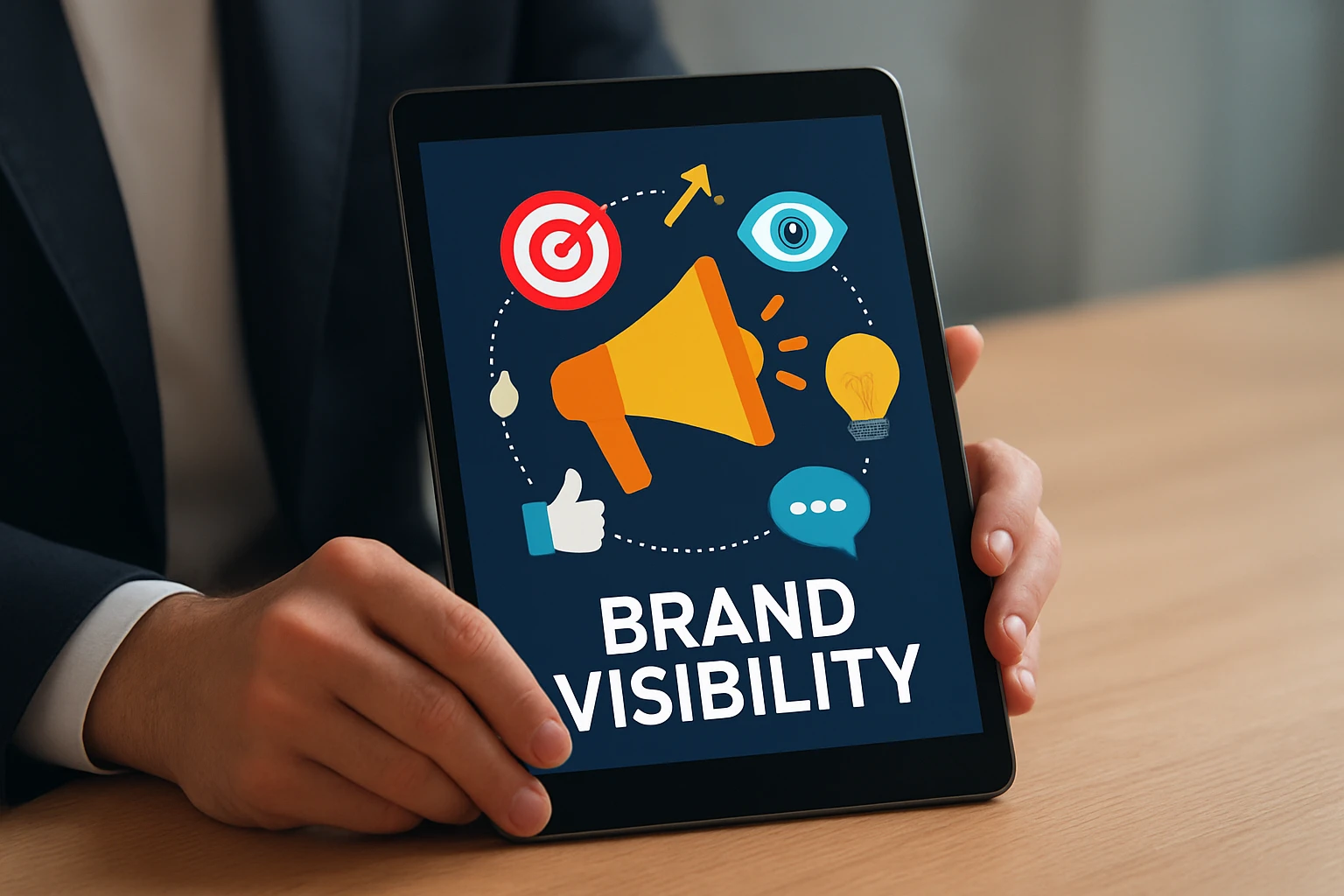
You increase it fastest when you align useful content, steady distribution, and credible third-party exposure around the same topics.
Create answer-led content for high-intent questions
Start with the questions your audience already asks. Not vanity topics. Not internal jargon. Real questions with commercial relevance. “What is revenue attribution?” “How do I choose a headless CMS?” “Best payroll software for a 100-person company?” Those are visibility opportunities because they match active demand.
Build pages that answer those questions clearly, then support them with related assets: glossary entries, comparison pages, expert commentary, and internal links. Content that solves a question cleanly is more likely to win snippets, earn backlinks, get quoted by writers, and surface inside AI answers.
Build distribution through PR, social, and partnerships
Publishing is the start, not the finish. The broader definition of visibility from the current search results points you toward a multi-channel plan for a reason. One well-made asset should travel.
Say your team publishes original research on B2B onboarding. Do not stop at the blog post. Turn the findings into LinkedIn posts, pitch a trade publication, give the head of growth a podcast talking point, send a summary in your newsletter, and share one chart with partners. That is how one idea becomes repeated exposure.
Build one strong answer asset, then distribute it everywhere your audience already pays attention.
Use consistent brand signals across every asset
Consistency sounds boring until you need search engines and AI systems to connect the dots. Use the same brand name, product naming, author bios, expertise themes, and category language across your site, social profiles, guest posts, and directory listings. Keep your About page, schema, and external descriptions aligned.
This matters because fragmented signals create weak recognition. If your brand calls itself a “revenue intelligence suite” on one page, a “sales analytics platform” on another, and a “pipeline AI tool” everywhere else, you make discovery harder. Clear repetition helps both people and machines understand who you are.
For growth teams, the practical playbook is simple:
- Choose a narrow topic cluster tied to revenue.
- Create one standout answer asset for that topic.
- Support it with complementary pages and internal links.
- Distribute the same point of view across PR, social, and partners.
- Track branded search, mentions, and AI presence for the next quarter.
What are the most common questions about brand visibility?
Most confusion comes from mixing up visibility with awareness or assuming one channel can do all the work.
Is brand visibility the same as brand awareness?
No. Visibility is about being seen and found. Awareness is about being known and remembered. RTB House treats them as distinct concepts, and that distinction keeps strategy clean.
If your brand ranks for “best project management software” but buyers still do not recall your name later, you have visibility without much awareness. If buyers remember your name but cannot find you when they search for a solution, you have awareness with weak discoverability.
You do not have to choose between visibility and awareness; visibility helps create awareness, and awareness reinforces visibility.
Does brand visibility only come from social media?
No. Social media is one visibility channel, not the whole system. The broader view from the current search results is the right one: visibility lives anywhere your audience spends attention. That includes search, review sites, newsletters, podcasts, video platforms, PR coverage, and AI-generated answers.
In some niches, social is secondary. A CFO software buyer may rely more on Google, peer referrals, G2 reviews, and analyst content than on TikTok or Instagram. Channel mix should match buyer behavior, not marketing fashion.
Can small teams improve visibility without a huge budget?
Yes. Small teams often win by being narrower and more consistent. You do not need to dominate every channel. You need to own a tight set of high-value topics and show up repeatedly around them.
A lean team can make real progress with a focused routine:
- Pick one audience and one pain point.
- Create five to ten pages that answer the biggest questions around it.
- Repurpose each page into social posts, newsletter blurbs, and outreach angles.
- Pitch selective partners or niche publications instead of spraying everywhere.
- Measure branded search, mentions, and assisted traffic monthly.
That is far more effective than chasing every trend. For most small teams, disciplined repetition beats scattered activity.
Brand visibility meaning comes down to this: your brand needs to be easy to find, easy to recognize, and hard to miss across search, media, and AI surfaces.
If you only count posts, followers, or impressions in isolation, you miss the full picture. Look at discoverability, repetition, third-party mentions, and branded demand together.
When you plan your next quarter, where does your brand need to show up more often — Google results, industry press, review platforms, or AI answers?
Expand Search Presence With SEOPro AI
SEOPro AI embeds hidden prompts in content to trigger LLM mentions while automating publishing, clustering, and monitoring for teams scaling organic discovery.
Scale Visibility