The Visibility Brand Checklist
At 9:07 on a Tuesday, your growth team searches a money keyword like “best expense management software.” The first screen fills with a Google AI Overview, a G2 citation, and a competitor quote pulled from a comparison page. Your brand — the one you spent six months pushing up the rankings — is nowhere in sight.
That missing first screen is where your visibility brand lives or dies. A visibility brand is not just the name buyers remember from a webinar or trade show. It is the brand they repeatedly encounter when they search, compare, ask AI tools for recommendations, and scan the communities they trust.
Set the visibility brand scope before you chase traffic
Before you celebrate rank improvements, define what “visible” actually means for your market. RTB House draws a clear line between brand visibility and brand awareness, and it asks the right follow-up question: how do you measure branding effectiveness and progress? Semrush pushes that further by defining visibility as how often your brand appears relative to competitors across the channels where buying decisions happen.
Watch This Helpful Video
To help you better understand visibility brand, we've included this informative video from Philip VanDusen. It provides valuable insights and visual demonstrations that complement the written content.
Write down the exact audience, product category, and query set you want to win
Start narrow. “More visibility” is not a goal. “Show up for CFO-led searches about AP automation, plus comparison terms against Ramp and Brex” is a goal.
- Name the buyer role first — founder, VP Marketing, RevOps lead, procurement manager.
- Write the product category in the language buyers actually use, not the phrase your internal deck prefers.
- List the core query set by stage: problem, comparison, solution, and branded follow-up.
- Record the top competitors already appearing on page one, inside AI Overviews, or on review sites like G2 and Capterra.
If you sell compliance software, “SOC 2 automation” and “Vanta alternatives” belong in the same working document, even though they sit at different points in the buying journey. You need both. One captures discovery. The other captures active evaluation.
Separate brand visibility from brand awareness before you set goals
Awareness answers, “Do people know you exist?” Visibility answers, “Do you show up when they make the decision?” Those are related, but they are not the same job.
| Question | Visibility Signal | Awareness Signal |
|---|---|---|
| Are buyers encountering you on decision queries? | AI Overview mentions, top-10 rankings, comparison-page presence, review-site placement | Usually indirect |
| Do people recognize your name? | Branded follow-up clicks after non-branded discovery | Branded search volume, direct traffic, social mentions |
| Can you track progress against competitors? | Share of appearance by query and surface | Brand recall surveys, share of voice campaigns |
Both matter. But if your team wants pipeline from “best warehouse management software,” awareness metrics alone will not tell you whether you are present when a shortlist gets formed.
List every place buyers can encounter the brand, from search results to communities
Semrush is right on this point: visibility now has to cover traditional search, AI-powered recommendations, and the social or community spaces that influence trust. For many B2B buyers, Reddit, LinkedIn comments, Slack groups, YouTube reviews, and marketplace listings shape the final click as much as a homepage does.
- Audit Google organic listings, featured snippets, and AI Overviews.
- Check AI answer engines such as ChatGPT and Perplexity for recurring prompts in your category.
- Review third-party proof surfaces — G2, Capterra, GitHub, analyst roundups, partner directories.
- Include community discovery points like Reddit, niche forums, LinkedIn threads, podcasts, and webinars.
If you can’t name the query, the channel, and the competitor, you don’t have a visibility goal yet.
Pre-work checklist: map the queries and entities you need to own
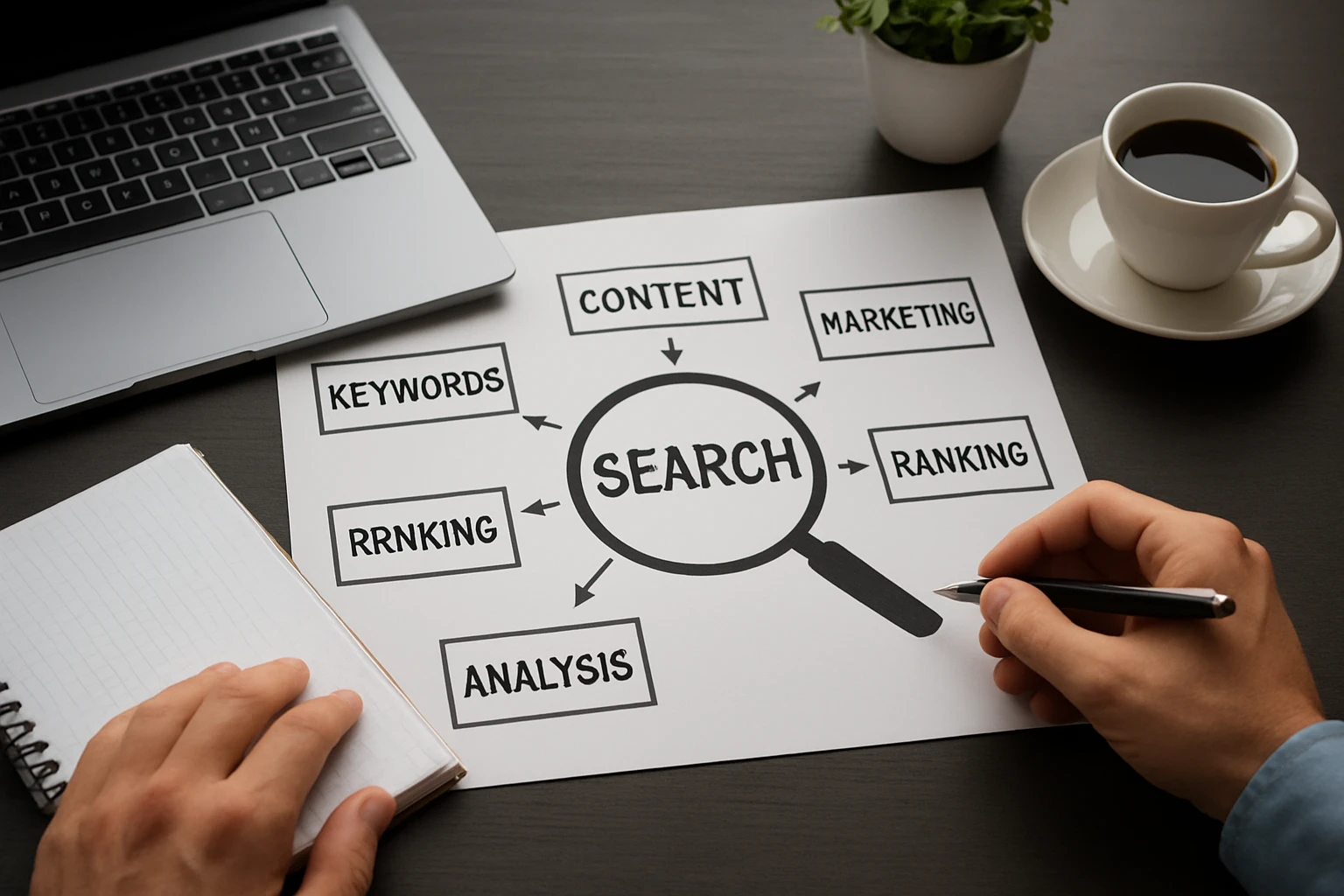
Do the mapping before you touch the CMS. This is the part most teams skip, then wonder why new pages feel busy but invisible.
Group intent by problem, comparison, and solution queries
Volume can mislead you. A 12,000-search informational term may look irresistible, while a 300-search comparison term drives actual revenue. Sort intent first, then prioritize.
| Intent Bucket | Example Query | Likely Surface | Needed Asset |
|---|---|---|---|
| Problem | how to reduce failed payments | AI Overview, blog posts, YouTube | Educational guide with direct answer blocks |
| Comparison | Stripe vs Adyen | Comparison pages, review sites, AI answers | Point-of-view comparison with proof |
| Solution | best subscription billing software | Listicles, category pages, AI Overview | Commercial landing page plus supporting assets |
| Branded follow-up | your brand pricing | Site links, product pages, review threads | Clear pricing and objection-handling page |
Why do this now? Because Google AI Overviews can answer the query directly on the results page, which means clicks may drop even when rankings stay flat. Your map needs to reflect the real surface buyers see, not the old blue-link-only model.
- Tag every target query as problem, comparison, solution, or branded.
- Add competitor names directly into the map for comparison coverage.
- Highlight “money queries” where a buying committee is likely active.
- Mark queries that repeatedly trigger AI Overviews, review sites, or forum threads.
Map the core entities, products, and people that should be associated with the brand
AI systems and search engines do not just read keywords. They infer relationships. That means you need a clear entity map: brand name, product lines, category terms, use cases, industries served, and the people who speak credibly for the company.
- Record the canonical brand name and every valid variation buyers use.
- Pair each product with its plain-English category and best-fit use case.
- Assign real experts to topics — founders, product leads, consultants, engineers.
- Collect proof assets tied to those entities: customer stories, docs, methodology pages, and benchmark posts.
If your site alternates between “customer data platform,” “CDP,” and “audience intelligence engine,” you are creating unnecessary ambiguity. Pick the terms you want associated with your brand and repeat them consistently across landing pages, author bios, FAQs, and support docs.
Identify the SERP features and AI surfaces most likely to appear for each query set
Not every query produces the same battleground. “Best CRM for field sales” may surface listicles, review sites, and an AI Overview. “How to reduce no-show rates” might pull a featured snippet, a Reddit thread, and a YouTube video. ChatGPT, Perplexity, and other AI platforms can also recommend products directly, so your pre-work has to account for those answer surfaces too.
- Search each priority query manually and note the recurring SERP features.
- Prompt AI tools with the same query set and log which brands get cited.
- Flag surfaces where competitors dominate before the click — especially review hubs and communities.
- Decide whether you need a page, a quote, a comparison asset, or third-party proof to compete there.
Do the query map first; content created without it usually chases volume instead of visibility.
Execution checklist: publish answer-first assets and support them with proof
This is where most teams either win cleanly or waste a quarter. Semrush describes the current moment as an AI search era, where machines evaluate sources and compose responses on the user’s behalf. That means your content must be easy to quote, easy to summarize, and worth trusting.
Create answer-first pages for your highest-value intents
Start with the queries closest to revenue. For a term like “best invoice automation software,” do not bury the answer below a brand anthem and three paragraphs of throat-clearing. State the answer fast, then earn depth.
- Open with a plain-English response in two or three sentences.
- Use subheadings that mirror likely follow-up questions.
- Add comparison tables, objections, and fit criteria for different buyer types.
- Make the next step obvious — demo, trial, guide, or deeper comparison.
Think like the answer box, then write like a practitioner. You want a page that a Google AI Overview can summarize, a buyer can scan in 45 seconds, and a serious evaluator can still spend eight minutes on.
Support each page with proof points, data, and clear brand/entity signals
Thin claims do not travel well. If you say your product cuts onboarding time, show the process, the context, and the caveats. If you compare your platform to two rivals, explain the basis of comparison. Named authors, fresh dates, product screenshots, methodology notes, and structured FAQs all help engines and humans trust what they see.
- Attach proof to every major claim — benchmarks, examples, screenshots, or documented workflows.
- Use consistent brand and product naming across titles, headings, copy, and bylines.
- Add schema where appropriate so search engines can parse the page more cleanly.
- Link supporting pages together so your commercial page is backed by educational depth.
This matters even more now because AI answer engines often compress pages into short recommendations. If your copy has no clear evidence, the model has little reason to prefer you over a better-documented competitor.
Repurpose the core message into formats that can travel across channels
Visibility does not stop at the page you publish. Semrush emphasizes presence across traditional search, AI answers, and community or social platforms. So take the core claim and adapt it — not copy it — into formats that match each surface.
| Core Asset | Repurposed Format | Best Channel |
|---|---|---|
| Commercial landing page | Short comparison post | LinkedIn, sales enablement |
| Research-backed blog post | Quote-led summary | Newsletter, community thread |
| FAQ page | Prompt-ready answer snippets | AI-facing content, help center |
| Case study | Objection-handling excerpt | Comparison page, webinar, Reddit AMA |
If AI search visitors convert at 4.4 times the rate of traditional organic visitors, as Semrush reports, then your job is not only to earn raw traffic. Your job is to create a trail of credible, consistent signals that attracts the qualified visit after the AI summary does its filtering.
Write for the answer box first, but keep enough depth on the page to earn the click that follows.
Validation checklist: measure whether visibility is actually increasing

Now test whether your work changed reality. RTB House asks how to measure branding effectiveness and progress. For visibility, the answer is simple: measure appearance, quality, and outcome — then compare all three against the competitors you mapped earlier.
Track branded and non-branded visibility across search and AI surfaces
Do not rely on a single dashboard. Use Google Search Console for impression trends, your rank tracker for core queries, analytics for landing-page behavior, and a manual prompt library for AI results. Save screenshots. Keep receipts.
- Build a fixed set of branded and non-branded prompts for monthly review.
- Log whether your brand appears in Google organic, AI Overviews, review hubs, and AI answers.
- Note the cited URL, snippet type, and competitor present on the same screen.
- Track wins and losses at the query level, not just the domain level.
For example, if “best CRM for contractors” keeps surfacing a Reddit thread and a vendor comparison page, your visibility score should reflect both. Ranking fifth with no first-screen mention is not the same as being cited directly in an AI Overview.
Compare impressions, clicks, and assisted conversions over time
A stronger presence may show up before clicks do. You might see non-branded impressions rise, branded follow-up searches increase, and assisted conversions improve even while click-through rate dips on AI-heavy queries. That pattern is not automatically bad.
| Metric | What It Tells You | Why It Matters |
|---|---|---|
| Non-branded impressions | How often you appear during category discovery | Shows early visibility growth |
| Branded query growth | Whether discovery is turning into recall | Connects visibility to intent |
| Clicks and landing-page sessions | Traffic volume and engagement | Still useful, but incomplete alone |
| Assisted conversions | Influence on downstream pipeline | Captures multi-touch value |
| Conversion rate by source | Traffic quality | Critical when AI visits are fewer but better qualified |
Semrush says AI search visitors can convert at 4.4 times the rate of traditional organic visitors. That is why raw session counts can fool you. Fewer visits from Perplexity or ChatGPT may still produce better demo rates than a broad informational post from Google.
Benchmark your presence against the competitors you mapped in pre-work
Visibility is relative. If you appear in three of 20 target query surfaces and your competitor appears in 14, you do not have a small gap. You have a distribution problem.
- Score each query-surface combination as present, cited, or absent.
- Calculate share of appearance by competitor for high-value clusters.
- Review which asset types win most often — comparison pages, review profiles, guides, videos.
- Prioritize gaps where commercial intent is high and current coverage is weak.
Do not judge AI visibility only by clicks; the traffic that does arrive may be far more qualified.
Common misses checklist: remove the blind spots that cap visibility
Most visibility problems do not come from one fatal error. They come from a stack of small omissions.
Don’t confuse awareness with visibility
You can sponsor a conference, grow direct traffic, and see a bump in branded search while still disappearing from high-intent category queries. I have seen teams leave SaaStr feeling triumphant, then fail to appear for “best PLG analytics tool” or “Mixpanel alternatives” the next week.
- Separate awareness KPIs from decision-surface KPIs in your reporting.
- Check whether non-branded discovery queries mention you before branded demand rises.
- Watch for brand activity that looks healthy but never touches buying queries.
Don’t optimize only for Google and ignore AI/community surfaces
Google still matters. A lot. But it is no longer the only place where buyers build trust. Semrush’s framing is useful here: visibility spans traditional search, AI-powered recommendations, and social or community spaces. Google AI Overviews, ChatGPT, and Perplexity can answer users before a click happens, and the source material often comes from third-party pages you do not control.
- Audit which communities or review sites repeatedly show up in your category.
- Create quotable, evidence-backed pages that AI systems can summarize confidently.
- Seed useful expert commentary where buyers already ask questions.
- Monitor which external sources keep outranking or out-citing your own site.
Don’t treat visibility as a one-time publishing project
Search shifts. AI answer patterns drift. Competitors publish new pages, win new reviews, and update their comparisons. If your team publishes once and moves on, you are building a snapshot, not a durable presence.
- Refresh top commercial pages on a fixed cadence — quarterly is a good starting point for competitive categories.
- Re-run your query and surface audit after launches, pricing changes, or category shifts.
- Expand your entity map when products, spokespeople, or use cases change.
- Consolidate thin pages that split authority across overlapping intents.
If you only measure branded search volume, you are missing most of the visibility story.
A strong visibility brand shows up where decisions actually happen — on query-matched pages, inside AI answers, and beside the competitors buyers compare you against.
When you align the right queries, the right channels, and the right measurement, your visibility brand stops being guesswork and starts becoming market presence.
Where does your visibility brand disappear first: the AI Overview, the comparison SERP, or the community thread your buyers trust most?
Expand Search Reach With SEOPro AI
SEOPro AI embeds hidden prompts in content to increase AI/LLM mentions while automating writing, publishing, clustering, schema guidance, and performance monitoring for scalable organic growth.
Explore Platform