The Semantic SEO Content Checklist
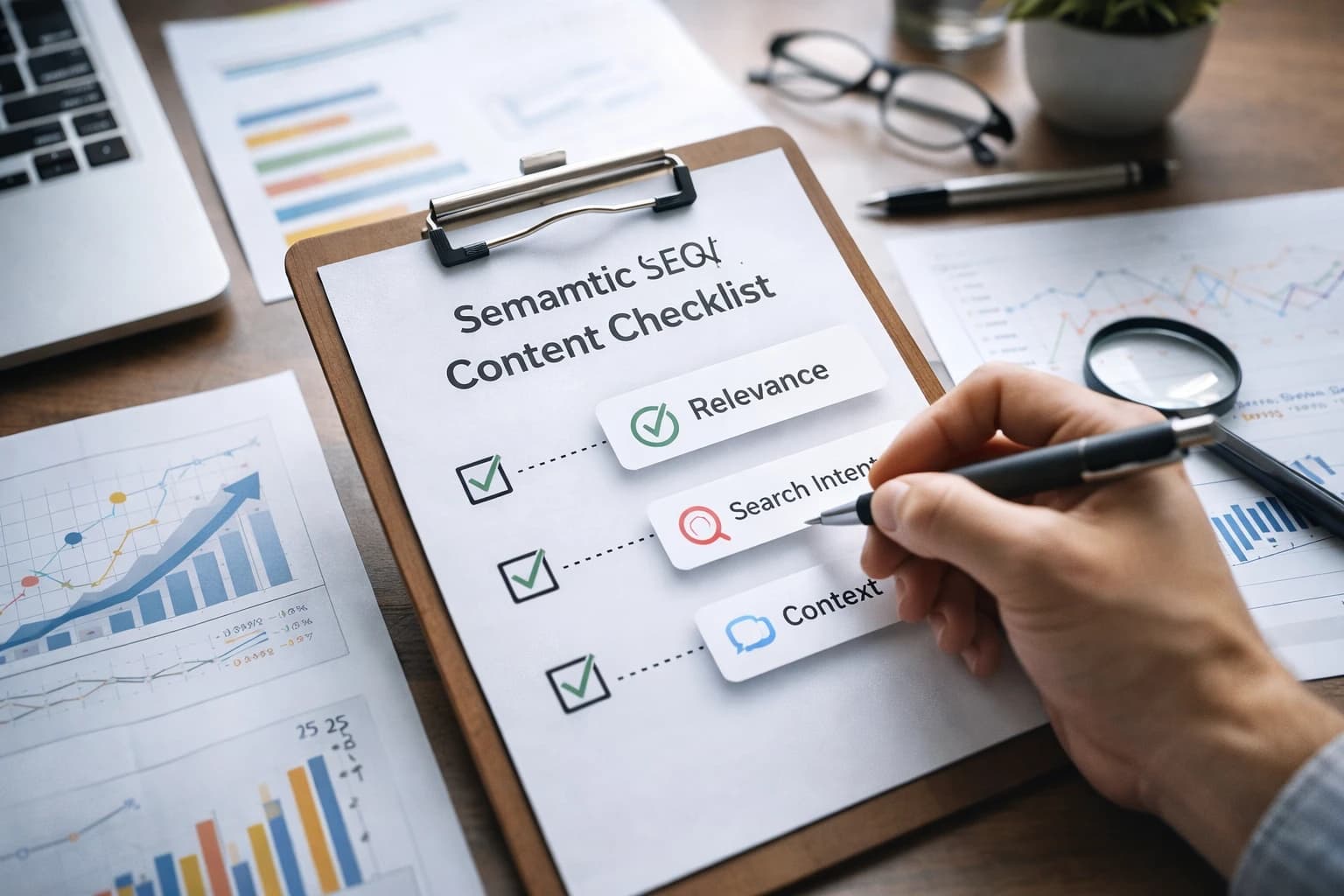
A content lead stands at a whiteboard at 8:12 a.m., marker uncapped, staring at a grid of yellow sticky notes: entities, FAQs, comparison pages, schema types, support docs, internal links. A laptop beside the coffee mug shows a live Google results page, with ChatGPT open in the next tab and Search Console in the third.
That scene is not overbuilt. It is what semantic seo content looks like before the first sentence exists. You are not just picking a phrase and stretching it across 1,800 words. You are mapping a topic, the things inside that topic, the questions around it, the pages that support it, and the proof that makes it trustworthy.
If the brief still starts with a keyword list, the process is already too small.
The labels vary — semantic SEO, entity SEO, generative engine optimization. The operating principle does not. Search engines have become better at understanding relationships between topics, entities, and intent, so your content process has to become better too. A page can mention the right phrase 20 times and still fail because it never actually answers the topic in full.
AI visibility changes the brief again. Current SEO guidance now breaks work into separate tracks for AI Search Strategy, LLM Seeding, and GEO, which tells you something useful: modern search is no longer only about blue links. You still want rankings in Google, but you also want passages that can feed AI Overviews and clean explanations that tools like ChatGPT, Gemini, and Perplexity can cite.
Do not treat that as a reason to ignore the basics. Internal linking is still a major driver for stronger rankings and clearer site structure. Technical SEO is still super important. If the page is hard to crawl, slow to load, missing context, or stranded without supporting links, semantic depth alone will not rescue it.
Build this system well and you can earn three outcomes at once: rankings for core queries, SERP features such as People Also Ask or rich results, and mentions in AI-generated answers. That is the real target for scalable content operations now.
Pre-work checklist
List the primary entity, related entities, and supporting questions
Start by naming the main thing your page is about. Not the headline. The thing. If you are creating a page about semantic SEO, the primary entity is the practice itself. Related entities might include internal linking, schema markup, entities, topical authority, E-E-A-T, AI search, search intent, knowledge graphs, and content clusters.
This is where the academic-sounding language from ontology tools becomes practical. Platforms such as WordLift talk about ontologies for specialized industry knowledge and dynamic knowledge graphs that connect data through semantic relationships. Strip away the jargon and the lesson is simple: define the entities and their relationships before you draft.
- Write a one-sentence definition of the primary entity.
- List the related entities a reader expects to see on the page.
- Collect alternate names, abbreviations, and close variants.
- Pull supporting questions from the SERP, sales calls, demos, support tickets, and FAQs.
- Note what proof you can provide: examples, screenshots, process steps, comparisons, or original experience.
| Brief Element | What You Need | Example for “Semantic SEO” |
|---|---|---|
| Primary entity | Main concept in plain language | Semantic SEO as topic- and entity-focused optimization |
| Related entities | Connected concepts readers and search engines expect | Internal linking, schema, E-E-A-T, AI search, knowledge graph |
| Supporting questions | User questions across awareness and evaluation stages | What is it, why it matters, how to do it, how it differs from keyword-first SEO |
| Proof assets | Evidence that makes the page credible | Examples, workflow steps, schema choices, link structure |
Start with entities, not headlines.
Audit the current SERP for intent, format, and feature opportunities
Open the SERP before you open your doc. Look at the top 10 results and ask a blunt question: what is Google rewarding here? A beginner guide? A category page? A glossary definition? A vendor-led framework? If seven results are educational guides and two are product pages, do not pretend the query is purely commercial.
Also look for feature opportunities. Are People Also Ask boxes showing up? Do you see videos, forums, snippets, AI Overviews, or comparison tables? Those features tell you how the engine is interpreting the query. If the results include “what is,” “how to,” and “why it matters,” you probably need a page architecture that answers all three without forcing readers to bounce.
- Record dominant intent: informational, commercial, navigational, or mixed.
- Note content format: guide, definition, comparison, template, case study, tool page.
- Identify missing angles your page can cover better.
- Mark opportunities for FAQ blocks, tables, definitions, or step-by-step sections.
- Watch for terminology differences across results — they often expose unresolved audience confusion.
You will sometimes see a real split. One page may treat semantic SEO as classic on-page topic depth. Another may frame it through AI search visibility and LLM mentions. That tension matters. If the SERP shows both, your brief should cover both.
Gather source inputs from SMEs, docs, product pages, and FAQs
The strongest pages rarely come from keyword tools alone. They come from source material with friction in it — the sales call where a prospect asked a sharp question, the implementation doc your onboarding team uses, the FAQ your support inbox answers every week, the product page that already defines the terms cleanly. A Stripe-style documentation page often contains better semantic language than a glossy homepage.
Collect these inputs before writing starts. They shape the vocabulary, the examples, and the claims you can defend. They also reveal schema opportunities early. If you know the page needs an author, a date, product attributes, an FAQ set, or breadcrumb structure, you can build those fields into the production process instead of bolting them on at the end.
- Interview a subject matter expert for nuance and edge cases.
- Pull phrasing from documentation, product copy, and support macros.
- Use FAQs and reviews to capture real-world language, not just internal jargon.
- Flag reusable supporting assets such as glossary entries, comparison pages, and tutorials.
- Capture markup needs early so structured data reflects the actual page.
Good pre-work is not glamorous. It saves drafts. It also makes scalable content generation much safer, because the model — human or AI — starts from a real semantic brief instead of a vague keyword target.
Execution checklist for semantic seo content
Cover the main question and the adjacent questions in one structure

Answer the main question fast. If the query is “what is semantic SEO,” define it in the opening section in plain English. Then expand into the adjacent questions readers almost always have: why it matters, how it works, how to implement it, what role internal links play, where schema fits, and how AI search changes the playbook.
This structure helps both readers and search systems. On-page SEO is not just about words on a page; it also has to support UX, bounce rate, and search intent. When readers land and immediately understand the page’s promise, they stay. When machines parse a clean outline that answers the central query and its natural follow-ups, they understand the page’s topical depth.
- Lead with a direct answer, not a throat-clearing intro.
- Move from definition to explanation to application.
- Use subheadings that reflect real questions, not clever branding.
- Add examples where confusion usually appears.
- Close sections with the decision criteria readers need next.
Write the page for the topic, then let the keyword fit naturally.
That means you do not need to cram exact-match phrasing into every heading. If the topic is clear, the entity coverage is strong, and the structure is coherent, the keyword will find its place. Forced repetition usually signals a weak brief, not strong optimization.
Use internal links to reinforce the topical graph
Internal links are not decoration. They are how you show search engines and readers where this page sits inside the larger site. A good semantic page should link upward to a broader hub, sideways to relevant supporting pages, and downward to narrower definitions or examples.
Think in clusters. If you publish a semantic SEO guide on a B2B SaaS site, connect it to pages about schema markup, internal linking, topic clusters, E-E-A-T, AI search optimization, and content briefs. That creates a web of meaning. It also gives readers the next step instead of sending them back to the SERP.
- Link from the hub page to the supporting pages.
- Link back from supporting pages to the hub.
- Use descriptive anchors that reflect topic relationships naturally.
- Refresh older pages so new content is not born orphaned.
- Support commercial paths where relevant, not only informational ones.
This is one reason connected content paths matter so much. Some platforms describe that as journey optimization — creating routes that connect research-stage content to product or category pages. Different phrase. Same operational truth.
Add structured data where it clarifies the page’s meaning
Use structured data when it makes the page easier to interpret. That can mean Article markup for authorship and dates, BreadcrumbList for hierarchy, FAQPage when the visible page genuinely contains FAQs, Product for product details, or Organization when brand context matters. The standard reference point is Schema.org.
Structured data should clarify meaning, not invent it. If the page does not visibly contain a question and answer pair, do not force FAQ markup. If the article is really a comparison page, make that explicit in the content first. Markup optimization helps search visibility because it gives engines cleaner machine-readable context, but it does not excuse thin writing or muddled intent.
- Match structured data to visible page content.
- Choose the smallest accurate schema set rather than the biggest possible one.
- Use consistent entity names across title, headings, body, and markup.
- Include breadcrumbs when hierarchy matters.
- Document the schema fields in your editorial workflow.
At scale, this matters even more. Content generation can produce high-quality drafts quickly, but you still need editorial logic around links, schema, and semantic scope if you want the output to perform.
Validation checklist
Confirm intent match, completeness, and readability

Before you publish, read the page like a skeptical visitor. Does it answer the query in the first screen? Is it complete enough to stand beside the current top results? Does it sound like a person who has done the work wrote it? This is where E-E-A-T stops being a slogan and becomes an editing standard.
Check for audience fit too. A glossary-level reader needs clean definitions. A practitioner may need implementation detail, tradeoffs, or examples. A strong page can serve both, but only if you signal the level clearly and structure the page so each reader can move fast.
| Reader Type | What to Check | Pass Signal |
|---|---|---|
| Human reader | Clarity, scanability, examples, usefulness | Understands the answer quickly and knows what to do next |
| Search engine | Intent match, headings, entity coverage, internal links | Can place the page within a clear topical cluster |
| AI system | Quotable definitions, explicit audience, proof, structure | Can summarize the page accurately without guessing |
- Trim filler intros and repeated definitions.
- Add specific examples where claims feel generic.
- Check that every major section earns its place.
- Verify author, source context, and update cues when appropriate.
Verify entity coverage and structured data output
Return to your original entity map. Did the page actually cover the related concepts you listed, or did the draft wander back to a narrow keyword obsession? This is where many pages fall short. The writer answered one question well but left out the surrounding ideas that help engines understand the topic fully.
Validate markup output too. Use Google’s Rich Results Test when applicable. Check the rendered page. Confirm that titles, headings, breadcrumbs, and schema point to the same meaning. If the markup says one thing and the visible page says another, fix the page, not just the code.
- Compare the final draft against the entity and question inventory.
- Test structured data for errors and mismatches.
- Confirm internal links resolve correctly and support the cluster.
- Look for orphan claims with no example, no source, or no explanation.
Machine-readability is not abstract. It shows up in whether systems can identify the page’s subject, hierarchy, author signals, and relationship to nearby content without confusion.
Test the page for AI/LLM citation readiness
AI search deserves its own review pass now. That is why current SEO education increasingly breaks out AI optimization and entity SEO into dedicated playbooks instead of hiding them inside old-school on-page advice. You should test whether your page contains short, defensible statements that can stand alone when quoted or summarized.
Run a few real prompts. Ask ChatGPT or Gemini a focused question your page targets. See what kind of answer format the model prefers. Then ask whether your page provides the kind of definition, table, example, or comparison that would make citation easier. If the answer is “not really,” the page probably needs sharper language or clearer structure.
If an AI system cannot identify who the page is for and what it proves, the page is not ready.
Bring customer language into this pass. Some platforms describe this as customer intelligence drawn from search, demand, and reviews. Again, the wording varies. The practical lesson is stable: use the phrases your audience already uses, especially where confusion or intent shifts show up.
Common misses
Do not skip technical SEO and on-page foundations
This is where smart teams still sabotage themselves. They put weeks into semantic planning, then publish on pages with crawl issues, weak title tags, bloated scripts, broken canonicals, bad mobile rendering, or no indexation. The more advanced your content strategy gets, the less patience you should have for sloppy fundamentals.
There is a reason mainstream SEO checklists still cover technical SEO, on-page SEO, and keyword research together. These are not rival disciplines. They are stacked dependencies. If the page is not discoverable, usable, and correctly framed, the semantic layer never gets the chance to work.
- Confirm indexability and canonical signals.
- Review page speed, mobile experience, and render quality.
- Write a clear title tag and meta description.
- Use headings that match the actual content structure.
- Check that the page fits the site architecture logically.
Do not publish thin pages that repeat the same point
Thin content is not just short content. It is content with no semantic range. A 2,000-word post can still be thin if it says the same thing six ways and never expands into adjacent questions, examples, objections, or related entities.
| Thin Page | Stronger Semantic Page |
|---|---|
| Repeats one definition | Defines the topic, explains it, and shows how it works |
| Targets one phrase in isolation | Covers the surrounding entity set and user questions |
| Has few or no internal links | Connects to hubs, supporting pages, and next-step paths |
| Uses generic statements | Includes examples, proof, and clear differentiation |
| Adds markup as an afterthought | Aligns visible content and structured data from the start |
Most semantic SEO failures are workflow failures, not writing failures.
This is the contrarian point many teams need to hear. The problem is often not that the writer missed a phrase. The problem is that the system never defined the topic properly, never gathered source material, never planned links, and never set a real QA gate before publishing.
Do not ignore refreshes, measurement, and content reuse
Publishing is the midpoint. Search results shift. AI answer formats shift. New competitor pages appear. Intent drifts. Review performance regularly and look at more than rankings alone: clicks, engagement, assisted conversions, internal-link traffic, indexation health, and any signals you have for AI visibility or brand mentions.
Then reuse what works. A strong article can feed a glossary page, FAQ section, product education module, sales enablement deck, or comparison page. Connected journeys matter here. If your research-stage content has no route to a category or product page, you are leaving both users and revenue stranded.
- Refresh pages when the SERP angle changes.
- Add internal links as new supporting pages go live.
- Reuse strong explanations across docs, FAQs, and commercial pages.
- Track which sections attract engagement and which sections get skipped.
- Treat semantic SEO as an operating system, not a one-time campaign.
Semantic SEO stops feeling vague once you run it as a disciplined system.
Map entities first, write for intent, connect the page to your site, and verify that search engines, AI systems, and humans can all understand your semantic seo content.
On your next brief, what would change if you audited the entities, proofs, and internal links before anyone wrote the headline?
Advance Semantic Reach With SEOPro AI
SEOPro AI combines its AI blog writer, CMS publishing, clustering, schema guidance, and monitoring so teams scale semantic SEO content and gain SERP features plus LLM mentions.
Start Scaling