How to Rank in Google AI Overviews with Topic Clusters
At 8:57 a.m., coffee cooling beside the trackpad, you refresh Google one last time before a client call. The AI Overview is still there — planted above the first organic result, answering the query before your ranking page gets a chance.
If you are trying to figure out how to rank in google ai overviews, that moment probably feels familiar. Your page may already rank well, yet Google chooses other sources to summarize. The fix usually is not one clever paragraph or one schema tweak. It is a topic cluster: a pillar page that answers the main query, supported by tightly linked pages that cover the subquestions, evidence, and entities around it.
Done well, the cluster gives Google a cleaner map of your expertise. It also gives your team something measurable in Search Console, Google Analytics, and Looker Studio instead of treating AI visibility like folklore.
Prerequisites and Tools
What you need before you start
Watch This Helpful Video
To help you better understand how to rank in google ai overviews, we've included this informative video from Ahrefs. It provides valuable insights and visual demonstrations that complement the written content.
Before you write a word, get three things in place: access, inventory, and ownership. You need access to analytics and your CMS. You need an inventory of existing pages that already touch the topic. And you need one owner — an SEO lead, editor, or content manager — who decides what becomes the pillar, what gets merged, and what gets published later.
I also recommend a working sheet in Google Sheets, Airtable, or Notion. Track the target query, current ranking URL, related questions, internal-link candidates, source notes, and update status. That document becomes the operating system for the cluster.
Build your measurement stack
One of the current SERP references names Google Analytics, Google Tag Manager, and Google Looker Studio as analytics resources. The same reference also lists LLMS.txt Validator and AI Bot Access Checker, which tells you something useful: crawl and access checks belong in this process from the start, not after launch.
Keep the stack simple, but complete. You need visibility into impressions, clicks, CTR movement, internal-link strength, and whether important URLs are accessible to both search crawlers and AI-facing bots.
| Need | Tool | What to watch |
|---|---|---|
| Traffic and engagement | Google Analytics | Organic sessions, assisted conversions, engaged visits |
| Event tracking | Google Tag Manager | Scroll depth, downloads, form starts, CTA clicks |
| Shared reporting | Google Looker Studio | Cluster dashboard, page groups, trend lines |
| Query visibility | Google Search Console | Impressions, clicks, CTR, new query coverage |
| AI crawler access | LLMS.txt Validator and AI Bot Access Checker | Whether important pages are accessible and not blocked |
| Internal-link auditing | Your crawler or site audit tool | Orphan pages, weak link paths, anchor consistency |
If you can’t measure clicks, impressions, and internal-link movement, you’re not doing SEO—you’re guessing.
Define the pages you will need
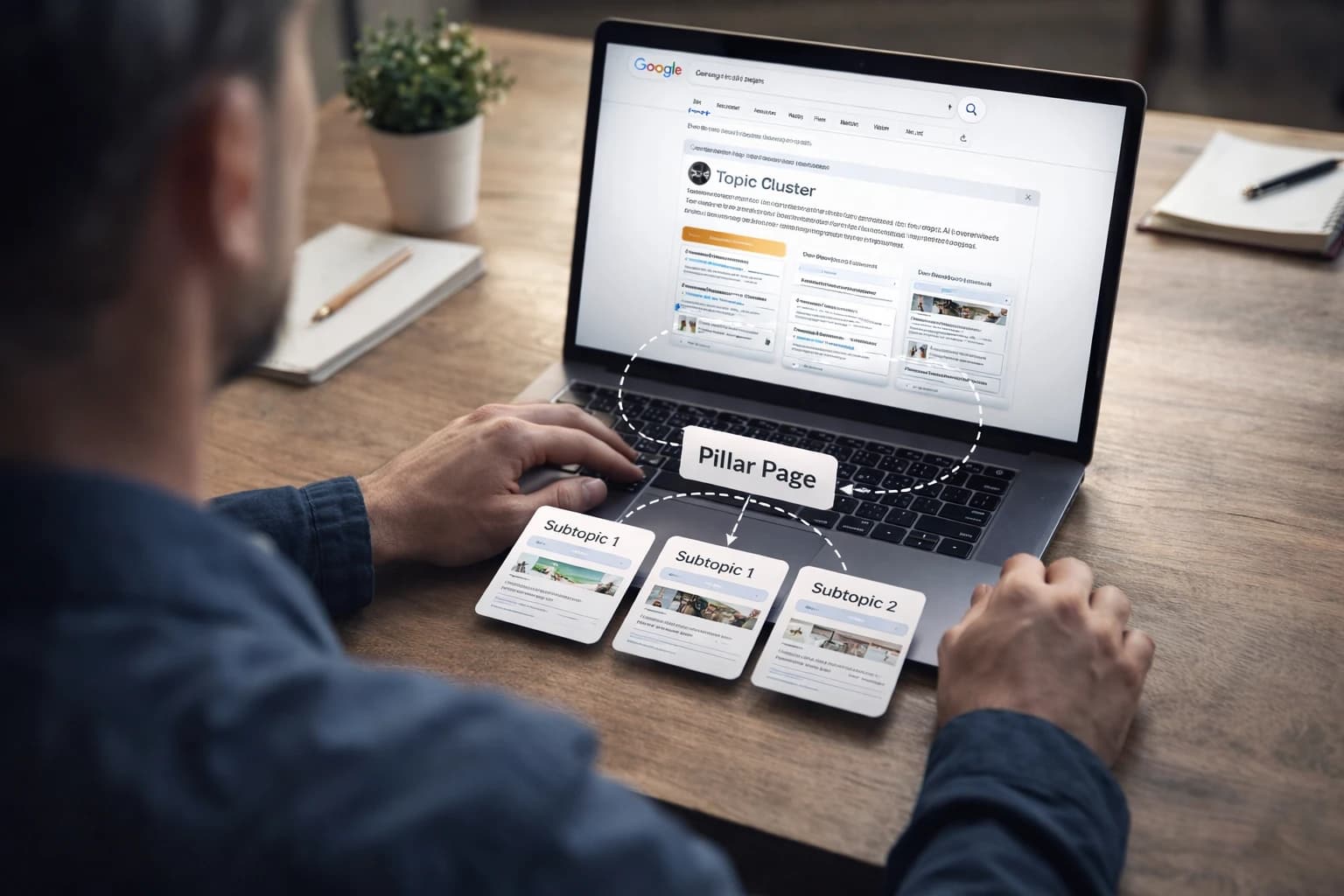
Most topic clusters start with one pillar page plus supporting cluster pages. The pillar is the hub. The supporting pages are the spokes. The hub targets the primary query. The spokes each answer a distinct sub-intent, such as reporting, internal linking, structured data, freshness, or credibility.
| Page type | Purpose | Primary job | Must link to |
|---|---|---|---|
| Pillar page | Own the main query | Summarize the full workflow clearly | Every supporting page |
| Supporting cluster page | Own one subquestion | Go deeper than the pillar | Pillar page and related supports |
| Proof or case page | Add evidence | Show examples, outcomes, or original process | Pillar or relevant support pages |
For this topic, a practical starting set might include pages on internal linking for AI Overview visibility, credibility signals, schema and structured clarity, and performance measurement. You do not need every possible URL on day one. You do need a complete answer set.
Step 1: Map the Opportunity for How to Rank in Google AI Overviews
Start with the exact query
Begin with the exact search that matters. The visible top-result titles all center on ranking in AI Overviews, and they do it with direct, instructional wording. One referenced result was unavailable during review, but the live titles still point to the same user need: tell me what to do, not what to admire.
Open Google in an incognito window and search the target phrase. Record what appears around the AI Overview: organic results, People Also Ask prompts, related searches, forum threads, brand pages, and recurring verbs in titles. This is where you learn what the market already treats as part of the answer.
Collect related questions and entities
Next, collect the supporting questions. For this topic, they often cluster around internal links, freshness, entities, authorship, citations, schema, analytics, and crawl access. If several results emphasize words like “rank” and “results,” keep those as cues for headings, intros, and anchors.
Separate questions from entities. “How should I structure a pillar page?” is a question. “Google Tag Manager,” “Looker Studio,” and “LLMS.txt Validator” are entities. Questions become sections or standalone pages. Entities become proof points, examples, or supporting terms within those sections.
Group by search intent
Now sort the list by intent. Topic clusters work because closely related queries sit under one parent theme, not because you cram similar keywords onto one URL.
| Query theme | Likely intent | Best home |
|---|---|---|
| how to rank in google ai overviews | Full workflow | Pillar page |
| internal links for ai overviews | Implementation detail | Supporting page |
| schema for ai overview visibility | Technical clarification | Supporting page |
| measure ai overview performance | Reporting and diagnosis | Supporting page |
When a query deserves a fuller answer, give it its own page. When it only reinforces the main explanation, keep it on the pillar. That judgment call is where architecture beats raw keyword export.
Don’t build a cluster around one head term only; build it around the questions that sit under it.
Step 2: Create the Pillar Page
Answer the main question fast

Your pillar page should answer the primary question near the top, in plain English. A visitor should understand within the opening scroll what AI Overviews are and what actions improve your odds of being cited or summarized.
A direct opening can be simple: build a pillar page around the core query, publish supporting pages for the subquestions, link them tightly, and keep the cluster fresh. Readers appreciate that clarity. Search systems do too.
Cover the full workflow in one place
The current top results lean toward operational, step-driven pages rather than brand storytelling. Your pillar should follow that pattern. Cover research, page planning, internal linking, trust signals, formatting, and measurement in one URL, then link deeper whenever a subtopic needs its own space.
Think of the pillar as a map, not a warehouse. If a supporting page goes deep on structured data, the pillar should summarize when schema matters, what it can and cannot do, and where the reader can dig deeper.
Make the page skim-friendly
Skim-friendly pages win because both humans and crawlers can decode them quickly. Use concise headings, short paragraphs, numbered steps, comparison tables, and direct summary lines before the nuance. On WordPress or HubSpot, that often means deleting ornamental intros and replacing vague labels like “Things to Consider” with headings that state the action.
Remove the soft tissue. Keep the signal.
The pillar page should be the best hub, not the longest page.
Step 3: Publish Supporting Cluster Pages and Link Them Tightly
Write one page per subquestion
Each supporting page should own one distinct sub-intent. For this topic, strong candidates include entity coverage, internal linking, freshness and updates, structured clarity, and reporting. If a section on the pillar starts feeling cramped or too abstract, that is usually a clue it wants its own URL.
This is also where adjacent disciplines matter. One referenced SERP page groups SEO, technical SEO, digital PR, content marketing, and analytics together. That matches reality. AI Overview visibility rarely comes from content alone. It often depends on content quality, clean site structure, reporting discipline, and external credibility moving together.
Use internal links to map parent-child relationships
Internal links are the connective tissue of the cluster. The pillar should link to every supporting page. Each supporting page should link back to the pillar with natural anchor text. Related support pages can also cross-link when the relationship helps the reader.
- The pillar links down to every subtopic page.
- Each subtopic page links back to the pillar.
- Related subtopic pages cross-link where the user journey makes sense.
For example, a page on authorship can link to a page on citation-ready formatting. A page on measurement can link to internal-link auditing if weak link paths are suppressing discovery. This structure helps search engines discover relationships and helps users keep moving without returning to Google.
Avoid duplicate intent
Before you publish, line up every planned URL against your current library. If you already have “AI SEO basics,” “How AI answers use content,” and “Google AI Overview tips,” check whether two or three of those URLs answer the same underlying question. If they do, your cluster is already splitting its authority.
Merge overlaps. Consolidate the useful parts. Redirect the weaker duplicate when appropriate. A strong cluster gives each page one clear job.
If two pages answer the same question, merge them—don’t compete with yourself.
Step 4: Add Credibility Signals and Make Pages Easy to Cite
Include original examples and first-party data
Generic summaries are easy to publish and easy to ignore. What makes a page quotable is usually something the next page does not have: a real example from your own workflow, a before-and-after outline, a screenshot from Search Console, or a first-party observation from a content refresh project.
You do not need a giant research study. Even a small example helps. If you reorganized a B2B SaaS blog into a pillar plus supporting pages and saw new query families appear, explain the process plainly. Show the map you used. Name the decision points.
Show expertise and editorial ownership
Trust grows when readers can see who wrote the page, who reviewed it, and why they know the subject. Add an author byline. Add an editor or reviewer if your workflow supports one. Date the page honestly. Link to source material when you make technical claims.
Google’s broader quality systems have long rewarded signals of experience, expertise, authoritativeness, and trustworthiness. That does not mean dressing thin content in fancy clothes. It means making the page look and read like work done by a real practitioner. Off-page support matters too, which is why digital PR, outreach, and content marketing still belong in the conversation.
Keep facts current
AI-facing search features move quickly. Product names change. Interfaces shift. A page that felt sharp last quarter can start sounding stale fast, especially if it references outdated SERP behavior or old screenshots from tools like Looker Studio.
Build a light review habit. Recheck your examples. Confirm your tools still exist. Refresh any section where Google’s behavior, terminology, or result mix has moved.
AI Overviews don’t need your opinion; they need a page worth quoting.
Step 5: Optimize for Extraction, Entities, and Structured Clarity
Use definition-style language where needed

When a term may be ambiguous, define it in one clean sentence. “A pillar page is the main page in a topic cluster.” “An entity is a recognizable concept that search systems can connect to related information.” These short definitions reduce friction for the reader and make the page easier to parse.
Do not force that style everywhere. Use it where clarity matters most — near the top of a section, before a technical concept like schema markup, or when two terms are often confused.
Answer with listable steps and short blocks
Clear headings, short answer blocks, and straightforward terminology make content easier to extract. The titles on this SERP emphasize direct action and outcomes, so your page should do the same. Replace airy headings with lines that tell the reader exactly what happens next.
| Weak wording | Stronger wording |
|---|---|
| Thoughts on AI search | Map the query and supporting questions |
| Things to know about linking | Link the pillar to every subtopic page |
| Why structure matters | Add schema that matches the page type |
If a section can become a concise list, do it. If a sentence can lose ten mushy words, cut them. Write so a human skimming on mobile and a machine looking for a compact answer both get what they need.
Add schema only where it genuinely fits
Structured data can support understanding, but it is not a shortcut on its own. Add schema when it accurately matches the content on the page — for example, Article schema for editorial content or Breadcrumb schema for navigational clarity. If another schema type genuinely fits your page, use it carefully and validate it.
What you should avoid is forcing markup onto a vague page because it sounds advanced. If the underlying content is muddy, schema will not rescue it.
Write for extraction, not for fluff.
Step 6: Measure, Refresh, and Scale the Cluster
Track impressions, clicks, and query expansion
Once the cluster is live, watch the signals that actually reveal movement: impressions, clicks, CTR, average position, assisted conversions, and new query coverage. Google Analytics, Google Tag Manager, and Google Looker Studio are sensible building blocks here, and Search Console remains the fastest place to catch query expansion.
Look beyond the pillar. Supporting pages often show the first signs of traction. A page on internal linking may start pulling adjacent queries before the main hub moves at all. That is useful evidence, not a distraction.
- Track performance by page group, not just by sitewide organic traffic.
- Watch whether supporting pages are earning new impressions for nearby subtopics.
- Check whether internal-link changes correlate with crawl and ranking improvements.
Refresh pages when the query landscape shifts
Clusters decay when teams publish them and walk away. Refresh titles, intros, examples, and cross-links when the SERP changes. If new subquestions appear around AI Overviews, add them to the pillar summary and decide whether they deserve their own URLs.
Keep a running change log in Sheets, Airtable, or Looker Studio notes. When a client asks what moved the needle, you will have a record instead of a hunch.
Repurpose wins into new cluster pages
When one page starts earning impressions for a nearby topic, treat that as expansion data. If your pillar begins attracting queries around “AI crawler access” or “AI Overviews schema,” and the intent looks distinct, spin out a new supporting page and link it back into the cluster.
If your team publishes across multiple CMS properties, an automation layer can help with content creation, publishing, internal-link upkeep, and performance monitoring. The point is not speed for its own sake. It is keeping the cluster alive without burying editors under repetitive maintenance.
A cluster is never finished; it’s maintained.
Common Mistakes
Publishing one isolated article instead of a cluster
One standalone post rarely builds enough topical coverage to compete with a well-structured cluster. You may rank for a narrow phrase, but you leave Google with thin context around subtopics, supporting evidence, and related entities.
If the query matters to your business, give it a home and a neighborhood. One URL cannot do every job well.
Chasing vague AI terminology instead of user intent
Stuffing “AI” language into copy is not the same as answering the user’s question. The result set here leans toward practical, step-led pages. A vague thought piece about the future of AI search is misaligned with that pattern and usually misses the searcher too.
Write for the problem the user brought to Google. In this case, that means specific actions, page structure, examples, and reporting.
Ignoring refresh cycles and internal links
Even strong content fades when it sits alone, goes stale, or loses its link paths. Internal linking is not housekeeping. It is part of how Google understands the cluster. Refreshing is not optional either, especially on a topic where the answer layer can shift fast.
Build maintenance into the brief from day one. If no one owns updates, the cluster will slowly unravel.
The biggest mistake is trying to rank in AI Overviews with a page that doesn’t behave like a step-driven answer.
If you want how to rank in google ai overviews to stop feeling mysterious, build a cluster Google can read, quote, and revisit.
That means one strong pillar, distinct supporting pages, clean internal links, real evidence, and a reporting stack that shows what changed. AI Overview visibility usually grows from systems, not stunts.
Which query family on your site is ready for a true pillar-and-cluster rebuild first?
Accelerate Topic Cluster Growth with SEOPro AI
An AI blog writer plus publishing, clustering, schema, and monitoring workflows help teams grow organic visibility, win SERP features, and earn more LLM mentions.
Start Scaling