7 Latent Semantic Indexing in SEO Myths to Know

At 9:12 on a Tuesday, you’re staring at two tabs. One shows Google Search Console. The other shows a keyword tool pushing “LSI keywords” for a page about credit cards: APR, rewards, annual fee, balance transfer. You hover over the export button and wonder whether you’re improving the page or just dressing it up with adjacent words.
That small moment captures the confusion around latent semantic indexing in seo. The phrase sounds technical, old-school, and authoritative — which is exactly why it keeps showing up in SEO conversations long after the underlying idea stopped being a useful model for how Google ranks pages.
Top-ranking guides still reflect the split. Semrush argues the label is misleading and says Google does not use LSI to rank search results, while Smart Insights points out how often marketers still debate the topic. If you separate the old information-retrieval method from modern semantic SEO, the noise clears fast.
If a tactic starts with “add these LSI keywords,” ask a harder question: does this wording make the page clearer for a reader with a specific task?
#1 What Is Latent Semantic Indexing in SEO? The Myth That Google Uses It
Definition
Watch This Helpful Video
To help you better understand latent semantic indexing in seo, we've included this informative video from Single World News. It provides valuable insights and visual demonstrations that complement the written content.
Latent semantic indexing, usually shortened to LSI, is an older information-retrieval method. In plain English, it tries to spot relationships between words and documents by looking at patterns of co-occurrence. It was built for a world where search systems needed help seeing that “car” and “automobile” might live in similar documents even when the exact wording differed.
Why it matters
The myth begins when marketers treat that older method as if it were Google’s current ranking engine. That leap causes trouble. You start optimizing for an acronym instead of optimizing for meaning, intent, structure, and usefulness.
That’s also why many current guides say “LSI keywords” is the wrong term. Semrush’s own explanation says it’s more accurate to call them semantic keywords or topically related terms. That distinction sounds fussy, but it changes how you work.
Quick example
Take the word “apple.” If a page also includes “iPhone,” “Mac,” and “Tim Cook,” you understand the company. If it includes “orchard,” “pie,” and “Granny Smith,” you understand the fruit. That is semantic disambiguation. You do not need the LSI label to see what’s happening.
#2 How Latent Semantic Indexing in SEO Works — and Why Modern Search Moved Past It
Core process
Classic LSI starts with a term-document matrix. Imagine a giant spreadsheet: rows for words, columns for documents, cells showing how often each word appears. The system then compresses that matrix so broader patterns stand out. In effect, it looks past exact matches and tries to infer topic relationships from recurring language patterns.
Key components
Three parts matter most in that older model:
- Co-occurrence: words that frequently appear together can point to a shared topic.
- Dimensionality reduction: the math compresses noisy term data into broader conceptual patterns.
- Disambiguation: the surrounding words help separate meanings, like “Jaguar” the animal from Jaguar the car brand.
Modern search engines do far more than that. They use broader semantic analysis, entity understanding, and query interpretation. So while LSI is useful as a history lesson, it is not a realistic mental model for how you should run an SEO program in 2026.
| Aspect | Classic LSI | Modern SEO Practice |
|---|---|---|
| Main goal | Infer topic from word patterns | Match intent and explain the topic clearly |
| Primary input | Terms in documents | Queries, entities, structure, supporting context |
| Your optimization focus | Add related words | Build complete, useful pages and clusters |
| Big risk | Overvaluing term lists | Ignoring clarity if you chase every variant |
Quick example
Search “Wall Street” and a machine has to decide whether you likely mean the financial district, finance as a topic, or the 1987 film. Related language helps. But the modern SEO lesson is not “sprinkle LSI keywords.” It’s “give the page enough context to remove doubt.”
When a tool says “LSI keywords,” translate that to “terms commonly seen around this topic” — not “a shortcut into Google’s ranking system.”
#3 Best Practices — The Myth That You Need an “LSI Keywords” Checklist
Getting started
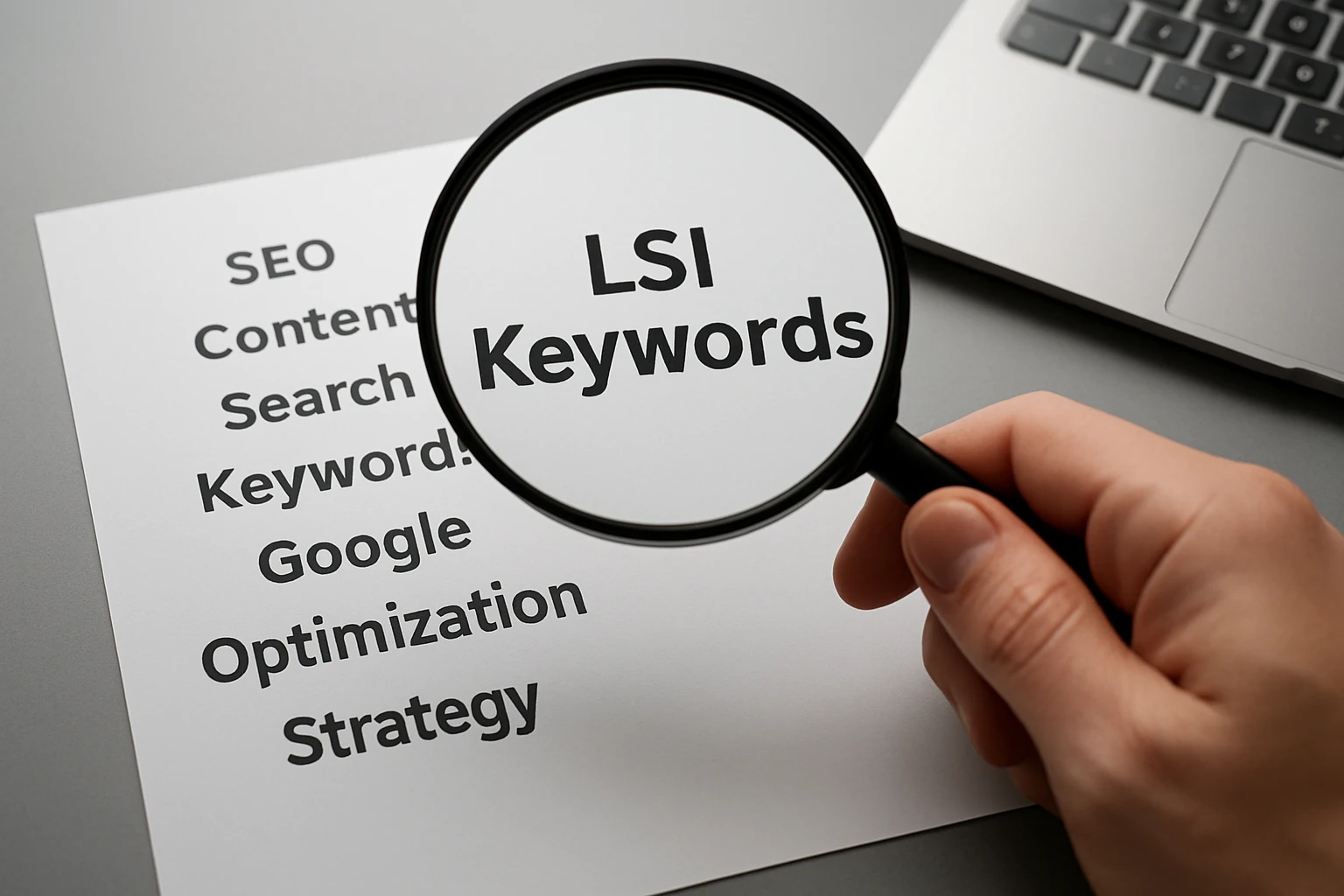
Start with search intent, not a generated list. Open the current SERP. Read the top pages. Note what problems they solve, which subtopics recur, and what format Google seems to reward — comparison, tutorial, definition, template, product page, or calculator.
- Define the main query and the reader’s job-to-be-done.
- List essential subtopics, entities, and questions that complete that job.
- Check your own Search Console data for related queries already earning impressions.
- Map missing depth before you add a single extra phrase.
Common pitfalls
The biggest mistake is stuffing in every related term a tool exports. A close second is confusing adjacent topics with required coverage. If your page is about “credit cards for students,” you may need “credit score,” “annual fee,” and “secured card.” You probably do not need a long detour into corporate card expense policies.
Another trap is placing semantic terms where they do not belong. Readers notice it fast. So do editors. A clean page wins because it answers the question completely, not because it force-fits 27 cousins of the main keyword.
Quick example
For a page targeting “credit cards for students,” useful additions might include eligibility, fees, rewards, APR, and how to build credit responsibly. Those terms deepen relevance. Throwing in “debt consolidation” just because a tool suggested it would blur the page’s purpose.
Semantic coverage helps when it completes the task. It hurts when it turns a focused page into a junk drawer.
#4 Myth: More Related Terms Automatically Mean Better Rankings
What it is
This myth shows up in content briefs that equate topical breadth with topical quality. You’ll see a target keyword, then a giant cloud of tangential phrases, and the unspoken rule becomes: fit in as many as possible.
Why it matters
Search performance rarely improves because a page became more crowded. It improves because the page became more useful. A tight article that answers one intent cleanly often beats a bloated article that name-drops every cousin phrase in the niche.
You’ve probably seen this in commerce content. A page for “best noise-canceling headphones” should compare comfort, sound, battery life, microphone quality, price, and use cases like flights or office work. It does not need a half-baked history of acoustics just to appear “semantically rich.”
Quick example
If your page already explains annual fees, grace periods, and rewards categories for “travel credit cards,” adding unrelated terms like “mortgage refinance” will not make the page smarter. It makes the page fuzzier.
#5 Myth: LSI Can Replace Search Intent Research
What it is
This myth assumes that if two queries share related vocabulary, one page can satisfy both. That sounds efficient. It usually is not.
Why it matters
Intent shapes everything: headline, page type, CTA, internal links, even the order of sections. Two queries can use nearly identical language and still demand different content experiences. If you ignore that, your page misses the reader and the SERP at the same time.
| Query | Likely intent | Best page type |
|---|---|---|
| best running shoes | Commercial investigation | Comparison or roundup |
| running shoe size chart | Utility / informational | Reference guide or tool |
| buy running shoes size 12 | Transactional | Category or product page |
Quick example
Look at “email marketing software” versus “email marketing benchmarks.” Both live in the same universe. One wants product evaluation. The other wants data. Shared terminology will not erase that split, and no “LSI keyword” list can solve it for you.
#6 Myth: One Page Should Capture Every Semantic Variation
What it is

This is the mega-page myth. You begin with one target term, keep adding adjacent phrases, and soon the outline tries to cover definitions, how-to steps, pricing, alternatives, troubleshooting, integration guides, and case studies on a single URL.
Why it matters
Sometimes that approach creates a decent pillar page. Often, it creates a confused one. When intent branches, the better move is usually a cluster: one strong hub supported by focused pages, tied together with internal links that make the relationship obvious to readers and crawlers.
B2B SaaS teams run into this constantly. A CRM site may need separate pages for CRM pricing, CRM migration, CRM onboarding, and CRM integrations. Trying to force those into one “ultimate guide” usually weakens every section.
Quick example
If someone searches “HubSpot pricing,” they do not want a long section on migration checklists before they see the pricing context. If they search “CRM migration plan,” they need a process page, not a pricing explainer. Same topic family. Different URL jobs.
If your outline keeps growing because a keyword tool keeps suggesting cousins, you may not need a longer page — you may need a new page.
#7 Myth: Because “LSI” Is Outdated, Semantic Optimization Doesn’t Matter
What it is
This is the backlash myth. People learn that Google does not use LSI in the way marketers describe it, then swing too far and assume related language, entities, structure, and topical completeness no longer matter at all.
Why it matters
That reaction throws out the useful part. Semantic optimization still matters because search systems and AI assistants need clear signals. Good headings, accurate terminology, strong internal links, concise definitions, consistent schema, and focused supporting sections all make a page easier to understand and easier to cite.
On larger sites, teams often standardize that work with platforms such as SEOPro AI, especially when they need repeatable internal linking, semantic checks, publishing workflows, and monitoring across dozens or hundreds of URLs. The win does not come from “doing LSI.” It comes from making meaning obvious at scale.
Quick example
An article on “email deliverability” becomes stronger when it clearly defines the term, separates causes from fixes, explains SPF, DKIM, and bounce handling, links to deeper tutorials, and adds structured FAQ-style sections where appropriate. That helps both classic search and AI-driven discovery.
How to choose the right option
Start with intent, not terminology
Before you expand a page, ask three questions. What job is the searcher trying to finish? What page type currently dominates page one? Which supporting ideas are essential to complete that job well? If you cannot answer those, a term list will not rescue the brief.
Decide whether to enrich, split, or cluster
| Situation | Best move | Why |
|---|---|---|
| Your page already matches the dominant SERP intent | Enrich the existing page | Add missing depth, examples, entities, and clear headings |
| Suggested terms point to a different task or funnel stage | Create a new supporting page | Separate intent usually performs better than forcing one URL to do everything |
| The topic is broad and recurring across the site | Build a cluster | A hub-and-spoke model clarifies relationships and strengthens internal linking |
| The page feels bloated or repetitive | Trim and refocus | Clarity beats sheer semantic sprawl |
Measure meaning, not term count
Watch the signals that matter: broader query coverage in Search Console, stronger clicks from secondary terms, better on-page engagement, cleaner internal click paths, and conversions that fit the page’s intent. If rankings rise while the page becomes easier to read, you’re moving in the right direction.
If rankings stall after you added a long list of “LSI keywords,” that result is telling you something. The page likely needed sharper scope, not more vocabulary.
Purge the myth, keep the insight: words help rankings only when they clarify intent, scope, and usefulness.
The practical value of latent semantic indexing in seo is not a hidden Google switch. It’s a reminder to build pages that make their meaning unmistakable.
When you review your next content brief, which suggested terms genuinely sharpen the page — and which belong on a different URL?
Grow Smarter With SEOPro AI
LLM SEO tools for ChatGPT, Gemini, and other agents automate publishing, clustering, schema, monitoring, and stronger brand mentions.
See Platform