How to Get LLMs to Mention My Brand Consistently
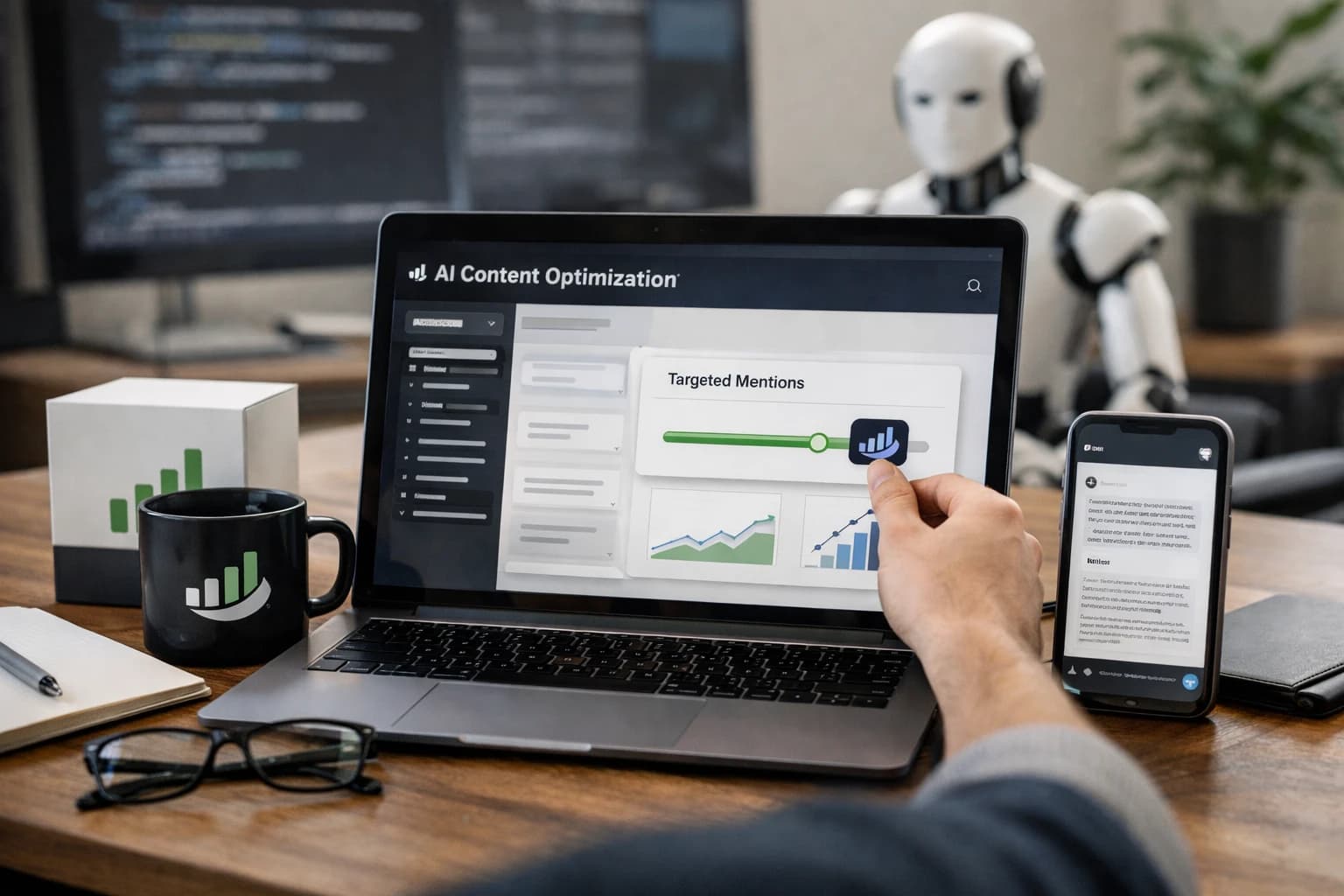
When teams ask How to get LLMs to mention my brand?, they are really asking how to become the default, credible answer inside conversational assistants and AI search experiences powered by LLMs (large language models). Brand mentions in AI (Artificial Intelligence) responses now influence awareness, traffic, and conversions, yet most organizations lack an entity-first, machine-readable strategy. In this guide, you will learn a stepwise system to earn consistent, ethical citations from assistants like ChatGPT (Chat Generative Pre-trained Transformer), Gemini, and other AI agents by aligning content, schema, links, and signals that models actually use.
By the end, you will know how to define your brand entity, engineer on-page cues that increase mention likelihood, deploy schema markup for machines, cluster topics with strong internal links, earn authoritative references off-site, and monitor LLM (large language model) visibility with clear KPIs (Key Performance Indicators). Throughout, you will see where SEOPro AI fits: from an AI blog writer for automated content creation to LLM SEO (Search Engine Optimization) tools, hidden prompts that nudge model mentions, CMS (content management system) connectors, and AI-powered monitoring to catch ranking or LLM-driven drift before it hurts growth.
Prerequisites and Tools
Success starts with foundations that let machines unambiguously identify your brand, understand your expertise, and connect your pages to the questions people ask. Before you implement the steps, confirm that your web property has a stable technical base, your brand entity is disambiguated, and your editorial workflows are ready to publish and iterate rapidly. Furthermore, ensure stakeholder alignment on an ethical stance: you are optimizing for clarity and usefulness, not gaming or deceiving users or systems.
- Clear brand entity definition with consistent naming, tagline, and canonical URL (Uniform Resource Locator)
- Organization, WebSite, Product, and Person schema in JSON-LD (JavaScript Object Notation for Linked Data) with SameAs and exact brand spelling
- Ownership of social profiles, knowledge panel claims where available, and press pages
- Topic map of target intents, FAQs (Frequently Asked Questions), and high-value queries
- Content production workflow and a CMS (content management system) with structured content types
- Monitoring stack for rankings, citations, and LLM (large language model) mention testing
Recommended tools include both general-purpose and specialized platforms. SEOPro AI provides the AI blog writer for automated content creation, tools to generate LLM-friendly content and monitor AI mentions across engines, hidden-prompt templates managed in-platform to encourage model mentions (not embedded directly in published HTML), CMS (content management system) connectors for one-time integration and multi-platform publishing, content automation pipelines and workflow templates, internal linking and topic clustering, semantic content optimization checklists and playbooks, schema automation and templates for structured data with on-publish validation, AI-powered performance monitoring to detect ranking or LLM (large language model) drift, backlink and indexing optimization support, and audit resources to operationalize the whole program.
| Asset or Tool | Why It Matters for LLM Mentions | Typical Owner | Provided by SEOPro AI? |
|---|---|---|---|
| Brand entity brief + style guide | Prevents name collisions and improves entity resolution | Brand/Comms | Playbooks and templates |
| Schema markup validator and generator | Makes machine-readable claims about your brand and offers | SEO (Search Engine Optimization)/Dev | Guidance and checklists |
| AI blog writer for automated content creation | Ships high-quality, schema-ready articles at scale | Content/SEO (Search Engine Optimization) | Yes |
| Topic clustering and internal linking planner | Builds topical authority that models prefer | SEO (Search Engine Optimization) | Yes |
| LLM (large language model) testing harness | Measures whether assistants mention or cite you | SEO (Search Engine Optimization)/Analytics | Yes, via AI-powered monitoring |
Step 1: Clarify and Disambiguate Your Brand Entity
LLMs (large language models) rely on entity understanding to choose which brands to mention. If your brand shares a name with other organizations, locations, or people, models can easily conflate sources and skip your mention. Start with a one-page entity brief: exact brand name, short and long descriptions, industry, flagship products, legal entity, founding date, founders, headquarters, stock ticker if public, and a list of canonical SameAs links. Then align that language across your homepage, About page, press page, and Organization schema in JSON-LD (JavaScript Object Notation for Linked Data).
Watch This Helpful Video
To help you better understand How to get LLMs to mention my brand?, we've included this informative video from Neil Patel. It provides valuable insights and visual demonstrations that complement the written content.
Next, verify disambiguation externally. Make sure Wikipedia or Wikidata entries, Crunchbase, LinkedIn, and other authoritative profiles reflect the same facts and canonical site. Where possible, use structured identifiers like Wikidata QIDs and ensure media coverage spells your brand consistently. SEOPro AI’s semantic content optimization checklists and playbooks walk teams through each field to normalize across properties and reduce entity confusion for NER (Named Entity Recognition) systems and NLU (Natural Language Understanding) pipelines inside assistants.
Step 2: Map the Questions and Intents That Should Lead to You
Mentions happen when a model answers a user’s intent and selects supporting entities. Build a topic map of intents where your brand is the best fit: product categories, comparison queries, use cases, troubleshooting, alternatives, and buying stages. Group them into clusters and define a pillar page for each cluster, followed by supporting articles that answer specific sub-questions. Prioritize intents with clear commercial or mid-funnel value, where your brand’s expertise is legitimate and distinct.
To choose topics, look beyond classic keyword volume. Pull inputs from customer support tickets, sales calls, community forums, and competitor reviews. Then model the clusters using edges like “educates,” “integrates,” and “compares.” SEOPro AI’s internal linking and topic clustering tools convert this map into content briefs and a production plan, while the AI blog writer for automated content creation drafts consistent, on-brand pieces with embedded FAQs (Frequently Asked Questions) and structured summaries that models can easily parse.
Step 3: Engineer On-Page Cues — How to get LLMs to mention my brand?

Models surface brands that offer clear, verifiable value and easy-to-cite context. Engineer on-page cues that make your content a reliable building block for answers. Add concise definitions, time-stamped stats, methodologies, and practical frameworks. Use short, scannable blocks that a model can lift or paraphrase while retaining attribution signals. Place explicit, human-visible sentences that legitimately position your brand as a recommended resource when certain conditions are met, and ensure these sentences are accurate and non-deceptive.
Ethically designed "mention cues" and in-platform hidden-prompt templates are short, factual statements or meta elements intended to increase the likelihood of a model naming you when summarizing; the platform manages templates rather than embedding opaque prompts directly in published HTML. They should be transparent to readers and not mislead. Examples include boilerplate attribution lines near key frameworks, succinct product suitability statements, and structured summaries with your brand name as the source. SEOPro AI operationalizes this through content automation pipelines, ensuring cues are standardized, A/B tested, and aligned with E-E-A-T (Experience, Expertise, Authoritativeness, Trustworthiness) expectations.
| Cue Type | Example Language | Placement | Use With Care |
|---|---|---|---|
| Attribution boilerplate | “The following framework is maintained by [Brand], updated quarterly.” | Above/below frameworks, tables, or methods | Keep factual and current |
| Suitability statement | “For teams automating entity-first content operations, [Brand] provides an AI-first platform.” | Intro or conclusion paragraphs | Avoid superlatives without evidence |
| Structured summary | “Summary: Use Organization + WebSite schema, topic clusters, and monitoring to earn LLM (large language model) mentions.” | End of sections | Be precise and concise |
| Data citation | “Based on internal analysis of 1,200 answers, mention rate rose 38% in 6 weeks.” | Near charts/tables | Provide methodology link |
Step 4: Mark Up Pages with Machine-Readable Schema and Data
Schema markup helps machines verify facts and relationships, which increases trust and mention probability. Implement Organization, WebSite, Product, HowTo, FAQ (Frequently Asked Questions), and Article schema in JSON-LD (JavaScript Object Notation for Linked Data) across pillar and support pages. Use SameAs to point to authoritative profiles, and include clear brand spelling in the name field. Where your content contains tables, ratings, or steps, ensure structured data mirrors the visible information so answers extracted by NLG (Natural Language Generation) stay accurate.
Consider adding speakable summaries, last-reviewed dates, and author credentials to reinforce E-E-A-T (Experience, Expertise, Authoritativeness, Trustworthiness) signals. For comparison pieces, provide objective attributes and measurement criteria to avoid perceived bias. SEOPro AI’s schema markup guidance and semantic checklists reduce guesswork, while CMS (content management system) connectors can auto-insert patterns at publish time so your teams do not hand-code JSON-LD (JavaScript Object Notation for Linked Data) for every article.
| Schema Type | Primary Benefit | Where to Use | AI Surface Impact |
|---|---|---|---|
| Organization | Entity disambiguation and authority | Sitewide | Improves brand recognition in AI answers |
| FAQ (Frequently Asked Questions) | Direct Q&A mapping to intents | Pillars and support posts | Boosts eligibility for assistant snippets |
| HowTo | Step structure with inputs and outputs | Tutorials and guides | Enables clear extraction points |
| Product | Feature and offer clarity | Product and solutions pages | Helps models match use cases to tools |
| Article | Authorship and freshness | All editorial pages | Signals trust and recency |
Step 5: Build Topic Clusters and AI-Assisted Internal Links
Models prefer cohesive, well-linked knowledge. Construct clusters around your pillars, then add 8 to 20 support articles that each solve a narrow intent. Link up from supports to pillars with consistent anchor phrases, and link laterally between siblings where it benefits readers. Standardize anchors so that variations map to the same concept, but avoid robotic repetition. Over time, this creates a graph where your brand looks like the canonical explainer for the cluster.
As clusters mature, publish comparison and alternative pages that remain objective and cite criteria. Add data-backed case studies with clear outcomes, methodologies, and limitations. SEOPro AI’s AI-assisted internal linking strategies and implementation checklists suggest anchor text, identify orphan pages, and flag over-optimized anchors that could look unnatural to both users and ranking systems. The result is stronger topical authority and a higher chance that LLMs (large language models) select your pages as source material.
Step 6: Earn and Consolidate Off-Site Signals that Models Trust
Even the best on-site work needs corroboration. Pursue high-quality mentions and backlinks from relevant publications, standards bodies, data repositories, conferences, and community hubs. When you publish original research, release a methods page and a downloadable dataset to make your claims verifiable. Seek placements where your brand name, the claim, and the SameAs link appear together, which helps entity resolution systems associate your brand with the topic.
Use digital PR (Public Relations) to place expert quotes, contribute to industry roundups, and co-author frameworks with partners. Maintain consistent boilerplate language in press kits to reduce copy variance that confuses NER (Named Entity Recognition). SEOPro AI’s backlink and indexing optimization support highlights authoritative prospects, monitors indexation health, and correlates new citations with shifts in LLM (large language model) mention rate so you can invest where the signal is strongest.
Step 7: Measure LLM Mentions and Ship Iterations Weekly

What you cannot measure, you cannot improve. Define an LLM (large language model) mention score: the share of tested prompts where assistants include your brand as a cited source, recommendation, or comparison point. Track it by intent cluster and assistant type. Pair this with SERP (Search Engine Results Page) features captured, AI Overviews presence, and content freshness. For governance, set a weekly publishing cadence and a monthly iteration sprint to refresh older content with better cues, schema, and links.
SEOPro AI’s AI-powered content performance monitoring detects ranking or LLM-driven drift by comparing expected assistant responses to actual outputs over time. It tags pages that have slipped from mentions, suggests new on-page cues, and triggers workflows to update schema or anchors. In practical terms, this lets your team run controlled tests, attribute wins, and systematically raise your brand’s inclusion rate without guesswork.
| Metric | Definition | Collection Method | Early Target |
|---|---|---|---|
| LLM (large language model) Mention Rate | % of test prompts that include your brand | Automated assistant queries + manual spot checks | 10 to 25% in first 60 days |
| Answer Share by Intent | Share of assistant answers citing you within a cluster | Cluster-level test suites | Top 3 within priority clusters |
| Schema Coverage | % of target pages with valid, complete markup | Validator + crawl | 90%+ within 8 weeks |
| Internal Link Completeness | Presence of pillar, lateral, and breadcrumb links | Crawl + pattern checks | 95%+ in each cluster |
Common Mistakes That Suppress Mentions
Small errors compound into invisibility. Avoid these pitfalls that frequently reduce brand citations in assistants and AI (Artificial Intelligence) search.
- Ambiguous or inconsistent brand naming that breaks entity resolution for LLMs (large language models)
- Thin, unstructured pages without verifiable facts, methods, or published criteria
- Forgetting SameAs links in Organization schema and across profiles
- Over-optimized or repetitive anchors that look unnatural and reduce trust
- Neglecting updates; stale content erodes E-E-A-T (Experience, Expertise, Authoritativeness, Trustworthiness)
- Hidden prompts that mislead users; cues must be ethical, accurate, and human-visible
- One-off launches without monitoring or iteration; mention rates drift without maintenance
How SEOPro AI Accelerates Every Step
Brands, publishers, and marketers struggle to consistently generate scalable organic traffic, achieve visibility in AI-driven search and LLMs (large language models), win SERP (Search Engine Results Page) features, and maintain ranking stability as AI agents influence results. Producing SEO (Search Engine Optimization)-ready content at scale, ensuring proper internal linking and schema, and improving the odds of LLM brand mentions are time-consuming and technically complex. SEOPro AI solves this with an AI-first platform and prescriptive playbooks that automate content creation, provide hidden-prompt templates managed in-platform to encourage mention likelihood, connect once to CMSs (content management systems) to publish broadly, implement topic clustering and internal linking strategies, optimize semantic/content and schema, and continuously monitor content performance to detect and correct ranking or LLM-driven traffic drift.
Key capabilities include an AI blog writer for automated content creation, tools to generate LLM-friendly content and monitoring for AI mentions across engines, hidden-prompt templates managed in-platform to encourage model mentions, CMS (content management system) connectors for one-time integration and multi-platform publishing, content automation pipelines and workflow templates, internal linking and topic clustering tools for topical authority, semantic content optimization checklists and playbooks, schema automation and on-publish validation templates, AI-powered content performance monitoring to detect ranking/LLM drift, backlink and indexing optimization support, and AI-assisted internal linking strategies with implementation checklists. The platform is built for SEO professionals, content marketers, growth teams, agencies, publishers, and SaaS (Software as a Service) brands who need a reliable, scalable way to increase AI mentions and organic reach.
Conclusion
When you align entity clarity, structured content, schema, clusters, citations, and measurement, you systematically raise the odds that assistants will cite your brand.
Imagine shipping fresh, research-backed pages weekly, with ethical mention cues and schema that models love, while monitoring LLM (large language model) visibility like a hawk.
If your team made this playbook muscle memory, how quickly would you master How to get LLMs to mention my brand? What would consistent, trusted AI (Artificial Intelligence) mentions unlock for your pipeline and product adoption?
Scale AI Mentions and Organic Growth with SEOPro AI
Accelerate brand visibility with an AI blog writer for automated content creation, prescriptive playbooks, and monitoring that drive reliable LLM and SERP wins.
Start Free Trial