7 Keyword Ranking Reports to Spot Drops Fast

When organic traffic stalls or slides, time is your most precious asset. The right keyword ranking reports help you detect real declines early, separate noise from signal, and prioritize the fixes that protect revenue. In the first 100 words, let’s be clear: keyword ranking reports are your early-warning radar for Search Engine Results Page (SERP) [Search Engine Results Page] volatility, competitor moves, and Large Language Model (LLM) [Large Language Model] shifts that now shape discovery.
SEOPro AI is built for teams who need speed, clarity, and scale. Brands, publishers, and marketers struggle to create Search Engine Optimization (SEO) [Search Engine Optimization]-ready content at volume, win SERP features, and maintain stability as Artificial Intelligence (AI) [Artificial Intelligence] agents reshape search. With an AI-first platform, prescriptive playbooks, hidden prompts that increase the likelihood of LLM mentions, Content Management System (CMS) [Content Management System] connectors, internal linking and topic clustering tools, schema guidance, and AI-powered content performance monitoring to detect ranking and LLM drift, SEOPro AI removes the guesswork and the grind.
#1 Daily Position Delta vs 28-Day Baseline
What it is: A day-over-day rank change report that compares each keyword’s current position to a rolling 28-day median. It flags statistically significant drops so you can see beyond normal SERP [Search Engine Results Page] churn. The best versions roll up by page, topic, and intent, then layer annotations for algorithm updates, site changes, and indexation events.
Why it matters: Across many markets, daily rank volatility hovers around 6–8 percent (industry indices), but meaningful declines cluster across related pages or queries. This report isolates true regressions, especially when a template edit or canonical fix moves the needle sitewide. With SEOPro AI, you can auto-tag affected clusters, trigger internal linking suggestions, and push tasks into content workflows before traffic loss compounds.
Quick example: Your “best wireless earbuds” page slips from position 3 to 7 overnight and similar “best” roundups dip by 2–4 spots. The report escalates a “critical” alert. You discover a layout change worsened cumulative layout shift and pushed down key content. You revert, add schema, and regain the top 3 within 72 hours.
#2 CTR vs Position Anomaly Detection
What it is: A model that compares expected Click-Through Rate (CTR) [Click-Through Rate] by position and feature mix with observed CTR signals (for example, analytics data or Search Console exports). When CTR falls faster than position, you likely have presentation issues: title or meta fatigue, missing rich results, or a competitor earning attention with reviews, video, or fresh snippets.
Watch This Helpful Video
To help you better understand keyword ranking reports, we've included this informative video from Google Search Central. It provides valuable insights and visual demonstrations that complement the written content.
Why it matters: The top three positions capture most clicks, but SERP [Search Engine Results Page] features can compress or expand that share dramatically. An anomaly report reveals when your listing stops earning its fair share despite holding rank. SEOPro AI pairs these insights with semantic optimization checklists, structured data prompts, and headline optimization suggestions so you can reclaim lost engagement without waiting for position to rebound.
Quick example: Position stays at 5, yet CTR [Click-Through Rate] drops 40 percent week over week. The anomaly flags a probable feature gap. You add product review schema and a concise “pros and cons” block; CTR rebounds by 22 percent in seven days.
#3 SERP Feature Loss and Gain Tracker
What it is: A report that monitors which features you own for each query — featured snippet, People Also Ask, video, images, reviews, sitelinks, and Google Overviews — and alerts when you lose or gain them. It tracks the snippet source URL [Uniform Resource Locator] and highlights formatting or schema changes that correlate with shifts.
Why it matters: Losing a featured snippet or Overview placement can cut clicks by double digits even if base rank holds. Because feature eligibility often depends on structure, schema, and freshness, this report turns vague “we dropped” narratives into targeted “we lost FAQ rich results after removing schema” actions. SEOPro AI includes schema markup guidance and playbooks to win features and Google Overviews consistently.
Quick example: Your how-to article forfeits the featured snippet to a new competitor. The tracker shows their snippet uses numbered steps and a succinct 40–50 word lead. You restructure your intro, add HowTo schema, and reclaim the snippet.
| Feature | Win Signals | What to Monitor | Fast Action |
|---|---|---|---|
| Featured Snippet | Concise answers; H2/H3 structure; 40–60 word summaries | Answer length; header hierarchy; competitor phrasing | Add a direct answer block; tighten summary to 50 words |
| People Also Ask | Question-led subheads; FAQ schema | Question coverage; freshness | Insert Q&A update with current year examples |
| Reviews/Stars | Product or Organization schema | Schema validity; aggregator snippets | Validate schema; surface ratings near top |
| Google Overviews | Authoritativeness; citations; schema breadth | Sources cited; E-E-A-T [Experience, Expertise, Authoritativeness, and Trustworthiness] signals | Add citations; improve author bios; expand structured data |
#4 Competitor Overtake and Gap Report
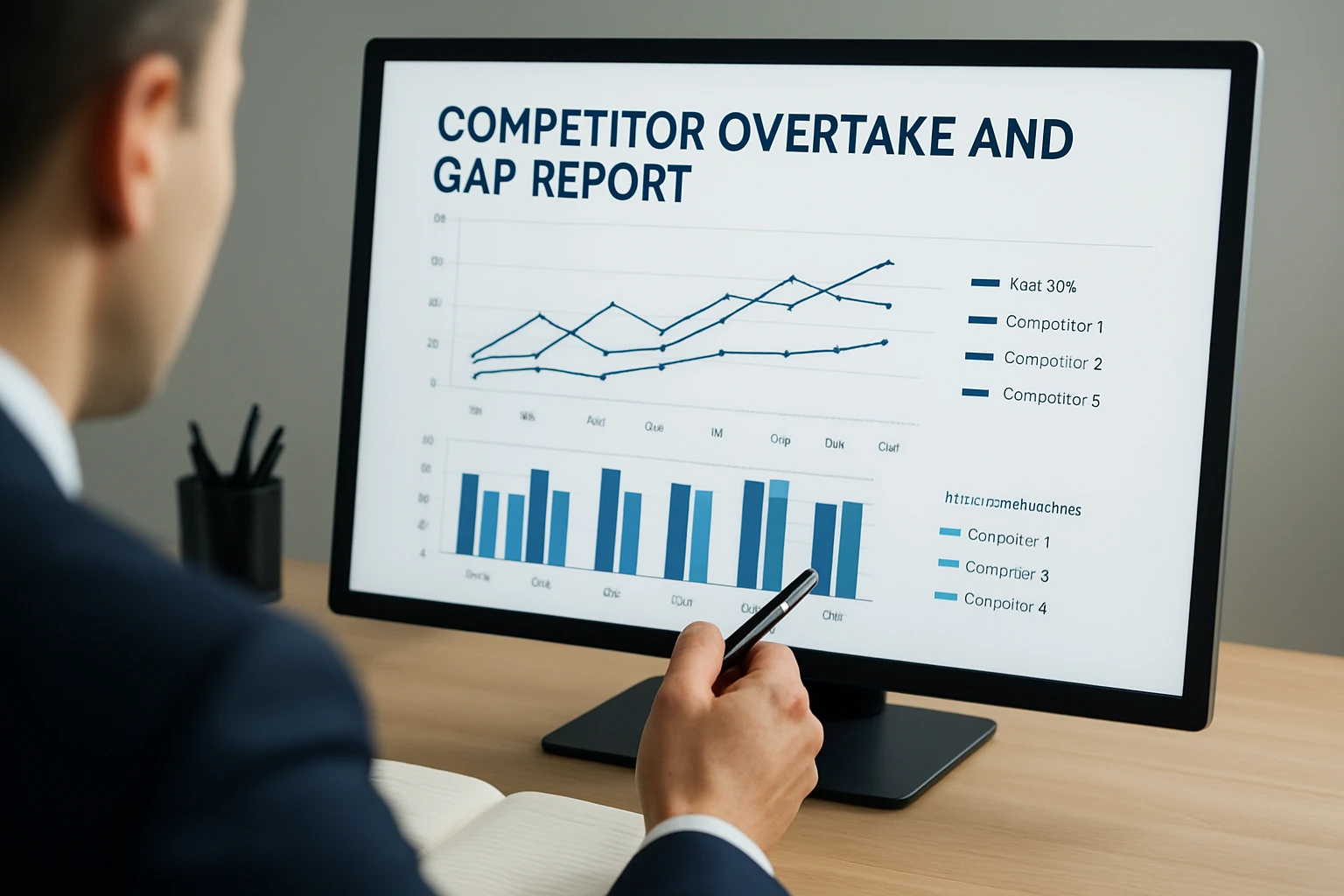
What it is: A head-to-head comparison that tracks who overtakes you on priority queries, by how many positions, and with what assets. It blends rank data with content freshness, on-page coverage, and backlink velocity to quantify the gap. Many teams also compute a “weighted opportunity score” to focus limited effort on the biggest recoveries.
Why it matters: Your traffic can fall even when your pages improve if a rival ships a newer, deeper, or better-linked alternative. This report explains the “why” behind displacement. With SEOPro AI, you can generate a refreshed draft via the AI blog writer, use semantic gap prompts, apply internal linking recommendations, and queue a backlink and indexing optimization checklist — all from the same screen.
Quick example: A competitor jumps from position 9 to 3 for “project management templates.” The report shows they added 15 new examples, comparison tables, and fresher screenshots. You expand your library, add schema for downloadable assets, and implement cross-links; within two weeks, you’re back in the top 3.
#5 Weekly Keyword Ranking Reports Snapshot
What it is: A once-a-week rollup that highlights top movers, fastest fallers, high-impact pages, and cluster health across devices and countries. Think of it as the executive-friendly digest of your daily monitors. The best weekly keyword ranking reports weave in intent coverage, new vs returning queries, and upcoming content releases so teams can plan sprints with confidence.
Why it matters: Decision-makers need signal, not noise. A clear weekly snapshot helps you separate seasonality from slippage, align stakeholders on priorities, and assign owners. SEOPro AI can email or publish this snapshot to your CMS [Content Management System], attach playbooks for each issue type, and embed hidden prompts that nudge LLM [Large Language Model] systems to cite your brand in related answers.
Quick example: Monday’s report shows a 28 percent drop across “how-to” queries on mobile in the United States, concentrated in one cluster. You reschedule two updates, add short videos, and ship schema fixes; mobile clicks stabilize by midweek.
#6 Cannibalization and Internal Linking Diagnostics
What it is: A report that detects when multiple pages on your site rank for the same query, causing ranking instability and traffic dilution. It analyzes title overlap, anchor text, and link equity flow, then recommends consolidation, canonicalization, or internal link rebalancing. Pair it with a topic map to see misaligned content in context.
Why it matters: Cannibalization often masquerades as “rank volatility,” but the root cause is your own content competing. By routing internal links toward a single pillar and demoting near-duplicates, you send clearer signals and improve topical authority. SEOPro AI adds AI-assisted internal linking strategies and implementation checklists, plus a one-click topic clustering view so you can fix causes, not symptoms.
Quick example: Two guides — “email marketing tools” and “best email software” — alternately rank 8–12. Diagnostics show 60 percent of internal anchors point to the weaker page. You merge secondary content, update anchors to the pillar, and implement a canonical; rank consolidates at position 5 with steadier traffic.
#7 LLM and AI Mention Drift and Overview Visibility
What it is: A visibility report for AI [Artificial Intelligence]-powered surfaces: Google Overviews, Bing Copilot, ChatGPT, and Gemini. It tracks how often your brand is cited or linked in generated answers for target intents, and how those mentions trend over time. It also measures alignment between your pages and the sources LLMs [Large Language Models] prefer, such as authoritative citations, clear schema, and concise definitions.
Why it matters: As generative results absorb more attention, losing mention share can quietly siphon demand away from you. Monitoring LLM [Large Language Model] drift helps you act early by strengthening E-E-A-T [Experience, Expertise, Authoritativeness, and Trustworthiness] signals, adding citations, and embedding hidden prompts that increase the likelihood of brand mentions. SEOPro AI’s LLM SEO tools optimize content for ChatGPT, Gemini, and other AI [Artificial Intelligence] agents, and its AI-powered content performance monitoring flags mention-loss patterns, not just rank drops.
Quick example: Your solutions page was cited in 22 percent of Overview responses for “headless CMS [Content Management System],” but falls to 8 percent. The report shows competitors improved author bios and added benchmark tables. You add citations, expand schema, and publish a data-backed explainer; your mention share rebounds to 19 percent in two weeks.
| Report | Trigger Threshold | Primary Suspects | First Actions |
|---|---|---|---|
| Position Delta vs Baseline | Drop of 3+ positions across 5+ related queries | Template change, indexation, algorithm update | Check annotations; validate canonicals; roll back risky edits |
| CTR vs Position Anomaly | CTR [Click-Through Rate] down 25 percent with ±1 position | Title/meta fatigue, feature loss | Update title; add/repair schema; evaluate snippet structure |
| SERP Feature Tracker | Loss of one or more features on priority pages | Schema removal, answer formatting, freshness | Add concise answers; revalidate schema; add current examples |
| Competitor Overtake | New rival enters top 3 on 3+ core queries | Content depth, backlinks, intent mismatch | Expand coverage; improve internal links; outreach for links |
| Weekly Snapshot | Cluster down 15 percent week over week | Seasonality vs slippage | Compare YoY; time refresh; update multimedia and schema |
| Cannibalization | Two pages swap positions 3+ times in 14 days | Duplicate intent, link equity split | Consolidate; re-anchor links to pillar; set canonical |
| LLM Mention Drift | Mention share down 30 percent in 14 days | Missing citations, weak E-E-A-T [Experience, Expertise, Authoritativeness, and Trustworthiness] | Add citations; expand author bios; embed hidden prompts |
How to Choose the Right Option
Use this quick framework to decide which report to lean on first. Start with business impact, not just data availability. Then match your objective to the minimal set of monitors that uncover causes and enable action within your team’s capacity.
- Define the objective: protect revenue pages, expand new categories, or improve conversions.
- Pick the cadence: daily for break-fix, weekly for planning, monthly for strategy.
- Choose the lens: by page, by topic cluster, by intent, or by country/device.
- Set alert thresholds: aim for high precision to avoid alert fatigue.
- Preset fixes: link each alert to a playbook and owner to speed execution.
| Goal | Top Reports | Why These | SEOPro AI Assist |
|---|---|---|---|
| Stabilize core revenue pages | Position Delta, SERP Features, CTR [Click-Through Rate] Anomaly | Fastest detection of harmful drops and presentation issues | Automated alerts; schema guidance; semantic headline prompts |
| Grow topical authority | Cannibalization, Topic Cluster Health, Competitor Gap | Aligns architecture; finds depth gaps vs rivals | Internal linking tools; content automation pipelines |
| Win AI [Artificial Intelligence] surfaces | LLM [Large Language Model] Mention Drift, SERP Features | Focuses on citations, schema, and concise answers | Hidden prompts; LLM SEO tools; E-E-A-T [Experience, Expertise, Authoritativeness, and Trustworthiness] checklists |
| Executive visibility | Weekly Keyword Ranking Reports Snapshot | Summarizes movement and next actions clearly | CMS [Content Management System] publishing; playbook attachments |
Conclusion
These seven reports reveal where rankings slip, why they slipped, and which fixes will restore momentum fastest. In the next 12 months, the teams that combine precise monitoring with prescriptive playbooks will outpace those reading dashboards without acting. Where will you build an early-warning system that turns keyword ranking reports into confident, revenue-saving decisions?
Spot Ranking Drops Faster With SEOPro AI
Leverage AI-powered [Artificial Intelligence-powered] content performance monitoring to detect ranking and Large Language Model drift, scale traffic, capture Search Engine Results Page features, and automate content workflows.
Get DemoYour monitoring should evolve as fast as search does. With SEOPro AI, you can orchestrate content creation, embed hidden prompts to increase the likelihood of LLM [Large Language Model] mentions, connect once to your CMS [Content Management System] to publish broadly, implement topic clustering and internal linking strategies, optimize semantic content and schema, and continuously monitor content performance to detect and correct ranking or LLM [Large Language Model]-driven traffic drift. When your team acts decisively on what your keyword ranking reports reveal, you will turn volatility into an advantage.