Top 10 LLM SEO Tools for 2026
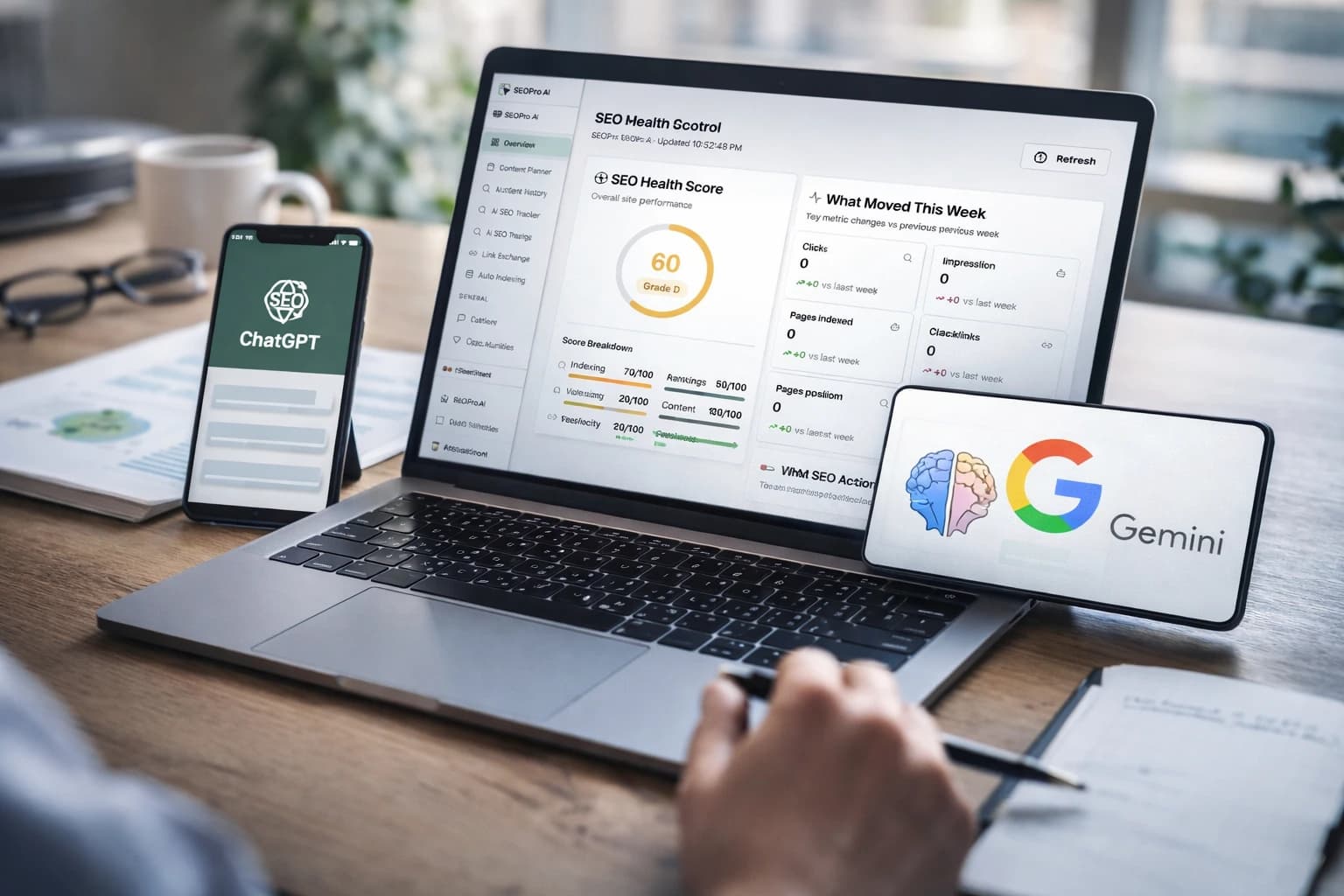
Monday, 9:07 a.m. The growth team opens the weekly dashboard and sees three very different stories: one brand cited in an AI answer, another stuck on page two of classic search, and a third missing from both. Nobody in the room needs a theory. They need a fix.
That is where llm seo tools earn their keep. In plain English, these are tools that help you research topics, shape pages, clean up site issues, publish faster, and track whether your brand shows up in AI-generated answers from systems like ChatGPT, Gemini, and search experiences that blend classic rankings with synthesized responses.
You are not looking for hype here. You are looking for software that helps a team ship better work with less manual busywork — especially if you need to grow organic traffic, win SERP features, and improve AI/LLM mentions across more than a handful of pages.
Who this roundup is for
SEO professionals and agencies managing multiple sites
Watch This Helpful Video
To help you better understand llm seo tools, we've included this informative video from Nicolai Nielsen. It provides valuable insights and visual demonstrations that complement the written content.
If you manage 5 client accounts or 50 site sections, your problem is rarely a lack of raw data. It is workflow drag. You need research you can reuse, audits you can prioritize, exports that fit a report, and recommendations your team can actually act on by Friday. The best-fit tools for agencies and in-house SEO leads tend to support repeatable systems, not one-off prompts pasted into a chat box.
Content, growth, and publisher teams shipping at high volume
If your team publishes 20, 50, or 200 pieces a month, every weak handoff multiplies. Bad briefs lead to slow drafts. Thin coverage creates rewrites. Missing entities or FAQs leave pages half-finished. Publishers, SaaS teams, and brand marketers usually need tools that can turn search intent into clear briefs, clean editing cues, and faster approvals without forcing senior editors to babysit every article.
What llm seo tools actually cover
The label is broader than it sounds. A serious llm SEO stack is not just an AI writer. It usually includes one or more of four jobs: keyword research, content optimization, technical auditing, and AI visibility tracking. That mix matters because classic search and AI answers now influence each other. You still need the fundamentals — crawl health, topical depth, internal linking, and solid on-page structure — even when the end goal is an LLM mention.
Selection criteria for ranking llm seo tools
Coverage: research, optimization, technical SEO, and AI visibility
A useful tool should do more than draft text. It should support a real SEO job: discover demand, improve a page, diagnose technical issues, or monitor brand visibility in AI answers. The strongest tools in this list are not identical. Some go deep on research. Others are sharp on on-page optimization. A newer group focuses on whether your brand appears in AI-generated discovery surfaces at all.
Workflow fit: speed, collaboration, and exportability
Feature depth is only half the story. Teams buy software to remove friction. So I weighted tools that help you move from insight to action quickly — cleaner briefs, easier exports, better collaboration, and reporting that works in an agency deck or an internal QBR. For many teams, that matters just as much as having one more chart or metric tucked inside a menu.
Trust signals: data sources, transparency, and reporting
When a tool gives a recommendation, you need some idea of where it came from. That is especially true in newer AI visibility categories, where dashboards can look polished while the underlying sampling stays fuzzy. I favored tools with clear use cases, transparent outputs, and reporting that helps you explain a decision to a writer, a client, or a VP of Growth.
If a tool only writes copy and cannot show how it supports SEO decisions, it is not enough for this category.
Here is the quick scan before we go tool by tool.
| Tool | Primary job | Best for |
|---|---|---|
| Semrush | Research, auditing, competitive analysis | Teams wanting one broad SEO workspace |
| Ahrefs | Backlink and keyword intelligence | Competitive researchers and link-focused teams |
| MarketMuse | Topical planning and content inventory | Large libraries and authority-building programs |
| Surfer SEO | On-page optimization | Writers and editors working inside content drafts |
| Clearscope | Content scoring and term coverage | Editorial teams that want clean guidance |
| Frase | Brief creation and question-led outlines | Fast-moving content teams |
| Screaming Frog | Technical crawling and audits | Site owners with real technical debt |
| AlsoAsked | Question discovery and clustering | Teams turning search questions into content maps |
| Otterly.AI | AI search visibility monitoring | Brands tracking mentions in AI answers |
| Profound | AI answer visibility tracking | Teams needing stakeholder-ready AI visibility reporting |
#1-#3: Research and content planning tools
Semrush — best all-in-one SEO suite

Semrush is still the broadest generalist in this group. It is widely known for keyword research, site audits, rank tracking, and competitive analysis, which makes it useful when you want one shared operating system instead of a patchwork. For in-house teams, that can simplify handoffs. For agencies, it can reduce context switching across accounts.
- Best for: teams that want one main platform for research, auditing, and reporting.
- Why it stands out: it covers several core SEO jobs in one place without forcing you into a research-only workflow.
- Watch-out: the breadth is real, but you still need a clear process or the tool turns into a giant tab farm.
Ahrefs — best for backlink and keyword intelligence
Ahrefs remains a strong pick when competitive research starts with links, authority signals, and keyword gaps. It is widely known for backlink analysis and keyword discovery, and that pairing makes it especially useful when you are trying to understand why a competitor keeps outranking you. When I need to pressure-test a topic against the existing field, Ahrefs is often where I start.
- Best for: SEO teams that care deeply about backlink profiles, competitor gaps, and keyword opportunities.
- Why it stands out: it is sharp on the “why are they winning?” question.
- Watch-out: if your real bottleneck is writing workflow, you will still need another layer after research.
MarketMuse — best for topical authority planning
MarketMuse sits in a different lane. It is commonly used for content inventory, topical gap analysis, and planning around subject coverage, which makes it particularly useful for larger sites with uneven depth. If your library has 800 posts and half of them overlap while the other half miss obvious subtopics, this is the kind of tool that helps you see the map instead of just the next keyword.
- Best for: publishers, SaaS content teams, and brands building authority across broad topic sets.
- Why it stands out: it helps you plan coverage, not just chase isolated terms.
- Watch-out: it is most valuable when you already have enough content volume to justify strategic pruning and expansion.
For research tools, breadth matters only if the team can turn data into a publishable plan quickly.
#4-#6: On-page optimization and answer-led briefs
Surfer SEO — best for on-page optimization
Surfer SEO is best known for its content editor and SERP-informed on-page guidance. That makes it a practical choice for teams who want writers working inside a tool that suggests headings, terms, structure, and coverage while the draft is still taking shape. It can be especially helpful when you need consistency across multiple writers or freelance contributors.
- Best for: content teams that want direct optimization guidance during drafting.
- Why it stands out: it turns ranking-page patterns into concrete editorial prompts.
- Watch-out: do not let the score become the assignment. A readable page still beats a robotic one.
Clearscope — best for content scoring and term coverage
Clearscope has long been valued for content grading and helping teams cover relevant terms and entities without drowning the writer in noise. In practice, it often feels cleaner than heavier optimization setups. Editors tend to like that. When you are trying to improve consistency across a team, a calmer interface and clearer recommendations can matter more than having every possible metric.
- Best for: editorial-led organizations that want straightforward content scoring.
- Why it stands out: it gives writers a tight lane — what to cover, what is missing, what needs better depth.
- Watch-out: like any scoring tool, it still needs human judgment to avoid stiff, over-optimized copy.
Frase — best for briefs and question-led outlines
Frase is commonly used to build briefs and surface the questions searchers are asking. That makes it especially handy when your team needs to go from topic idea to usable outline fast. It is not just about speed, either. Question-led structures often map well to answer-driven search behavior, which matters when AI systems and search engines both reward clear, direct page structure.
- Best for: lean content teams that need fast briefs and useful first-pass outlines.
- Why it stands out: it helps you turn search questions into sections a writer can actually build from.
- Watch-out: without a strong editor, you can still end up with generic FAQ-shaped content.
The best optimization tool does not just score a page; it tells the writer what to add, cut, or clarify.
#7-#8: Technical SEO and question discovery
Screaming Frog — best for crawling and technical audits

Screaming Frog is a staple for a reason. It is a widely used website crawler for finding technical SEO issues at scale — broken links, redirect chains, indexability problems, duplicate metadata, canonicals, and a long list of issues that quietly suppress performance. If your site is large, messy, or recently migrated, this is not optional kit. It is how you find out what is actually wrong.
- Best for: technical SEOs, site owners, and agencies cleaning up large or complex websites.
- Why it stands out: it gives you a crawl-based view of the site rather than a guess based on a few pages.
- Watch-out: beginners can get lost quickly unless they already know what signals matter.
AlsoAsked — best for question clustering
AlsoAsked is known for surfacing question relationships based on search behavior and People Also Ask-style patterns. That makes it useful when you want to build article outlines, FAQ sections, or topic clusters around the way users actually phrase follow-up questions. It is one of those tools that can open up a content plan in 10 minutes when a keyword list feels flat and abstract.
- Best for: teams expanding content around audience questions and intent paths.
- Why it stands out: it visualizes the “what else would someone ask next?” layer that keyword spreadsheets often miss.
- Watch-out: it complements research; it does not replace full demand analysis or technical hygiene.
Why these two jobs work better together
Technical cleanup and question discovery solve different problems, and strong teams handle both before publishing more content. One fixes the site you already have. The other tells you what the next page should answer. Ignore the first and your new pages may never perform. Ignore the second and you publish clean pages nobody asked for. On a 10,000-page publisher site, that difference is expensive.
Technical cleanup and question discovery are separate jobs; the best teams do both before they publish more content.
#9-#10: AI visibility and monitoring
Otterly.AI — best for AI search monitoring
Otterly.AI is associated with monitoring brand visibility in AI search and answer experiences. That puts it in a newer category, but an increasingly relevant one. If your leadership team now asks, “Are we showing up in AI answers?” a conventional rank tracker will not fully answer that. Tools like this aim to show whether your brand appears, how often, and in what kinds of AI-driven discovery moments.
- Best for: brands that need a readable view of AI-search mention visibility.
- Why it stands out: it focuses on the emerging reporting gap between classic rankings and AI answer presence.
- Watch-out: this category changes fast, so data coverage and methodology deserve a close look.
Profound — best for AI answer visibility tracking
Profound is positioned around tracking how brands appear in AI-generated responses and related discovery surfaces. Compared with older SEO tooling, that is a very different job. You are not just measuring rankings. You are measuring inclusion, framing, and presence in answers that may vary by prompt, source set, and model behavior. For teams under real pressure to report on AI visibility, that can be valuable.
- Best for: larger teams that need stakeholder-friendly reporting on AI answer exposure.
- Why it stands out: it speaks directly to the new “are we cited at all?” question.
- Watch-out: visibility data tells you what happened; it does not always explain causation.
What this category can and cannot prove
Be a little skeptical here. AI visibility tools are useful, but they are still monitors, not magic. They can help you see whether brand mentions are rising or falling across answer surfaces. They cannot guarantee that one content change caused a specific mention, because answer generation shifts with prompts, freshness, retrieval behavior, and model updates. Use them as directional instruments — not as a shortcut around good SEO.
If your stakeholders care about AI mentions, you need monitoring before you need more content.
How to choose the right option
Pick one core research tool first
Most teams do better with a stack than with a single all-purpose tool, but that stack should start with one research engine. If your pain is breadth and reporting, Semrush is a sensible center. If competitive gaps and backlinks drive most decisions, Ahrefs often fits better. If your site already has depth and the real issue is uneven topical coverage, MarketMuse can be the smarter first purchase.
Add one optimization layer for publishing
Once research is in place, add the tool that removes friction from publishing. Surfer SEO fits teams that want active on-page guidance inside drafts. Clearscope suits editorial organizations that want clean scoring and term coverage. Frase works well when speed-to-brief is the main blocker. Agencies and publishers usually need stronger collaboration habits and clearer exports here than solo marketers do, because multiple hands touch every page.
Decide whether you also need AI visibility monitoring
This is where hype can burn budget. Add an AI visibility monitor if you already have stakeholders asking about brand mentions in ChatGPT, Gemini, or similar experiences — or if you are seeing divergence between classic search performance and AI answer presence. If not, fix research, writing, and technical cleanup first. Screaming Frog and AlsoAsked often create more immediate gains than a shiny monitoring dashboard when the basics are still loose.
Buy for the workflow bottleneck you have now, not the one that sounds impressive in a demo.
| Main bottleneck | Start with | Add next | Hold off on |
|---|---|---|---|
| You cannot find or prioritize topics well | Semrush or Ahrefs | Frase or Clearscope | AI visibility monitoring |
| You publish slowly and briefs are weak | Frase or Surfer SEO | Semrush or Ahrefs | Extra niche tools |
| Your site has technical debt | Screaming Frog | Semrush or Ahrefs | Another optimization scorecard |
| You need better topic depth across a large library | MarketMuse | Clearscope or Surfer SEO | Question-only tooling as a primary system |
| Leadership asks about AI mentions every week | Otterly.AI or Profound | Your core research platform | Buying a second monitoring tool too early |
The pattern is usually simple. Start with the tool that fixes the biggest bottleneck. Then add the layer that makes the next step faster. A tight three-tool stack often beats a seven-tool pile nobody fully uses.
The smartest 2026 setup is usually small: one research engine, one optimization layer, and one monitor that shows whether AI visibility is actually moving.
That mix keeps your llm seo tools stack practical instead of theatrical. You get cleaner decisions, faster publishing, and a clearer read on whether classic rankings and AI answers are moving together or drifting apart.
When you open your next dashboard, which bottleneck is really costing you ground — research, writing, technical cleanup, or AI visibility?
Grow AI Search With SEOPro AI
Automate creation, clustering, schema, publishing, and drift checks for ChatGPT, Gemini, and other AI agents while expanding mentions, SERP features, and organic traffic.
See Platform