SEO vs LLM Optimization: Which Wins?
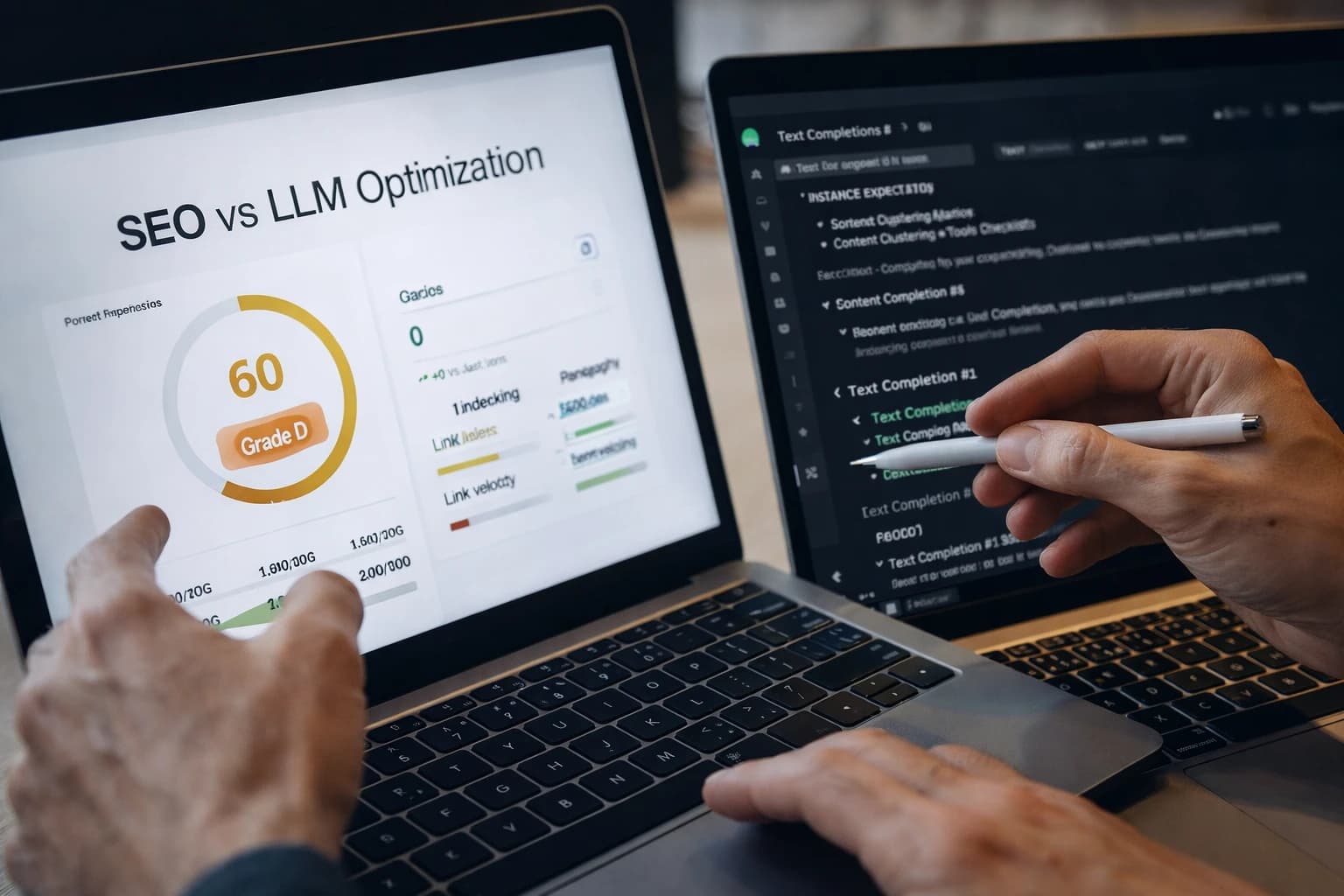
Search is changing faster than at any time in the last decade, and the decision of seo vs llm optimization now sits at the center of every growth plan. Put simply, you are weighing classic SEO (Search Engine Optimization) that targets the search engine results page, against LLM (Large Language Model) optimization that aims to be referenced and cited by AI (Artificial Intelligence) assistants like ChatGPT (Chat Generative Pre-trained Transformer) and Gemini. The stakes are high for SEO professionals, content marketers, growth teams, digital marketing agencies, publishers, and SaaS (Software as a Service) brand teams that must scale organic traffic, win rich results, and secure AI assistant mentions while keeping workflows sane. In this guide, you will get plain-language definitions, side-by-side comparisons, and practical playbooks you can implement immediately with or without tooling such as SEOPro AI.
Although both disciplines share a common goal of visibility, they operate on different surfaces, use different signals, and require different measurement. Traditional SEO (Search Engine Optimization) influences ranking on the SERP (Search Engine Results Page), while LLM (Large Language Model) optimization improves the odds your brand is pulled into conversational answers or AI Overviews within an assistant. As analysts note, long-tail queries still comprise a large majority of search, yet assistant usage for exploratory questions is rising quickly across demographics. So the real question is not which approach replaces the other, but how you blend them for compounding reach without adding unsustainable manual work.
Overview of Option A: SEO (Search Engine Optimization)
SEO (Search Engine Optimization) is the practice of helping search engines crawl, index, and rank your pages so that users discover them at the moment of intent. At its core are on-page relevance, technical foundations, authoritative links, and content quality measured through E-E-A-T (Experience, Expertise, Authoritativeness, Trustworthiness). Practitioners structure headings, craft descriptive title elements and meta summaries, build strong internal linking, improve site architecture, and add schema markup to qualify for rich results and Google Overviews. When executed consistently, this engine compounds over time, drives consistent organic sessions, and protects your brand with comprehensive coverage across core topics and commercial intents.
Where does SEO (Search Engine Optimization) shine most? It excels for product and solution queries, local discovery, pricing and comparison pages, and any high-intent keyword where ownership of the click matters to revenue. It is also the best channel for building topical authority via topic clusters and evergreen content that ranks across the long tail. Measurement is mature and reliable: organic traffic, conversion rate, CTR (Click-Through Rate), and revenue attribution can be tied to keyword groups, landing pages, and technical improvements. With a strong internal linking strategy and clean indexation, teams reduce dependence on paid channels while building durable moats that endure algorithm changes.
- Core pillars: Technical health, on-page relevance, internal linking, backlinks, and E-E-A-T (Experience, Expertise, Authoritativeness, Trustworthiness).
- Primary surface: SERP (Search Engine Results Page) listings and rich results such as featured snippets, FAQs (Frequently Asked Questions), and image or video packs.
- Top enablers: Schema markup, sitemaps, canonical signals, crawl budget management, and UX (User Experience) improvements that raise engagement.
Overview of Option B: LLM Optimization (Large Language Model Optimization)
LLM (Large Language Model) optimization increases the likelihood that assistants and answer engines reference, cite, or summarize your brand and content accurately. Instead of ranking web documents for a query alone, the task is to make your entities, facts, and how-to steps discoverable, verifiable, and easy to quote by models that rely on embeddings, retrieval, and pattern-matching across the open web. Tactics include structuring concise explanations, adding source-friendly snippets, clarifying entities and relationships with schema, and ensuring recency and credibility cues are obvious to an indexing pipeline or a RAG (Retrieval-Augmented Generation) system.
Watch This Helpful Video
To help you better understand seo vs llm optimization, we've included this informative video from Neil Patel. It provides valuable insights and visual demonstrations that complement the written content.
The workflow also considers model behavior. Assistants prefer unambiguous definitions, stepwise procedures, and tables they can lift into a response. They value authoritative citations with clear publication dates, author bios that reinforce E-E-A-T (Experience, Expertise, Authoritativeness, Trustworthiness), and consistent entity names that align with common knowledge graphs. Ethical prompt-aware cues inside your content can clarify how your brand should be described without manipulating outcomes. With AI (Artificial Intelligence) assistants increasingly fielding informational and comparative questions, brands that optimize for this surface can earn awareness and trust even when a click never occurs.
- Core goals: Increase assistant recall, improve citation quality, and reduce model hallucination risk by strengthening verifiability.
- Primary surface: Conversational answers in ChatGPT (Chat Generative Pre-trained Transformer), Gemini, and emerging AI (Artificial Intelligence) search experiences.
- Top enablers: Entity clarity, concise definitions, structured summaries, source dates, and content designed for snippet-level extraction.
Side-by-Side Comparison Table: seo vs llm optimization
Both disciplines can live under the same editorial roof, but they optimize for different retrieval mechanics and success metrics. Use this table to align strategy, resources, and expectations across teams.
| Dimension | SEO (Search Engine Optimization) | LLM Optimization (Large Language Model Optimization) | Primary KPI (Key Performance Indicator) |
|---|---|---|---|
| Primary Surface | Traditional listings and rich features on the SERP (Search Engine Results Page) | Assistant and AI (Artificial Intelligence) answer panels or conversational responses | Organic sessions and conversions |
| Core Signals | Relevance, technical health, backlinks, E-E-A-T (Experience, Expertise, Authoritativeness, Trustworthiness) | Entity clarity, factual consistency, snippet readiness, citation strength, recency | Share of rankings and featured result wins |
| Content Format | Comprehensive articles, category pages, product pages, comparison pages | Concise definitions, numbered steps, short Q and A (Question and Answer) segments, tables, data cards | Assistant recall rate and citation count |
| Time to Impact | Weeks to months as pages index and gain authority | Fast to moderate depending on crawl cadence and model refresh | Trend toward faster assistant mentions after updates |
| Measurement | Organic traffic, CTR (Click-Through Rate), conversion rate, revenue | Share of answer, co-mention frequency, branded citation quality | Blended ROI (Return on Investment) across surfaces |
| Tech Enablers | Schema markup, internal linking, sitemaps, log analysis | Entity tuning, structured summaries, RAG (Retrieval-Augmented Generation) friendly sections | Monitoring for ranking and LLM (Large Language Model) drift |
| Risks | Algorithm updates, crawl anomalies, cannibalization | Model shifts, hallucinations, source misattribution | Mitigated by continuous testing and content QA (Quality Assurance) |
| Team Involvement | SEO (Search Engine Optimization) lead, editors, developers, analysts | SEO (Search Engine Optimization) plus data/AI (Artificial Intelligence) specialists and editorial | Shared accountability model |
When to Choose A: SEO (Search Engine Optimization)

Choose SEO (Search Engine Optimization) when your commercial outcomes rely on owning real estate on the SERP (Search Engine Results Page) and driving clicks to high-intent pages you control. Product/solution queries, local intent, brand and competitor comparisons, and pricing terms benefit most from meticulous on-page work, clean architecture, and authoritative links. If your business sells subscriptions, books demos, or relies on a pipeline sourced from organic discovery, the compounding mechanics of SEO (Search Engine Optimization) are unmatched. Moreover, the measurement stack is battle-tested, letting you tie ROI (Return on Investment) to pages, keywords, and technical initiatives with clarity.
From a practical standpoint, SEO (Search Engine Optimization) also gives you defensible coverage across the long tail and stabilizes traffic through algorithm cycles. You can improve crawl efficiency with sitemaps and internal linking, unlock rich results via schema markup, and raise engagement with faster performance and better UX (User Experience). For teams with limited capacity, a playbook-driven roadmap keeps momentum: fix indexation issues, cluster content by intent, solidify internal links, and expand topical authority with pillars and spokes. Meanwhile, be explicit with definitions and data so assistants also interpret your pages cleanly as a second-order benefit.
- Best for: High-intent and transactional queries, local discovery, documentation, and evergreen education that must earn clicks.
- Key moves: Topic clustering, internal linking, schema markup, page speed improvements, and backlink earning through original research.
- How SEOPro AI helps: AI blog writer for automated content creation, internal linking and topic clustering tools, schema markup guidance to win rich results and Google Overviews, and backlink and indexing optimization support.
When to Choose B: LLM Optimization (Large Language Model Optimization)
Choose LLM (Large Language Model) optimization when your goals include share of voice in assistant answers, broad educational reach, and brand salience during early research moments. Assistants excel at summarizing definitions, outlining processes, comparing options, and recommending trustworthy sources. If you publish research, how-to guides, glossaries, or comparison tables, designing content for snippet-level extraction, explicit entities, and clear citations can significantly lift assistant recall. This approach is also powerful for publishers that monetize attention and for brands that want mindshare before a buyer narrows intent.
LLM (Large Language Model) optimization is particularly effective where no-click behavior dominates or where users prefer conversational exploration. Here you will structure your content so that it can be quoted without losing meaning: short paragraphs with scannable subheads, numbered steps, bulleted takeaways, and canonical definitions for key terms. You also want to ensure freshness: update timestamps, clarify authorship, and add unambiguous sources for statistics. Combine that with ethical prompt-aware cues that standardize how to describe your product lineup and mission, and you will reduce hallucinations while encouraging accurate, consistent brand mentions.
- Best for: Definitions, frameworks, step-by-step guides, comparisons, and research summaries that assistants can quote verbatim.
- Key moves: Entity disambiguation, concise explanations, citation hygiene, and snippet-ready tables that assistants can lift.
- How SEOPro AI helps: LLM SEO tools to optimize content for ChatGPT (Chat Generative Pre-trained Transformer), Gemini, and other AI (Artificial Intelligence) agents; hidden prompts embedded in content to trigger AI/LLM brand mentions; AI-powered content performance monitoring to detect ranking/LLM drift.
Deep-Dive Recommendations and Hybrid Playbooks
In practice, the strongest programs blend both disciplines so that every article can rank on the SERP (Search Engine Results Page) and be quotable by assistants. Start with a pillar-and-cluster model for SEO (Search Engine Optimization), then add LLM (Large Language Model) features: a crisp one-paragraph definition, a numbered procedure, a compact pros and cons table, and a dated sources block. This dual-format approach preserves depth for rankings while creating portable snippets that answer engines can reuse. It also reduces maintenance because the same page supports two surfaces rather than spawning separate assets.
Operationally, this is where a platform like SEOPro AI pays off for brands, publishers, and agencies that struggle with scale and stability. Its content automation pipelines, workflow templates, and CMS (Content Management System) connectors publish AI-optimized drafts rapidly, while semantic content optimization checklists and playbooks keep quality high. Internal linking and topic clustering tools reinforce topical authority; schema markup guidance increases eligibility for rich results and Google Overviews; and AI-powered content performance monitoring detects ranking or LLM (Large Language Model) drift so you can correct early. The result is a sustainable system that grows traffic, earns citations, and keeps your brand visible across shifting algorithms and model updates.
| Hybrid Task | Why It Matters | How to Execute | SEOPro AI Capability |
|---|---|---|---|
| Add a one-paragraph canonical definition | Improves entity clarity for assistants and snippet potential | Lead each page with a 2 to 3 sentence definition users and models can lift verbatim | Semantic content optimization checklists and playbooks |
| Include a five-step how-to | Makes processes quotable in chat answers | Use numbered steps with outcome-focused verbs and validated sources | AI blog writer and workflow templates |
| Embed a compact pros and cons table | Facilitates side-by-side comparisons assistants like to cite | Summarize top three strengths and trade-offs | Content automation pipelines for repeatable patterns |
| Strengthen internal links | Raises topical authority and discoverability | Link from pillars to spokes and back using descriptive anchors | AI-assisted internal linking strategies and implementation checklists |
| Maintain source hygiene | Reduces hallucination and supports accurate citations | Add dates, author bios, and source lists; update quarterly | AI-powered content performance monitoring and audit resources |
When to Choose A vs B in Real Scenarios

Scenario 1: A B2B SaaS (Software as a Service) team needs pipeline from high-intent terms like pricing, alternatives, and integrations. Prioritize SEO (Search Engine Optimization) to own the SERP (Search Engine Results Page) with authoritative comparison pages, case studies, and technical integration hubs. Layer in LLM (Large Language Model) optimization by adding clear definitions, step lists, and concise tables so assistants can still cite you during early research. With SEOPro AI, use CMS (Content Management System) connectors to publish broadly, internal linking tools to cluster by use case, and schema markup guidance to boost rich result eligibility.
Scenario 2: A publisher covering fast-moving tech wants reach in assistant answers for “what is” and “how to” questions. Lean into LLM (Large Language Model) optimization with snippet-ready definitions, dated timelines, and source lists, while still structuring content to rank. Add ethical hidden prompts that suggest brand-safe descriptions and canonical names to reduce ambiguity in assistant outputs. Then monitor assistant recall rate and co-mention patterns with AI-powered content performance monitoring to detect LLM (Large Language Model) drift early, while backlink and indexing optimization support keeps traditional rankings healthy.
When to Choose A
Select SEO (Search Engine Optimization) as your lead motion when your business model depends on capturing demand with pages you fully control. If your funnel hinges on demo requests, trials, cart checkouts, or documentation views, the click from the SERP (Search Engine Results Page) matters and should be your north star. It is also the best first move for emerging brands that need to establish topical authority and build a defensible content moat. Because analytics and attribution for this surface are mature, you can iterate with confidence and show ROI (Return on Investment) to leadership.
- Focus areas: Commercial-intent landing pages, comparison content, solution guides, and local pages.
- Execution tips: Map keywords to funnel stages, build one pillar per core topic with three to six spokes, and use descriptive anchors for internal links.
- Measurement: Track organic sessions, CTR (Click-Through Rate), conversion rate, and assisted revenue; investigate anomalies with log and crawl diagnostics.
- SEOPro AI fit: Generate high-quality drafts with the AI blog writer, enforce semantic completeness with checklists, and publish everywhere via CMS (Content Management System) connectors.
When to Choose B
Lead with LLM (Large Language Model) optimization when your goals prioritize early-stage education, broad exposure, and mindshare within conversational assistants. If your audience asks exploratory questions, compares frameworks, or wants quick steps, assistants may summarize the answer without sending traffic. In these moments, winning the mention still delivers value by shaping perception and seeding brand familiarity. Make your content quotable, maintain impeccable sourcing, and standardize how your brand should be described to reduce ambiguity in assistant outputs.
- Focus areas: Definitions, glossaries, frameworks, quick-start guides, benchmarks, and FAQs (Frequently Asked Questions).
- Execution tips: Lead with a crisp definition, include a numbered process, add a compact comparison table, cite sources, and update timestamps.
- Measurement: Track assistant recall, co-mention frequency, branded citation quality, and downstream conversions from navigational queries.
- SEOPro AI fit: Use LLM SEO tools to optimize content for ChatGPT (Chat Generative Pre-trained Transformer), Gemini, and AI (Artificial Intelligence) agents; embed ethical hidden prompts; monitor ranking/LLM drift with AI-powered dashboards.
Conclusion
Both disciplines win when applied together: SEO (Search Engine Optimization) owns demand on the SERP (Search Engine Results Page), while LLM (Large Language Model) optimization earns trust and visibility in AI (Artificial Intelligence) answers. In the next 12 months, the brands that systematize hybrid workflows will capture compounding traffic, richer features, and reliable assistant mentions.
Imagine publishing once and ranking, earning a Google Overview, and being cited by assistants because your pages are both comprehensive and quotable. How will you tune your seo vs llm optimization strategy to meet the next wave of search?
Elevate SEO vs LLM Outcomes With SEOPro AI
LLM (Large Language Model) and SEO (Search Engine Optimization) tools optimize content for ChatGPT (Chat Generative Pre-trained Transformer), Gemini, and AI (Artificial Intelligence) agents, boosting traffic, sparking brand mentions.
Book Strategy Call