Complete Guide to Semantic Content Optimization Checklist
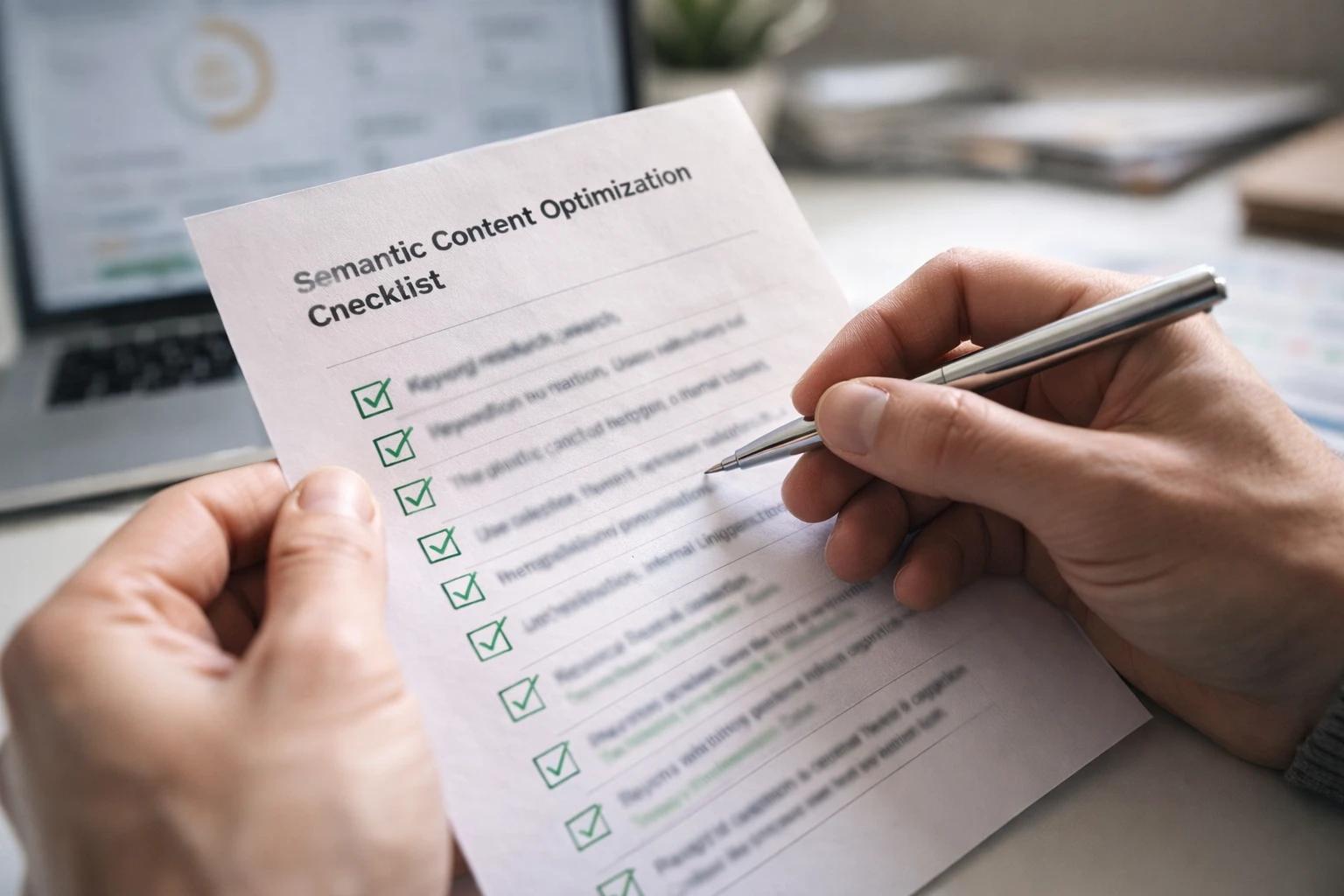
At 8:17 a.m., you open a draft, scan the title, H1, section heads, named entities, and internal links in one pass, and you can feel the answer almost immediately. Either the page covers the topic from multiple angles, or it just repeats the same phrase with better formatting.
That is why a semantic content optimization checklist matters. You are not checking whether a keyword appears 17 times. You are checking whether the page matches one primary intent, includes the right entities and supporting questions, and gives search engines and AI systems enough structure to understand the topic without guessing.
This matters more now because your audience can discover content through Google, AI Overviews, ChatGPT, Gemini, Perplexity, and Copilot long before they click a blue link. A page that is semantically complete has a better shot at ranking, getting cited, and staying useful when machines summarize it.
Fundamentals of a Semantic Content Optimization Checklist
Semantic SEO vs. traditional keyword optimization
Traditional keyword optimization starts with a phrase and asks, “How often should this appear?” Semantic optimization starts with intent and asks, “What does a complete answer need?” That is a different job.
When you work semantically, you map a page to one primary intent plus supporting entities and questions. That is common SEO knowledge, and it is the most practical mental model I know. If the page targets “semantic content optimization checklist,” you also need concepts such as search intent, topic clusters, internal links, headings, schema, and content coverage. If those pieces are missing, the page may be readable but still incomplete.
| Dimension | Traditional keyword model | Semantic model |
|---|---|---|
| Primary focus | Exact phrase targeting | User intent and topical coverage |
| Research inputs | Keyword variants | Entities, questions, SERP patterns, related pages |
| Page structure | Repeat term across elements | Organize content around subtopics and relationships |
| Success signal | Phrase match relevance | Coverage, clarity, and machine-readable meaning |
What belongs on a semantic content optimization checklist
A good checklist is not vague. You should be able to check each item without arguing over interpretation. In practice, most strong pages need the same core elements:
- One clear primary intent
- A defined audience and task
- Core entities, terms, and expected subtopics
- Headings that reflect the actual information architecture
- Examples, comparisons, or explanations that complete the task
- Internal links to supporting cluster pages
- Schema that matches the content type where relevant
- A refresh note for what may go stale first
If that sounds more like editorial planning than old-school on-page SEO, good. It is. The strongest semantic work happens before the draft is written.
Why it matters for organic traffic and AI/LLM visibility
The thin evidence we have from the current SERP still points in a useful direction. The Humanswith.AI article by Gregory Shevchenko — originally published on May 27, 2025 and updated on August 5, 2025 — frames SEO fundamentals as a bridge between quality content and search engine recognition. That framing is exactly right for semantic optimization: content quality alone is not enough if machines cannot recognize what the page fully covers.
The same excerpted page presents itself as cited across ChatGPT, Gemini, Google AIO, Google AI Mode, Perplexity, and Copilot. Whether you take that as proof or positioning, the lesson stands: visibility now depends on being understandable to both ranking systems and answer systems.
Optimize for a topic cluster, not a single phrase.
How Semantic Content Optimization Works
How search engines read entities and relationships
Search engines do not read your page like a teacher grading an essay. They infer meaning from terms, entities, relationships, structure, and context. “Apple” can mean a company or a fruit. “Java” can mean an island, a language, or coffee. Machines resolve that ambiguity by looking at surrounding signals.
If your page mentions crawl budget, XML sitemaps, canonical tags, and robots.txt, the engine has far more confidence that the topic is technical SEO than general marketing. The same rule applies to every topic cluster you publish. Entities are not stuffing material — they are disambiguation material.
How headings, schema, and internal links reinforce meaning
Clear headings tell a machine what each section is about before it processes every sentence. Schema can confirm content type and key attributes. Internal links show how this page relates to others in your site architecture. Together, they reduce uncertainty.
That is why common knowledge best practice still holds: clear headings, schema, and internal links help machines resolve topical context. If you publish a buying guide with vague H2s like “What You Need to Know” and “Final Thoughts,” you make the job harder. If you publish “Pricing Models,” “Implementation Timeline,” and “Security Requirements,” you make meaning explicit.
| Signal | What it reinforces | Common failure |
|---|---|---|
| Headings | Section-level topic clarity | Clever but vague labels |
| Schema | Content type and structured details | Markup that does not match page content |
| Internal links | Cluster relationships and depth | Random links added only for crawl paths |
Why AI overviews and LLMs reward clear topical signals
AI systems compress. They summarize. They synthesize across sources. That means pages with clear topical signals have an advantage because the system can more safely extract and restate the information.
The Humanswith.AI excerpt again offers a useful phrase: SEO fundamentals bridge the gap between quality content and search engine recognition. Extend that to AEO and GEO, and the implication is obvious. Your page needs substance, yes, but it also needs explicit structure that lets models identify claims, sections, definitions, and supporting relationships quickly.
If the page only makes sense to humans after a full read, it is probably under-signaled for machines.
The Checklist: Page-Level Best Practices
Search intent and topic coverage
Start with one question: what job is this page supposed to do? Informational? Comparative? Transactional? Diagnostic? You should know before writing the introduction.
For a practical semantic content optimization checklist, I like these pre-publish intent checks:
- Can you state the primary intent in one sentence?
- Does the opening paragraph confirm that intent?
- Do the main headings cover the obvious follow-up questions?
- Would a reader complete the task without opening five more tabs?
If you cannot answer yes to all four, the page is not ready. Coverage is not about length. It is about finishing the job the query implies.
Entities, terms, and subtopics to include
Include semantically related subtopics only where they help complete the reader’s task. That part matters. You are not sprinkling related phrases because a tool suggested them. You are building a complete answer.
Take this page as an example. A useful version has to cover intent, entities, headings, schema, internal links, topic clusters, editorial QA, and common failure modes. If it only repeated “semantic content optimization checklist” in every header, it would be optimized on paper and weak in practice.
A simple way to build your entity list is to review the top results, note recurring nouns and concepts, then separate them into three buckets: essential, helpful, and optional. Essential items must appear. Helpful items appear where relevant. Optional items stay out unless the draft genuinely needs them.
On-page structure: titles, headers, media, and internal links
Common knowledge still wins here: the title tag, H1, and opening paragraph should all reinforce the same primary topic. Your H2s should divide the task logically. Your media should explain, not decorate. Your internal links should point to related pages that expand the topic cluster.
When we review pages, we also check whether every internal link has a semantic reason to exist. Linking “pricing page” from a definition section just because it is important to the business is sloppy. Linking to a deeper guide on schema markup from a section on structured data is useful. Readers feel the difference.
A checklist item is only useful if it can be checked without interpretation.
| Checklist item | Pass condition | Fail pattern |
|---|---|---|
| Title tag, H1, intro | All reinforce the same primary topic | Each frames a different angle |
| Primary intent | Obvious in the first screen | Reader must infer purpose |
| Core entities | Expected terms and concepts appear naturally | Target phrase repeated without related concepts |
| Subtopic coverage | Main follow-up questions are answered | Thin sections padded with repetition |
| Headings | Specific, parallel, descriptive | Generic or clicky section labels |
| Examples | At least one concrete example clarifies the advice | Abstract guidance only |
| Internal links | Related pages expand the cluster | Random links added for volume |
| Schema | Matches the page type and visible content | Added mechanically or left outdated |
Best Practices for Scaling Semantic Optimization Across Teams
Use briefs with intent, entities, and examples
Teams get inconsistent results when briefs are little more than a target keyword and a word count. A strong brief tells the writer what the page must accomplish.
Your brief should include the primary intent, intended reader, essential entities, required questions, internal link targets, and one or two examples of what “complete” looks like. If you run an agency with six writers or a SaaS content team publishing 20 pages a month, this single change can cut revision loops fast.
- Primary query and intent
- Secondary questions to answer
- Essential entities and terminology
- Pages to link to and from
- Schema type, if needed
- Examples, screenshots, or proof points to include
Build reusable content templates and QA steps
The reference article from Humanswith.AI is positioned as a comprehensive framework and complete checklist. That framing matters because semantic optimization scales best as a system, not a one-off editor skill.
Create templates for recurring page types: glossary pages, comparison pages, service pages, tutorials, category pages, and product-led explainers. Then add QA steps at the end of every workflow. Editorial QA is where semantic gaps are easiest to catch before publication — missing entities, empty headings, weak links, or questions the draft never answered.
Standardize optimization for writers, editors, and SEOs
Give each role clear ownership. Writers cover the topic. Editors test clarity and completeness. SEOs validate intent alignment, cluster fit, and page relationships. Publishers confirm schema and final links. Without that division, everyone assumes someone else handled the semantic details.
| Role | Primary responsibility | QA question |
|---|---|---|
| SEO strategist | Intent map and entity list | Is one primary intent clear? |
| Writer | Coverage, examples, explanations | Does the draft complete the reader's task? |
| Editor | Structure, clarity, redundancy removal | Do headings reflect real content? |
| Publisher | Links, schema, formatting checks | Do the technical signals match the page? |
The fastest teams optimize upstream in the brief, not downstream in the CMS.
Common Mistakes That Weaken Semantic Relevance
Keyword stuffing and shallow topic coverage
Repeating a keyword without adding related concepts does not improve topical completeness. It usually does the opposite. You create the appearance of optimization while starving the page of meaning.
I still see drafts where “enterprise SEO platform” appears in every paragraph, but the page never covers migration effort, reporting needs, workflow controls, integrations, or governance. That page is not semantically rich. It is semantically narrow.
Ignoring entities the SERP expects
Missing expected subtopics can make a page look incomplete even when the target keyword appears often. If every top-ranking page for a query explains setup, pricing model, limitations, and alternatives — and your page skips two of those — you have a coverage problem, not a density problem.
This is where manual SERP review beats blind tool output. Look for recurring entities, repeated comparisons, and shared questions. Those are often the concepts search engines already associate with the topic.
Over-optimizing headings without adding substance
Some teams fix semantic problems cosmetically. They rewrite H2s, add a FAQ block, sprinkle in synonyms, and call it done. But the paragraphs under those headings are still thin.
The Humanswith.AI excerpt emphasizes foundations and recognition. Read that carefully. Structure helps recognition, but structure alone is not enough without substance. A heading that says “How Schema Supports Topical Clarity” needs an actual explanation of what schema confirms, when to use it, and how to avoid mismatch.
If every paragraph is about ranking, none of them are about the reader's problem.
Tools, Templates, and Resources to Operationalize the Checklist
Research tools for intent and entity mapping
You do not need a giant stack to do this well. Start with the SERP itself. Review top-ranking pages, People Also Ask results, related searches, and your own site search or Search Console data. Put recurring entities and unanswered questions into a working sheet.
For larger programs, add a crawler, a keyword and question dataset, and a content inventory. The goal is not to collect endless terms. The goal is to map which pages should own which intents, then spot gaps in the cluster.
Validation tools for headings, schema, and links
The Humanswith.AI article includes a section called “Essential Website Technical Audit Tools,” and that belongs here too. Semantic optimization is editorial work supported by validation. You need ways to inspect headings, test schema, crawl internal links, and verify that live pages still reflect the brief.
Google Search Console, crawler outputs, browser inspections, and rich result validation are all useful because they check whether the page says what you think it says. Choose tools that help you verify meaning, not just measure word count.
Templates for briefs, audits, and content refreshes
A mature workflow needs four stages: research, drafting, validation, and refresh. Keep your checklist as a living document, not a one-time PDF that no one opens after Q1.
If you want this system inside one workflow, platforms such as SEOPro AI can help centralize drafting, internal linking, schema guidance, publishing, and performance monitoring. That is useful when your team manages dozens of cluster pages across multiple CMS environments.
| Workflow stage | What to capture | Output |
|---|---|---|
| Research | Intent, entities, SERP expectations, related pages | Content brief |
| Drafting | Coverage, examples, structure, link targets | Working draft |
| Validation | Headings, schema, links, on-page alignment | Pre-publish QA sheet |
| Refresh | Traffic shifts, stale sections, new expected entities | Update log and revision plan |
Choose tools that help you verify meaning, not just measure word count.
A solid brief template, a pre-publish QA sheet, and a refresh log will outperform most bloated process docs. Keep the system tight. Keep it repeatable. Keep it visible.
A semantic content optimization checklist turns messy content decisions into a repeatable system for intent, coverage, structure, and machine-readable relevance.
When those pieces line up, your pages stand a better chance of winning search visibility, AI citations, and reader trust without sounding engineered. That is the point.
Where does your semantic content optimization checklist break today — research, drafting, QA, or refresh?
Build Stronger Topical Signals With SEOPro AI
SEOPro AI gives SEO teams an AI blog writer, publishing, clustering, schema, and monitoring workflows that expand organic reach and improve LLM mention odds.
Start Scaling