How Does a Hide Google AI Overviews Extension Work?
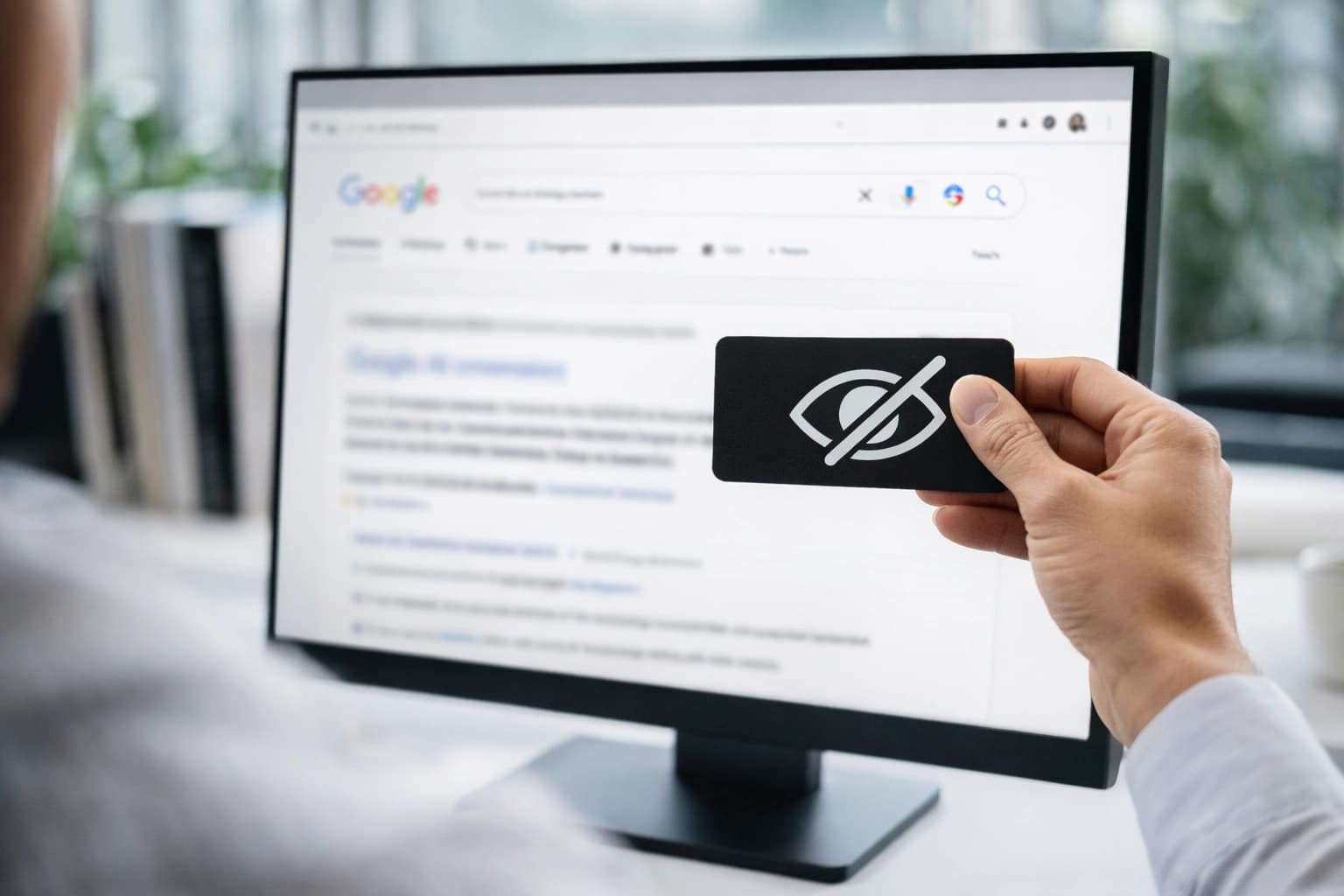
At 8:12 a.m., you open Google to check a high-value query, and an AI Overview lands above the blue links you planned to screenshot. You click a browser extension, the box disappears, and the page suddenly becomes readable again. That small moment is why the phrase hide google ai overviews extension keeps showing up in search.
This is not a fringe curiosity. One current top result is Tom's Hardware's article titled “Google is killing the web with AI Overviews – I made an extension to block them”. Another is “Hide Google AI Overviews - Firefox Add-ons”. A Google Search Community thread titled “How to turn off AI in Google Search?” also appears in the current SERP. Put those together, and you get a clear signal: people are looking for a practical workaround, not just theory.
If you work in SEO, publishing, or content ops, that distinction matters. You are not changing Google itself. You are cleaning up your own view so you can research, compare, and document results faster.
What is a hide google ai overviews extension?
Browser extension vs. Google setting
Watch This Helpful Video
To help you better understand hide google ai overviews extension, we've included this informative video from How-To Authority. It provides valuable insights and visual demonstrations that complement the written content.
A hide Google AI Overviews extension is a browser-side tool that removes or hides the AI Overview box from your Google Search page view. It runs inside Chrome, Firefox, Edge, or another supported browser profile after the results page loads.
That makes it different from a built-in Google control. In the current search results, you see third-party pages and community discussions, including Tom's Hardware, Firefox Add-ons, and the Google Search Community thread. You do not see one dominant official page that clearly says, “Here is the universal off switch for everyone.” That tells you a lot about how people are solving the problem.
| Question | Browser Extension | Google-Level Setting |
|---|---|---|
| Where does it run? | Inside your browser and profile | Inside Google's product or account settings |
| What does the current SERP suggest? | Third-party workarounds are active | No single clear universal switch dominates these results |
| Who sees the change? | Only you, on that setup | Potentially broader, if Google offered it that way |
It changes what you see in the browser, not what Google serves to everyone else.
What it actually removes from the page
Usually, the extension targets the AI Overview module itself — the box, wrapper, or container that sits near the top of the results page. Some tools hide it with CSS. Others remove the visible element from the rendered page structure. In both cases, the goal is the same: collapse that section so the organic results move up.
What it does not remove is just as important:
- Your underlying rankings do not change.
- Featured snippets, ads, and People Also Ask still exist if Google serves them.
- Search Console data does not change because you hid something locally.
- Another teammate on a different device will still see the original page unless they install the same tool.
Think of it as editing the stage set after the actors already walked on. The page is still the page. You are changing your line of sight.
Who usually installs it
The typical user is not just a casual searcher. It is often an SEO manager reviewing branded queries, a content strategist mapping SERP features, a publisher checking page placement, or an agency analyst building a Monday report across 40 keywords. If you spend hours each week in Google results, even a small visual cleanup can feel meaningful.
The Firefox Add-ons result matters here because it shows this use case is concrete enough to support dedicated browser tools. People are not only asking whether AI Overviews can be hidden. They are already installing software to do it.
Why does it matter for SEO, content, and publishing teams?
Cleaner manual SERP reviews

AI Overviews appear directly on the Google results page, so they can dominate the first screen. If you are trying to review classic organic listings, compare title tags, or inspect whether a featured snippet is present, that big block can get in the way. Hiding it gives you a cleaner working surface.
Say you are reviewing a query like “best CRM for startups.” You may want to compare positions 1 through 5, note whether a listicle or category page ranks, and capture how competitors write their titles. If an AI Overview pushes those listings downward, your manual review takes longer. A hidden view removes that friction.
Faster screenshotting and reporting
Anyone who has built client decks knows this pain. You need a screenshot that shows the ranking page clearly, maybe for 12 target keywords, and the top of the page is cluttered by a module you are not discussing in that specific slide. A hide extension can speed up that workflow.
That practical angle fits the current SERP. The top results include a Tom's Hardware explainer, a Firefox add-on listing, and a Google Search Community thread. That mix suggests users are looking for hands-on fixes, not a neat official tutorial page.
| Task | Why a Hidden View Helps | What You Still Need Separately |
|---|---|---|
| Manual ranking review | Organic listings become easier to scan | Neutral tracking data from your usual tools |
| Screenshots for reports | Cleaner visuals with less top-of-page clutter | A note if the live SERP included an AI Overview |
| Competitor checks | Faster side-by-side comparison of titles and snippets | Awareness of all visible SERP features in the real page |
Less noise during keyword research
When you are categorizing intent, looking for content gaps, or deciding whether a keyword behaves like a product query or an informational query, visual noise slows you down. For content teams working through 50 or 100 terms in one sitting, that adds up.
Still, you should stay disciplined. If Google shows an AI Overview in the real SERP, that is part of the search environment. Hiding it can help you think more clearly, but it should not erase the fact that the feature exists.
Use it for workflow clarity, not as a replacement for real SERP monitoring.
How does it work in the browser?
Page-element hiding and DOM manipulation
The short answer: the extension waits for Google Search to load, finds the AI Overview element on the page, then hides or removes that element from the live browser view. This happens on your device after the page renders.
If you hear people mention the DOM, they just mean the live structure your browser builds from the page. A browser extension can interact with that structure. It can say, in effect, “Find this box and make it disappear.” That is normal client-side behavior, not a server-side change.
- You search on Google and the results page loads.
- The extension detects that you are on a matching Google Search URL.
- Its script looks for the AI Overview container or related markers.
- It hides that element or removes it from the rendered page.
- The rest of the results shift upward after the refresh or page repaint.
The Firefox Add-ons result in the current SERP supports this model. It suggests at least one implementation exists as a browser extension rather than as a Google account preference.
Think of it as a visual filter: it edits your view, not Google’s system.
Why it works only where it is installed
Because the extension runs locally, its effect is limited to the browser, profile, and device where you installed it. If you add it to Firefox on your work laptop, that does not mean Safari on your phone will behave the same way. If your teammate in another office opens the same query, they will still see whatever Google serves to them.
This local scope is easy to forget. I have seen teams share a screenshot from a cleaned-up desktop browser and then assume the public SERP now looks that way for everyone. It does not. The browser view changed. The search product did not.
What happens after you refresh the page
Most of the time, the extension runs again after a page refresh because that is part of its job. Every time Google loads a matching results page, the script checks whether the targeted element is present. If it is, the script hides it again.
That also explains why these tools can fail. If Google changes the page layout, the extension may no longer find the right element. On Monday, it works. On Thursday, after a markup change, the AI Overview is back or the page shows an awkward gap. Then the extension developer has to update the rule.
What are the limitations and trade-offs?
It can stop working after page changes

This is the biggest technical weakness. Extensions that hide page elements depend on the browser-facing structure Google uses at that moment. If Google changes its markup, class names, wrappers, or rendering behavior, the extension can miss the target.
That is why Tom's Hardware framing matters. A blocker is a workaround, not an official control panel. Workarounds tend to be brittle. They can be excellent on Tuesday and outdated by Friday.
It does not affect search rankings
A hidden AI Overview does not move your page from position 6 to position 3. It does not increase clicks. It does not change Search Console impressions. It does not rewrite what Google indexed. You are changing the interface you look at, not the underlying ranking system.
| What Changes | What Does Not Change |
|---|---|
| Your visual layout on that browser | Google's actual rankings |
| The screenshots you capture manually | Traffic, impressions, and clicks |
| How easy the page is to scan | What other users see on their devices |
| Your local workflow speed | Search Console and analytics data |
That distinction sounds obvious, but it trips people up. A cleaner screen can create a false sense that the SERP itself is cleaner. It is not.
It is not the same as disabling AI Overviews for everyone
A local browser extension cannot remove AI Overviews from Google Search for other users, other browsers, or other devices. It cannot change what your clients, prospects, or customers see. It cannot act as an org-wide policy switch unless every user installs and maintains the same tool in the same environment.
So yes, it is useful. No, it is not a governance control. Treat it like a convenience layer for research and reporting, not a change to the public web.
Treat it as a convenience tool, not a policy switch.
What are the most common questions about using one?
Hide vs. turn off
Can you hide AI Overviews? Yes, with a browser-side workaround, if an extension supports your setup.
Can you turn them off for Google itself with that extension? No. Hiding is local. Turning off implies a product-level change or official preference. The current SERP — with its mix of community threads and third-party extension pages — shows why people often frame this as a workaround question.
Why do people confuse the two? Because the screen looks different after the extension runs. The visual result feels like a feature was disabled, even though only your own rendered page changed.
Browser support and installation
Will it work in Firefox? The current SERP includes a Firefox Add-ons result, so Firefox support is clearly part of the live conversation.
Will it work in Chrome, Edge, or Safari? Maybe — but support depends on what third-party developers publish and maintain for each browser store. Check the extension listing, required permissions, recent update history, and whether the tool says it targets Google Search specifically.
- Confirm the extension was updated recently.
- Read reviews for breakage reports after Google page changes.
- Test in a secondary browser profile before rolling it into your main workflow.
- Document which browser and profile you used for screenshots.
If you manage a team, standardize this. One analyst on Firefox and another on Chrome with different add-ons can produce messy, inconsistent evidence in the same weekly report.
Impact on SEO reporting
Does it help with reporting? Yes, especially for manual reviews and screenshots. Agencies and publishers often need uncluttered visuals when they compare organic listings, snippets, and page layouts.
Does it change the data you should report? No. Your rank tracking, Search Console exports, and traffic analysis should still reflect the real search environment. The hidden view is a convenience for people, not a substitute for measurement.
What is the safest process? Keep two lanes: one for documentation screenshots and one for raw SERP observation or tool-based monitoring.
If you are auditing rankings, keep the hidden and unhidden views separate in your documentation.
That simple habit prevents a lot of confusion. When someone asks six weeks later, “Did Google still show an AI Overview for this query?” you will have a clear answer instead of a cleaned-up screenshot that hides the evidence.
A hide google ai overviews extension cleans your screen, not Google’s index.
Use one when you want faster SERP reviews, cleaner screenshots, and less visual clutter during research. Just remember the trade-off: the real page still exists, and your reporting should reflect that reality.
If your team adopts a hide google ai overviews extension, where will you draw the line between a cleaner working view and the live SERP you still need to measure?
Plan Smarter Growth With SEOPro AI
SEOPro AI gives teams an AI blog writer that drafts, links, publishes, and monitors search-ready articles to grow organic traffic and win LLM mentions.
See Platform