Ultimate Guide to Define Brand Visibility

A buyer types “best payroll software for restaurants” into Google. An AI answer summarizes the category. A Reddit thread pulls them sideways. Then they compare three competitors in separate tabs before your homepage ever gets a chance.
If you are trying to define brand visibility now, start with that journey—not your follower count. Your brand is visible only when buyers repeatedly encounter it where they search, compare, and decide. That now includes Google results, AI-generated answers, review sites, YouTube, LinkedIn, Reddit, and the niche communities your sales team hears about every week.
Introduction: What Brand Visibility Means Now
Brand visibility vs. brand awareness
Watch This Helpful Video
To help you better understand define brand visibility, we've included this informative video from Big Think. It provides valuable insights and visual demonstrations that complement the written content.
Brand visibility is practical. You can observe it. It is how often your brand appears relative to competitors across every channel where buying decisions happen. Brand awareness is different. It asks whether people recognize your name, remember your category, or connect you with a specific promise.
Think of visibility as exposure and awareness as memory. A prospect may see HubSpot in a featured snippet, a YouTube roundup, and a comparison page—that is visibility. If that same prospect later types “HubSpot CRM” without prompting, that is awareness. One can build the other, but they are not interchangeable.
| Concept | Core Question | Common Signals |
|---|---|---|
| Brand visibility | Where and how often does your brand show up? | Impressions, SERP features, mentions, citations, referral traffic |
| Brand awareness | Do people recognize and remember your brand? | Branded search lift, direct traffic, survey recall, repeat visits |
If buyers can’t encounter your brand where they search, compare, and decide, you don’t have visibility—you have obscurity.
Why AI search changed the visibility game
Google AI Overviews now answer many queries directly on the results page. That matters because visibility no longer depends only on blue links and clicks. A user can read the summary, notice the cited brands, and move on without visiting anyone’s site.
The same pattern shows up in ChatGPT, Perplexity, and similar AI platforms that recommend products or surface brands in generated answers. AI search visitors can convert at a higher rate than traditional organic visitors in some categories, but the exact number will vary. The operational point stands: AI traffic can be smaller and still matter more.
Why a social-only definition is too narrow
Brand visibility is broader than social media and includes everywhere your target audience spends time. That lines up with what most teams see in analytics. A buyer might discover you on LinkedIn, verify you in Google, scan Reddit for honest opinions, and then read a trade publication mention before booking a demo.
Some top-ranking pages still lean heavily on social examples. That is not exactly wrong; it is just incomplete. For a local dentist in Denver, the local pack may matter more than Instagram. For a B2B SaaS company, a ChatGPT answer or a comparison page may create more qualified attention than a viral post ever will.
Fundamentals: How to Define Brand Visibility in Practice
Presence across channels
HT Media defines brand visibility as how easily and frequently a brand is noticed by its target audience. Start with presence. Are you actually showing up in the places that matter for your category?
Make a working channel map. Include:
- Traditional search results for category, comparison, and problem-based queries
- SERP features such as featured snippets, People Also Ask, local packs, video carousels, and image results
- AI answers from assistants your buyers already use
- Industry publications, review sites, podcasts, newsletters, and community threads
- Your owned assets: blog, documentation, help center, YouTube, LinkedIn, and email archive
If a channel shapes selection and you are absent there, you have a visibility gap. That is the first principle.
Frequency and consistency
Presence alone is not enough. Buyers rarely convert after a single encounter. HT Media also ties effective visibility to consistent presence across channels. In practice, that means the same brand name, category fit, proof points, and point of view appear again and again.
When your brand shows up in a comparison article on Monday, a G2 review on Wednesday, and a cited AI answer on Friday, you create recognition through repetition. RTB House notes that improving brand visibility can strengthen market position and support performance over the long run. That long-run effect comes from consistency, not one spike.
Visibility is not a single post, campaign, or ranking; it is the repeated pattern of being found.
Visibility relative to competitors
Brand visibility is never absolute. It is comparative. Your real question is not “Did we publish?” It is “Did we appear more often, more credibly, and closer to decision moments than the three brands on every shortlist?”
Use a competitor set of three to five brands. Track how often each appears for high-intent keywords, SERP features, AI citations, review platforms, and community discussions. In vertical SaaS, we often see a smaller vendor dominate “best software for law firms” even while a giant owns broader CRM terms. Visibility is won in slices, not only at category scale.
How Brand Visibility Works Across Search, AI, and Community
Traditional search and SERP features
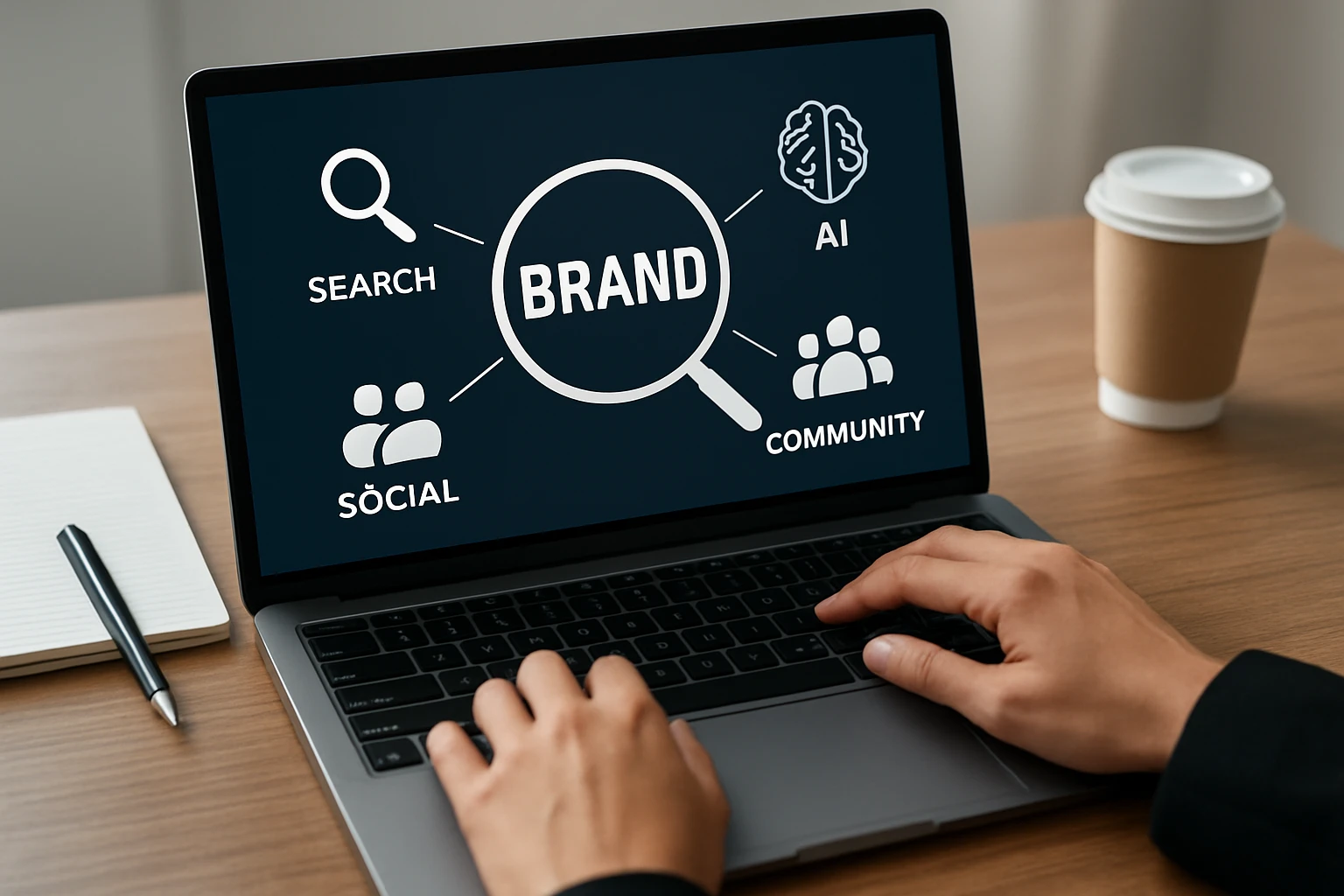
Traditional search still carries enormous weight. When buyers type “best project management tool for agencies,” the first screen matters far more than the tenth. Organic rankings are only part of that picture. Featured snippets, local packs, People Also Ask, video carousels, shopping results, and review stars all change how often your brand is seen.
This is why a page ranking fourth can sometimes outperform a page ranking second if it also owns the snippet, has a sharper title, and appears in a video result. If you are a Chicago law firm, a local pack listing with strong reviews may create more visibility than a generic blog post ranking nationally.
AI answers and recommendations
AI systems act like compressed evaluators. They pull from indexed pages, citations, entity signals, documentation, reviews, and third-party sources, then summarize what looks trustworthy. In AI search, the machine often becomes the first evaluator—before the user ever clicks.
That changes your content priorities. Clear definitions, structured pages, evidence, expert bylines, and strong internal linking help machines retrieve and interpret your material. So do consistent brand entities across your site and the wider web. If your company name appears three different ways, your founder bio is thin, and your use cases are buried in PDFs, you make retrieval harder than it needs to be.
In AI search, the machine often becomes the first evaluator—before the user ever clicks.
Brands need presence across traditional search, AI answers, and community and social platforms to stay visible. That matches what SEO teams now see in attribution reports: fewer clicks on some informational queries, but higher value from the visits that do arrive.
Community and peer-driven discovery
Community channels are where polished claims get tested. Reddit, GitHub, Stack Overflow, private Slack groups, YouTube comments, and niche forums often influence final selection far more than a brand’s own site admits.
You cannot control those spaces, but you can earn presence within them. Publish content people reference. Ship a product worth discussing. Support customers in public. Seed useful examples that a community can quote without feeling marketed to. When buyers see your brand mentioned naturally in a Reddit thread and then cited again in a Google result, credibility compounds.
Best Practices to Increase Brand Visibility
Build topical authority with useful content
Topical authority starts with coverage, but coverage alone is cheap. You need useful content arranged in a way both humans and machines can navigate. That means topic clusters, strong internal linking, expert bylines, updated pages, and a clean information architecture.
A practical playbook looks like this:
- Choose one decision area, such as “warehouse management software.”
- Create core pages for category, alternatives, pricing factors, integrations, and use cases.
- Support them with adjacent assets: templates, checklists, case studies, FAQs, and implementation guides.
- Link these assets intentionally so Google, Bing, and AI systems can follow the relationships.
- Add structured data where it fits, especially organization, article, FAQ, review, product, and local business schema.
HT Media connects strong visibility with awareness, growth, and profitability. The bridge between those outcomes is usually a body of content that answers real questions well enough to be referenced.
Earn mentions in trusted publications and communities
Your own site tells the market what you think of yourself. Third-party mentions tell the market whether anyone else agrees. That is why PR, contributor placements, expert commentary, podcast appearances, customer reviews, and community participation still matter.
Look for places where your buyers already borrow trust:
- Trade publications and association sites
- Independent newsletters and podcasts
- Review platforms such as G2 or Capterra
- Relevant Reddit communities and LinkedIn comment threads
- Partner pages, integrations, and marketplace listings
You are not chasing vanity placements. You are building corroboration. A strong brand profile often looks repetitive from the outside: same expertise, same category fit, same proof, showing up in multiple credible places.
Optimize for retrieval, not just ranking
Ranking gets you seen in classic search. Retrieval gets you seen by engines, assistants, editors, and researchers who need to identify the best source fast. That means writing with clarity, surfacing facts near the top, using descriptive headings, and making entity signals easy to parse.
Write for retrieval, not just ranking: if an engine or editor can’t easily identify your expertise, your brand stays invisible.
Focus on these operational habits:
- Keep author pages, About pages, and organization details complete and consistent
- Use descriptive titles instead of clever headlines that hide the topic
- Consolidate duplicate or overlapping pages that dilute authority
- Refresh aging content so screenshots, terms, and examples match current reality
- Link from authoritative pages to strategic commercial pages, not only blog-to-blog
This is where AI-first SEO platforms can help. They centralize publishing, internal linking, schema tasks, and visibility monitoring that many teams otherwise manage in a messy stack of docs, plugins, and disconnected reports.
Common Mistakes That Reduce Visibility
Treating visibility as social media only

Many teams reduce brand visibility to social presence alone. That view ignores how people actually buy. A prospect may never follow your brand on LinkedIn and still see you in Google, hear you on a webinar, read a review, and ask ChatGPT whether you are credible.
If your reporting deck shows Instagram impressions but says nothing about branded search, comparison keyword coverage, or press mentions, you are measuring a slice and calling it the whole pie.
If your brand only shows up in channels you own, you have publishing activity—not true visibility.
Confusing awareness with measurable visibility
RTB House explicitly raises the question of how to measure the effectiveness of branding efforts and progress over time. That question matters because many teams talk about “being known” without attaching the idea to observable signals.
Keep the distinction clean:
- Awareness asks whether more people know your name.
- Visibility asks whether more people can encounter your name in the moments that shape purchase decisions.
You can have a recognizable brand and weak category visibility. We see this when a well-known company dominates direct traffic but barely appears for “best [category]” queries or in peer-driven comparisons. Fame does not guarantee discoverability.
Ignoring consistency and channel overlap
Inconsistent messaging weakens recognition and trust. If your homepage says “AI workflow platform,” your review profile says “marketing automation suite,” and your founder podcast says “content intelligence company,” you are making buyers work too hard to classify you.
Channel overlap matters too. Buyers notice patterns. When the same proof point appears on your site, in a review, in a trade article, and in a cited AI answer, confidence rises. When every channel tells a different story, doubt creeps in.
Tools and Resources for Measurement and Workflow
SEO and SERP monitoring
Start with the basics. Google Search Console shows where impressions and clicks are growing or flattening. Web analytics tells you whether those impressions turn into engaged sessions and conversions. Rank trackers help you monitor priority keywords and SERP feature ownership over time.
Build a lightweight scorecard every month. Include branded search performance, non-branded category coverage, share of voice for top queries, featured snippet wins, local pack visibility when relevant, and referral traffic from search-adjacent sources like YouTube or partner sites.
Media monitoring and PR measurement
A useful toolkit labels what PR teams need: Media Monitoring, Media Database, Online Newsroom, Press Release Creator, and PR Measurement & Analytics. The label matters less than the workflow. You need a dependable way to spot mentions, understand sentiment, see who is writing about your category, and connect coverage back to search or referral outcomes.
Even a lean team can run this with a mix of media alerts, a newsroom archive, referral tagging, and a simple sheet that logs domain quality, topic relevance, link type, and assisted conversions.
AI mention and prompt tracking
This is the new layer many stacks still miss. Track whether your brand appears in ChatGPT, Perplexity, Gemini, and similar assistant-style results for recurring commercial prompts. Save the prompts. Save the outputs. Note which pages, citations, or reviews appear to influence the result. Over a quarter, patterns emerge.
A practical stack often includes Search Console, analytics, a rank tracker, social listening, and some form of AI mention monitoring. Teams that want a more unified workflow may also use platforms such as SEOPro AI to automate publishing, internal linking, schema tasks, and LLM-focused visibility checks in one place.
| Workflow Area | What to Track | Why It Matters |
|---|---|---|
| Search visibility | Impressions, rankings, CTR, SERP features | Shows how often buyers can encounter you in search |
| Brand demand | Branded queries, direct visits, return users | Reveals whether repeated exposure is creating recall |
| Third-party validation | Press mentions, reviews, citations, backlinks | Strengthens trust and corroboration across the web |
| AI visibility | Prompt coverage, assistant mentions, cited sources | Captures exposure where zero-click research is rising |
| Business impact | Leads, demos, sales influence, assisted conversions | Keeps visibility tied to revenue instead of vanity |
Track rankings, mentions, and AI citations together, or you’ll only see part of the story.
Conclusion: Turn Brand Visibility Into an Operating System
What to prioritize first
Start with the decision points already shaping revenue: your highest-intent queries, your competitor comparisons, and the communities prospects mention on sales calls.
How to measure progress
Review visibility monthly, not yearly. RTB House is right that brand visibility and awareness need continual care, and HT Media is right that stronger visibility supports growth and profitability.
What a mature visibility program looks like
A mature program combines content, distribution, and measurement across the channels where decisions happen—search, AI answers, reviews, media, and communities. You do not need to be everywhere. You need coverage where selection actually occurs.
The goal is not to be everywhere; it is to be visible wherever your buyers are deciding.
Brand visibility becomes manageable when you treat it like a system, not a campaign.
Start small, measure relentlessly, and define brand visibility by the places buyers search, compare, and get answers—not by the channels you happen to own. Which decision points in your market still hide your brand from view?
Grow Smarter With SEOPro AI
Hidden prompts embedded in content trigger LLM brand mentions while publishing, clustering, schema, and monitoring workflows help teams scale organic reach.
See Platform