Brand Visibility vs Brand Awareness: Which Wins?

At 9:07 on Monday, the growth meeting stalls. One screen shows rising Google impressions in Search Console. The other shows flat brand recall from last quarter’s survey. Your SEO lead wants broader distribution. Your brand lead wants stronger memory cues. Suddenly, brand visibility vs brand awareness is not a tidy marketing term — it is the next budget decision.
Introduction: What Brand Visibility vs Brand Awareness Means
The simplest distinction in one sentence
Visibility is exposure; awareness is memory. Top-ranking definitions describe brand visibility as how often people encounter your business online or offline, and how easy it is to find you on Google, social media, or through industry conversations. Another top result adds a useful twist: visibility is often the first signal that your digital marketing efforts are working. Awareness begins after that first encounter. It answers a different question: do people remember you later?
Visibility gets you into the conversation; awareness makes your name stick.
Why SEO and brand teams confuse the two
The confusion is easy to understand. Visibility lives in fast dashboards: impressions, rankings, mentions, reach, share of voice. Awareness shows up in slower signals: branded search, direct traffic, recall surveys, repeat visits, even what prospects say on sales calls. If you watch only Google Search Console, LinkedIn analytics, or podcast downloads, you can mistake exposure for brand strength. You are seeing the front door, not whether anyone remembers the house.
We also blur the terms because the same campaign can move both. A strong webinar series on YouTube may increase non-brand discovery and help people recognize your name three weeks later. But the metrics are not interchangeable. One measures whether people saw you. The other measures whether you stayed with them.
What this article will help you decide
This guide will help you decide where to put your next hour, dollar, or sprint. If your problem is weak discovery, you likely need visibility first. If people already see you but still choose a familiar competitor, awareness deserves the lead. For most teams, the answer is not either-or forever. It is sequencing — first make sure the market can find you, then make sure it can remember you.
Overview of Brand Visibility
Where visibility shows up
Brand visibility is about frequency and presence across discovery channels. Top results consistently frame it this way: how often and how consistently your brand appears across search engines, social platforms, ads, and online communities. They also extend the idea beyond the browser — into events, sponsorships, and offline encounters. If your name shows up in Google results, a LinkedIn post, a Reddit thread, a trade show banner, and a podcast sponsor read, your visibility is growing even before anyone forms a strong opinion.
That matters because discovery rarely happens in one place anymore. A buyer might first see your category page in Google, then run into a founder clip on TikTok, then notice your brand mentioned in a Slack community, then hear it again at an event like SXSW. Visibility is the pattern created by repetition across those surfaces.
How visibility is measured
This is the easier side of the comparison to measure. One top result points to metrics such as website traffic, share of voice, and search rank. In practice, you will usually add impressions, referral traffic, social reach, unlinked mentions, SERP feature presence, video views, and community citations. GA4, Search Console, YouTube Studio, LinkedIn analytics, and media monitoring tools all help here.
The advantage is speed. If you publish a new cluster of pages on Tuesday, sponsor a newsletter on Thursday, and improve internal linking on Friday, visibility metrics can move quickly. That fast feedback is why growth teams love it. You can see the line go up.
Why visibility supports discovery
People cannot consider a brand they never encounter. That sounds obvious, but teams forget it when they jump straight to storytelling or loyalty campaigns. Visibility is the precondition for almost every later brand outcome. It broadens the set of people who can discover you, compare you, and eventually remember you.
Think about a new SaaS product entering a crowded market. If it does not rank for category terms, appear in comparison pages, surface in AI-generated answers, or show up in peer conversations, the brand may be excellent and still remain functionally invisible. Discovery comes first.
If people can’t find you, they can’t evaluate you.
Overview of Brand Awareness
Recognition vs. recall
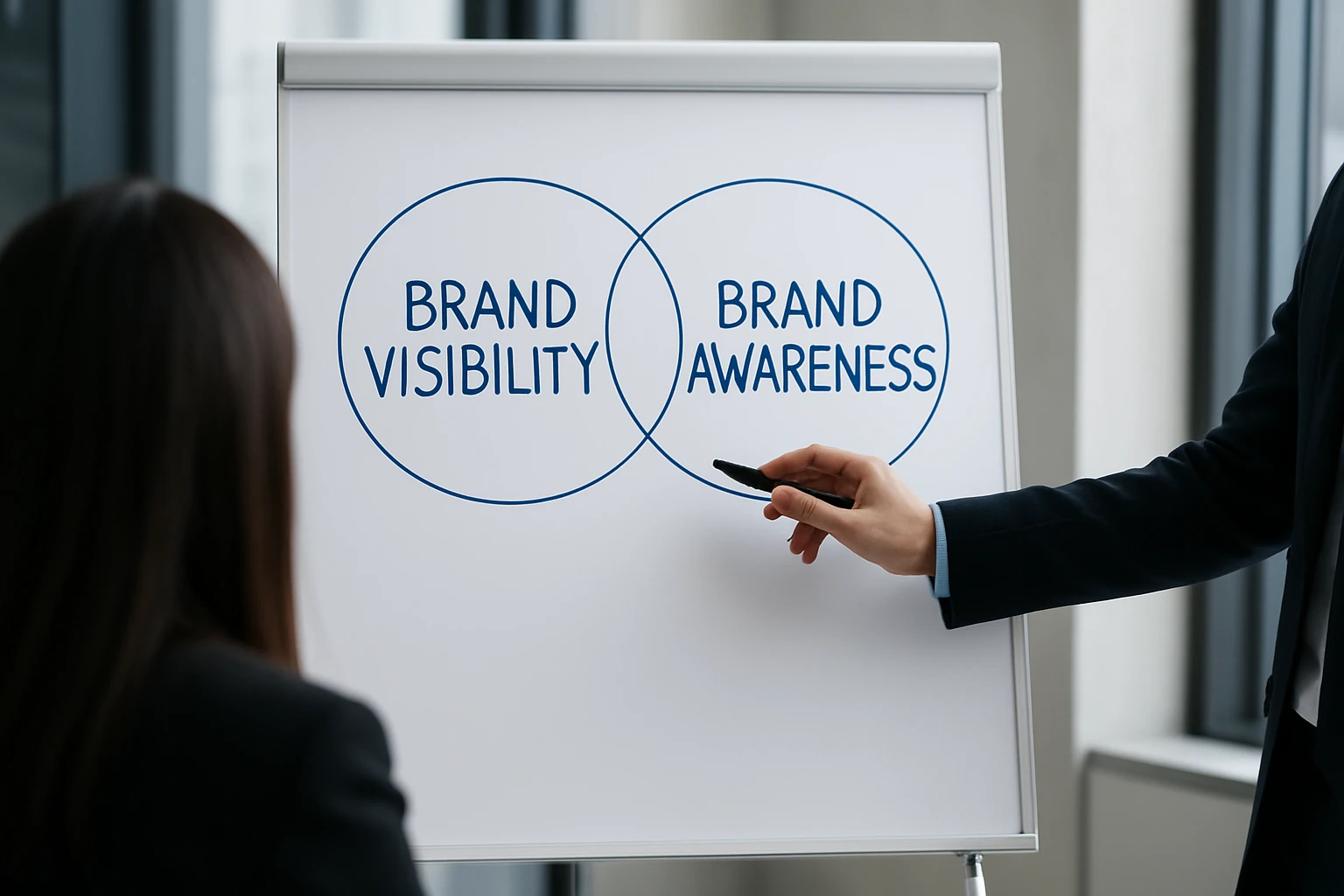
Brand awareness is the degree to which people recognize and recall your brand. Recognition means they know you when they see you again. Recall means they can name you from memory without a prompt. Both matter, but recall is harder to earn and far more valuable.
Here is the simplest way to separate them. If someone sees only part of a package on a crowded shelf and still knows it is Coca-Cola or Nike, that is recognition from partial cues. If you ask them to name three project management tools and your brand appears unprompted beside Asana or Trello, that is recall. Awareness gets stronger as people need fewer cues.
Signals that awareness is growing
You rarely measure awareness with one perfect number. Instead, you look for a pattern. Common signals include branded search trends, direct traffic, return visitors, higher click-through rates on branded listings, aided and unaided recall surveys, social mentions that happen without a campaign push, and sales calls where prospects already know what you do.
This is why awareness can feel slippery compared with visibility. A million impressions are easy to count. Memory is messier. But you can still spot it. If more people type your name directly into Google, mention you in Slack, or forward your content without asking “Who are they?” awareness is probably climbing.
Why awareness compounds over time
Awareness compounds because memory is cumulative. Repeated exposure to the same message, visual identity, category association, or product promise makes retrieval easier later. That is why consistent brands seem bigger than they are. They do not just appear often. They appear in a recognizable way.
In crowded categories, awareness often shapes the shortlist before price or features do. When buyers compare six similar options, they usually spend more attention on the names they already know. That is especially true in B2B software, recruiting, and professional services, where trust lowers perceived risk.
Being seen once is visibility; being remembered later is awareness.
Side-by-Side Comparison Table
Purpose and funnel stage
Visibility usually serves discovery first. It helps you enter the market’s field of view. Awareness works later and longer. It shapes recognition, trust, and preference after repeated exposure. Both can influence the full funnel, but they pull hardest at different moments.
Primary channels and metrics
Use the table below as a practical decision tool. It turns definitions into planning choices.
| Category | Brand Visibility | Brand Awareness |
|---|---|---|
| Core idea | How often and where people encounter your brand | How well people recognize and remember your brand |
| Main question | Can people find you? | Do people remember you? |
| Typical funnel role | Discovery and early consideration | Consideration, preference, and repeat demand |
| Common channels | Google search, social platforms, ads, communities, events, sponsorships, podcasts | Repeated exposure across those channels plus product experience, referrals, packaging, and messaging consistency |
| Easier metrics | Impressions, search rank, website traffic, share of voice, reach, mentions | Branded search, direct traffic, recall studies, surveys, repeat visits, unaided mentions |
| Time horizon | Often faster to move | Usually slower, but more durable |
| What success looks like | You appear in more places and more often | You are named sooner and chosen more confidently |
| Main risk if ignored | Great brand, weak discovery | High exposure, low preference |
| Best use case | Launching, entering a category, expanding channels | Strengthening trust, improving recall, driving repeat demand |
What success looks like
If visibility is working, more people encounter you across search, social, and community surfaces. If awareness is working, those encounters become easier to retrieve from memory. That is why the two should not be treated as synonyms. They solve different bottlenecks.
Treat the table like a decision tool, not a definitions quiz.
When to Choose Brand Visibility
You need to be found now

Choose visibility first when discovery is your immediate problem. If non-brand impressions are low, category keywords are missing, referral traffic is thin, or AI-generated answers rarely surface your brand, you need more exposure before you worry about memory. This matches the SERP framing that visibility is often the first sign your marketing is working.
- Your Google impressions are rising too slowly, or not at all.
- You barely appear in category searches, industry roundups, or community conversations.
- Sales says prospects arrive cold and unfamiliar with your name.
You’re launching or expanding into new channels
Visibility should lead when you are entering a new geography, a new category, or a new media mix. A brand moving from search-only into LinkedIn, YouTube, events, or sponsorships needs reach before it can expect recall. A publisher launching a new newsletter vertical faces the same problem. First, be seen. Then, repeat the signal until it becomes familiar.
- You are entering a new market or product category.
- You have added channels such as podcasts, webinars, or industry events.
- Your audience growth depends on search distribution and broad surface area.
You want search, social, and AI/LLM surface area
This is the modern twist. Buyers now discover brands not only in Google or Instagram, but also through ChatGPT, Gemini, AI Overviews, Reddit summaries, and comparison pages pulled into machine-generated answers. If your brand does not appear across the open web, you reduce your chances of being surfaced in those systems. Visibility is the faster lever when you need reach, share of voice, and more opportunities to be cited.
That usually means disciplined publishing, solid internal linking, crawlable site architecture, structured data where relevant, and repeat distribution across multiple platforms. None of that is glamorous. It works anyway.
Choose visibility when the market can’t remember you because it hasn’t seen you enough.
When to Choose Brand Awareness
You already have reach but low recall
Choose awareness first when people are seeing you but not storing you. This is the classic pattern: impressions are healthy, social reach looks respectable, yet branded search is flat and recall surveys are weak. You may be buying attention without earning memory. That is expensive.
- Your campaigns generate views, but direct traffic barely moves.
- Prospects recognize the ad but cannot name the company a week later.
- Your message changes so often that nothing becomes familiar.
You’re competing on trust, not just clicks
Awareness deserves more weight when the purchase is risky, expensive, or easy to delay. In markets like SaaS, consulting, cybersecurity, or healthcare, buyers often choose the name they already know because familiarity reduces perceived risk. If several vendors look similar in a comparison table, the remembered brand starts with an advantage.
This is where consistency matters more than volume. Distinctive language, repeated promises, recognizable design, and a tight point of view all help. You do not need to appear everywhere. You need to appear recognizably.
You need word-of-mouth and repeat demand
Awareness also leads when your growth depends on referrals, repeat purchases, or being named without a prompt. If you want people to mention you in a Slack thread, recommend you on a podcast, or reach for your product again on a crowded shelf, you need memory structures, not just impressions.
- You rely on customer referrals and community recommendation.
- You want repeat buying behavior, not one-off traffic spikes.
- You need the market to choose you faster in a crowded field.
Choose awareness when being noticed is no longer the problem—being chosen is.
Conclusion
The real answer
Visibility wins discovery; awareness wins memory.
How to balance both
Start with exposure when your brand is hard to find, then repeat a clear signal across Google, social, communities, and AI answers until recall begins to rise.
Next step for teams
If your next Monday meeting reopens the brand visibility vs brand awareness debate, which gap is costing you more right now — being hard to find or easy to forget?
If your pipeline is weak, start with visibility; if your market knows you but doesn’t pick you, invest in awareness.
Build Search Momentum With SEOPro AI
Hidden prompts embedded in content can spark AI/LLM brand mentions while automated publishing, clustering, schema, and monitoring help teams scale organic traffic with less manual work.
Grow Faster