Brand Visibility SEO Checklist

You search your company name on an iPhone during a Monday standup. The screen shows your homepage first, a G2 profile second, and a competitor ad wedged above both. You take a screenshot before anyone says a word.
That cramped mobile results page is where brand visibility SEO stops feeling abstract. It is not just about one rank for one keyword. It is about whether your brand shows up clearly across classic organic listings, sitelinks, reviews, knowledge panels, and newer AI or search-summary surfaces when real people look for you.
Use This Checklist to Turn Brand Visibility SEO Into a Repeatable Process
Define what brand visibility means for your team
Start by naming the surfaces that count. If your team only reports on blue-link rankings in Google Search Console or Semrush, you will miss half the picture. A branded search can show your homepage, documentation, YouTube channel, LinkedIn page, Google Business Profile, review pages, a knowledge panel, and AI-generated summaries — all before a user clicks anything.
Write your definition down. Keep it blunt. For most teams, brand visibility includes these checkpoints:
- Show the right brand-owned page for your company name.
- Show the right supporting pages for product, pricing, support, and leadership queries.
- Occupy or influence rich results, review snippets, sitelinks, and knowledge-panel details where possible.
- Appear accurately in AI surfaces such as Google AI Overviews, ChatGPT web answers, Gemini summaries, or Bing Copilot-style responses when relevant.
- Reduce the space taken by outdated, weak, or off-brand third-party pages.
Treat brand visibility as an operating system, not a one-time optimization.
Decide who owns each step
Do not leave ownership fuzzy. Brand visibility breaks the moment everyone assumes someone else is handling it. SEO can lead the work, but content, PR, product marketing, web, and customer teams each control a piece of the entity graph users and search engines see.
| Workstream | Primary Owner | What They Control | Proof of Completion |
|---|---|---|---|
| Branded query audit | SEO | Query sets, rank checks, SERP captures | Dated baseline sheet |
| Page copy updates | Content or product marketing | Titles, H1s, meta descriptions, body copy | Published URLs |
| Schema and technical markup | Web or engineering | Organization, Person, Product, Article, FAQ markup where relevant | Validated markup on live pages |
| External profiles and citations | PR, social, or brand team | LinkedIn, Crunchbase, YouTube, review sites, bios | Consistent naming across profiles |
| Reviews and community signals | Customer marketing or support | Review freshness, response process, community updates | Updated profile activity |
A checklist works best when those teams share the same targets. If the SEO lead wants sitelinks while PR keeps publishing leadership bios with a different company name, you create noise instead of authority.
Set the review cadence before you start
Pick the rhythm now, before changes go live. I like a simple cadence: weekly checks for branded queries, monthly screenshot comparisons, and quarterly entity cleanup. Small teams can keep it lean. Large publishers or SaaS brands may need a 14-day loop because search features and AI mentions move faster than traditional content refresh cycles.
- Set one recurring branded SERP review meeting.
- Choose one folder structure for screenshots by date, device, and location.
- Define which queries get checked every week and which get checked every month.
- Agree on what counts as improvement: more owned results, cleaner messaging, richer features, higher click share, or fewer competitor intrusions.
If you do this first, your brand visibility SEO program becomes measurable instead of anecdotal.
Pre-work Checklist: Baseline Your Brand Footprint Before You Optimize Anything
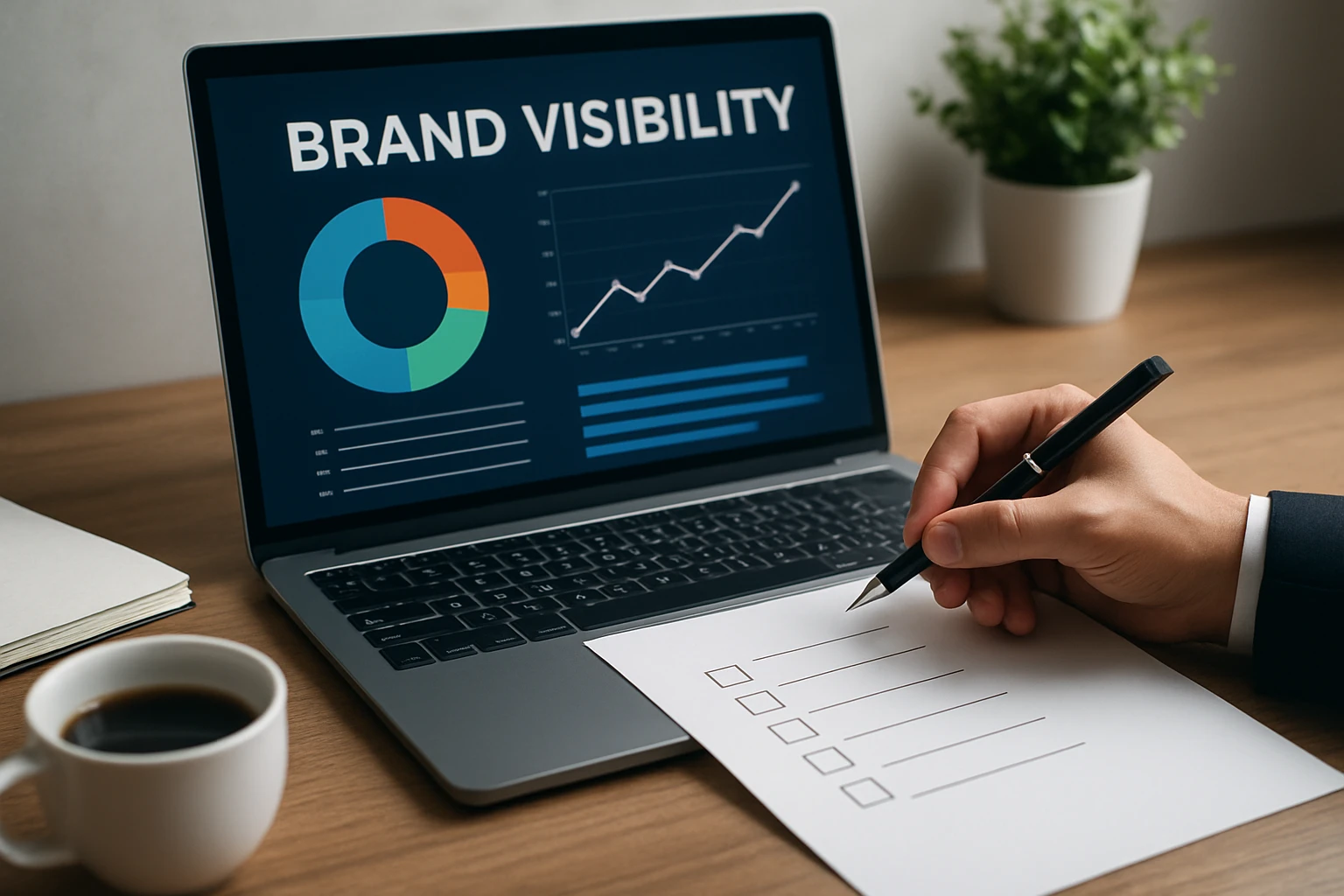
Audit first. Change later. You need a clean picture of what already ranks, what search engines already understand, and where ambiguity still lives.
Search your brand, product names, and leadership names
Run the obvious searches, then the ones your internal team forgets. Search your company name, product names, abbreviations, common misspellings, executive names, and brand-plus-modifier queries such as “pricing,” “reviews,” “careers,” and “docs.” “Acme Cloud,” “Acme pricing,” and “Maya Patel Acme” will often produce very different pages.
- Check both mobile and desktop.
- Check at least one consistent location.
- Use the same browser state each time so comparisons stay fair.
- Record whether ads, map packs, review sites, or AI summaries appear.
SERPs change with query intent, device, and location. A desktop result in Chicago can look cleaner than a mobile result in Austin. If your audience skews mobile, treat the phone result as the primary experience.
Map the pages and profiles already ranking
Build a simple inventory. For each branded query, list every result on page one that represents the brand or sits next to it. That usually includes the homepage, sitelinks, pricing page, support center, docs, app-store listings, LinkedIn, YouTube, GitHub, Wikipedia if one exists, and review properties like G2 or Trustpilot.
- Mark each result as brand-owned, partner-controlled, media-controlled, or unowned.
- Note the message each page sends. Does it match your current positioning?
- Flag pages with outdated names, old logos, retired product language, or weak descriptions.
- Identify gaps where a better page should exist but does not.
This step exposes something teams miss all the time: your site may not be the only thing defining your brand in search. Often, third-party profiles fill the gaps you left open.
If you skip the baseline, you will not know whether you improved visibility or just shifted where it appears.
Capture screenshots of current SERP features and AI surfaces
Take screenshots like evidence, not like souvenirs. Save them in a dated folder. Label them by query, device, and city. Capture the full page when possible, because the relationship between a knowledge panel, ad, review snippet, and organic result matters.
- Capture classic page-one results for each priority branded query.
- Capture any knowledge panel, sitelinks, People Also Ask boxes, review stars, video packs, or image blocks.
- Capture AI or summary-based answers when your brand appears, is omitted, or is cited indirectly.
- Keep one before-and-after set for every optimization cycle.
A screenshot set is one of the simplest ways to prove change to a CMO, a founder, or a skeptical sales lead. Numbers matter. Visible proof often lands faster.
Execution Checklist: Optimize the Pages, Entities, and Signals Search Engines Can Trust
Now you can improve the assets that shape perception. Focus on clarity, consistency, and trust. Search engines should not have to guess who you are, what you sell, or which page deserves the branded click.
Tighten titles, H1s, and meta descriptions around branded relevance
Start with your highest-visibility pages: homepage, pricing, product pages, category pages, docs, help center, about page, careers, and executive bios. Make sure each page says exactly what it is and how it connects to the brand.
| Page Type | Weak Version | Clearer Branded Version |
|---|---|---|
| Homepage title | Welcome | Acme | Acme Cloud | Revenue Analytics Software |
| Pricing page H1 | Plans | Acme Cloud Pricing |
| Support page title | Help Center | Acme Cloud Help Center and Product Support |
| Leadership bio | About Maya | Maya Patel, CEO of Acme Cloud |
- Use the current brand name in titles and H1s where it helps recognition.
- Write meta descriptions that reinforce what the page covers, not generic filler.
- Match on-page labels to the language used in branded searches.
- Remove vague headings like “Platform,” “Solutions,” or “About” when more specific labels fit.
Write for clarity first: if the page name, title, or entity label is vague, the algorithm has to guess.
Add schema, entity cues, and internal links where they fit
Structured data does not guarantee a rich result, but it does help search engines interpret page meaning and feature eligibility. Add schema where it accurately describes the page. Then support it with visible page copy, clean navigation, and internal links that reinforce the relationship between entities.
- Use Organization details on core brand pages where appropriate.
- Use Person details on executive, founder, or author pages when those pages matter for branded search.
- Use Product, SoftwareApplication, Article, FAQ, or Review-related markup only where the content truly matches.
- Link from the homepage to the pages you want associated with the brand: pricing, docs, category pages, flagship products, newsroom, and leadership pages.
- Link back from those pages using descriptive anchor text, not endless “learn more” links.
Internal linking spreads authority and clarifies structure. A support article linked from nowhere rarely helps your brand. A support article linked from product and footer navigation has a real chance to become the right answer for a branded support query.
Align citations, bios, and external mentions across the web
Search engines read across the open web. Users do too. If your LinkedIn description says one thing, your YouTube bio says another, and your G2 profile uses an old product name, you create ambiguity. Consistent naming reduces confusion for both humans and machines.
- Standardize your brand name, tagline, and one-sentence company description.
- Update founder and executive bios on your site and on external profiles.
- Refresh review-site descriptions, app-store listings, and partner directories.
- Check that logos, category labels, and product names match across all major profiles.
- Ask PR and social teams to use the same naming conventions in bylines, press quotes, and media kits.
This is where cross-functional discipline pays off. Brand visibility does not only live on your domain. It lives in every consistent citation that confirms who you are.
Validation Checklist: Confirm That Visibility Improved Across Rankings, Features, and Mentions
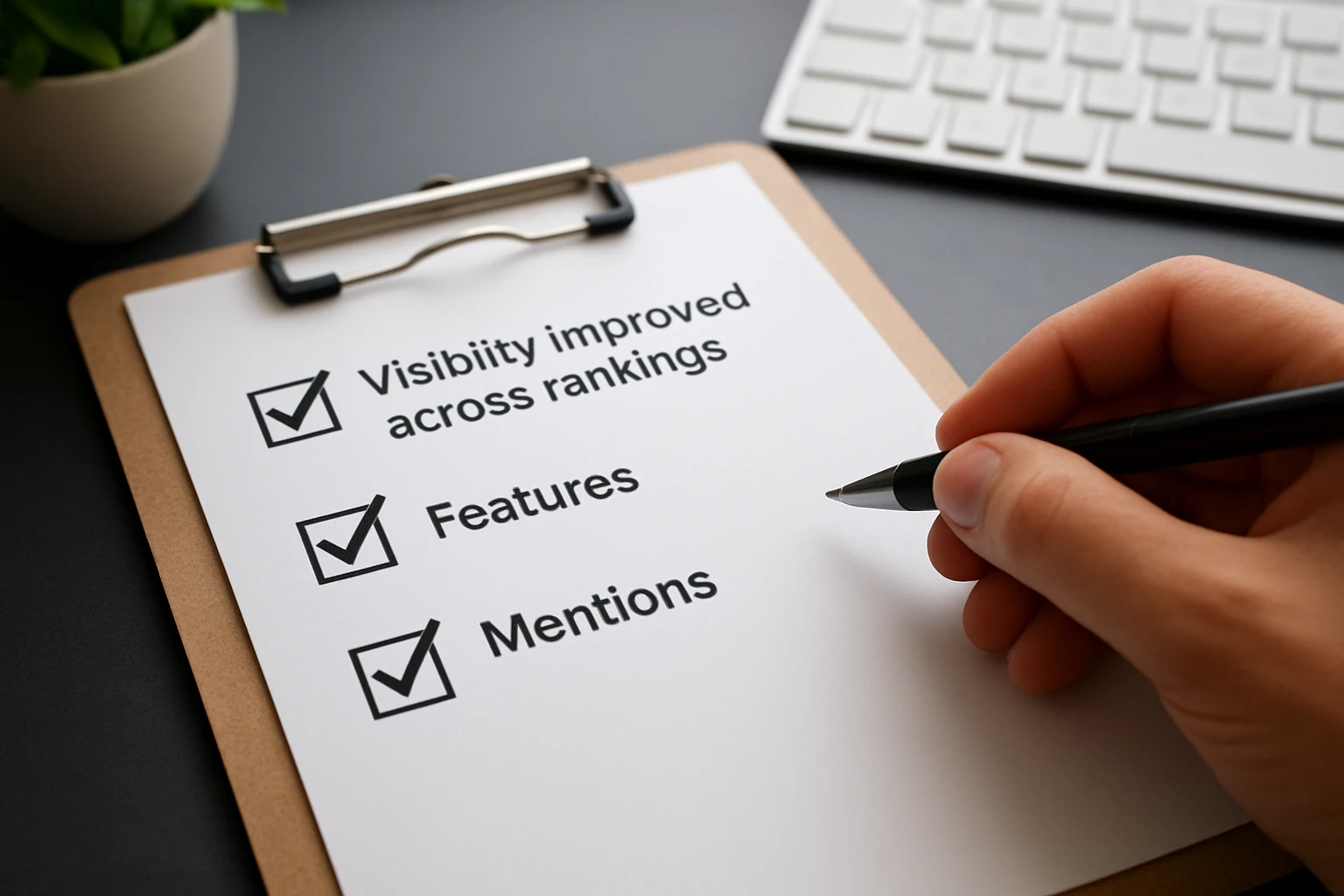
Do not assume the work landed. Verify it. Brand visibility improves when the brand appears more often, more prominently, and more accurately across different surface types.
Review ranking movement for branded and category queries
Check exact-brand queries first, then brand-plus-intent combinations. Your homepage may already rank first for the company name, but that tells you almost nothing about “brand pricing,” “brand integrations,” or “brand alternatives.” Those modifiers often reveal whether the right supporting pages are doing their job.
- Track pure branded terms, product-branded terms, and brand-plus-category phrases.
- Look for page swaps. A docs page outranking your product page can be a win or a problem depending on intent.
- Note whether a third-party result moved above or below a brand-owned result.
- Review trends over 2, 4, and 8 weeks instead of reacting to one-day noise.
Classic rank position still matters. It just does not explain the whole branded experience anymore.
Track SERP features, knowledge panels, and AI mentions
Feature visibility is query-specific and unstable. A review snippet can appear one week and vanish the next. A knowledge panel may populate new fields. AI answers may cite different sources than the organic top five. You need a record of where your brand appears, how it is described, and whether the source is yours.
| Surface Type | What to Check | Evidence to Save |
|---|---|---|
| Sitelinks | Are the right brand pages shown? | Mobile and desktop screenshots |
| Knowledge panel | Is the company description, logo, and website accurate? | Annotated screenshot |
| Reviews | Do review sites outrank your pages for trust-heavy queries? | Rank log plus screenshot |
| AI summaries | Is the brand mentioned, summarized correctly, or cited at all? | Prompt log and capture |
| Video, image, or news blocks | Are the assets current and on-message? | Result capture by date |
Do not stop at position tracking; brand visibility means being visible, cited, and clicked across the full results page.
Compare the latest screenshots against the baseline
Pull up the before-and-after images side by side. This is where you catch changes that ranking tools miss. Maybe your rank stayed the same, but a competitor ad disappeared, a sitelink improved, or a review page dropped below your pricing page. That is still progress.
- Compare the same query, device, location, and browser state.
- Check message quality, not only placement.
- Mark wins, regressions, and unexplained changes.
- Send one annotated summary to stakeholders with the exact screenshots attached.
Visibility should be evaluated beyond rank position alone. Being seen clearly often matters as much as being ranked highly, especially on mobile where only a few elements fit above the fold.
Common Misses Checklist: Fix the Gaps Teams Usually Overlook
Most brand visibility problems are not dramatic. They are quiet. A stale profile here. A vague H1 there. Enough of those gaps create a messy entity picture, even when the site looks polished in a launch deck.
Do not optimize only the homepage
The homepage gets attention because it is visible. It is rarely enough. Product pages, category pages, author pages, support articles, pricing pages, comparison pages, and leadership bios all help shape branded search outcomes.
- Audit every page likely to appear for a branded query.
- Improve page-level titles and headings across the full journey.
- Strengthen internal links from high-authority pages to under-supported brand assets.
- Include help-center and documentation content if your customers search support terms directly.
I see this mistake constantly in SaaS teams: the homepage is immaculate, while the pricing page still carries last year’s messaging and the help center uses a retired product name.
Do not ignore weak or inconsistent brand naming
Pick one naming system and stick to it. If your site says “Acme Cloud,” your LinkedIn page says “Acme,” and your review profile says “Acme Analytics Platform,” you dilute recognition. Abbreviations can help in copy. They can also fragment entity understanding when used carelessly.
- Choose one canonical company name.
- Choose one canonical product name for each offer.
- Document approved abbreviations and where they may appear.
- Update headers, footers, bios, and directory profiles to match.
This sounds basic. It is not. Rebrands, mergers, and naming shortcuts break branded relevance faster than many technical issues do.
Do not leave profiles, bios, and review signals stale
Freshness matters when users compare trust signals. A neglected LinkedIn About section, a 2023 founder bio, or unanswered reviews can weaken how credible the brand looks when someone lands on your result. Review and community signals also shape whether third-party pages dominate queries that should support your brand instead of overshadowing it.
- Refresh external bios every quarter.
- Check review platforms for outdated positioning or broken links.
- Respond to important reviews and keep profile details current.
- Update logos, screenshots, and category tags on external platforms.
- Revisit Reddit, GitHub, YouTube, or community pages that often appear for your brand.
The fastest way to lose brand visibility is to optimize one page and ignore the rest of the entity graph.
This work is not glamorous. It is durable. And if you want a scalable system, durable beats flashy every time.
This process turns brand visibility SEO into a trackable operating rhythm.
When you baseline the SERP, tighten entity signals, and verify changes against dated screenshots, you stop guessing and start seeing what actually improved.
Where will your team start first — branded queries, stale bios, weak internal links, or the AI surfaces your current brand visibility SEO plan still ignores?
Strengthen Search Presence With SEOPro AI
Get LLM SEO tools for ChatGPT, Gemini, and other agents—plus publishing, clustering, schema, and drift monitoring—to scale organic traffic, SERP features, and model mentions.
See Platform