Best AI Brand Visibility Tools 2026

At 8:12 a.m., a growth lead opens three tabs and sees their brand quoted in one AI answer, skipped in another, and misrepresented in a third.
If you run SEO for a SaaS company, manage content for a publisher, or report performance for an agency, AI brand visibility is no longer a curiosity. It is part of how buyers discover, compare, and remember you across ChatGPT, Perplexity, Claude, Gemini, and the rest.
The tricky part is not the concept. It is the tool choice. Some teams need a wide-angle view first. Others need to know exactly which page, prompt, or citation is driving the result. This guide focuses on the core modules and trackers commonly used in AI search intelligence workflows, then shows where each one fits in a real SEO and content workflow.
Selection criteria for AI brand visibility tools in 2026
When I evaluate AI visibility software, I start with three filters. Not price. Not screenshots. I want to know whether the tool covers the answer engines that matter, whether it explains the “why” behind the answer, and whether the team can actually use it every week without friction.
Watch This Helpful Video
To help you better understand similarweb ai brand visibility, we've included this informative video from Skill Leap AI. It provides valuable insights and visual demonstrations that complement the written content.
Coverage across major AI answer engines
Coverage is the first screen. Look for support across the major AI systems your audience actually uses, including ChatGPT, Perplexity, Claude, Grok, Gemini, and Deepseek. That breadth matters because brand visibility is not uniform across models.
A B2B security company might show up strongly in Claude for technical comparisons, then fade in Perplexity for commercial queries. A publisher may see the reverse. If you only track one assistant, you risk optimizing for the wrong behavior pattern.
Visibility depth: share of voice, citations, prompts, sentiment
Coverage tells you where to look. Diagnostic depth tells you what to change. Share of voice helps you benchmark presence against competitors. Citation analysis shows which sources or URLs influence the answer. Prompt analysis reveals the wording that triggers mentions. Sentiment analysis tells you whether visibility is helping or hurting the brand.
Choose the tool that answers the question you actually need: “Were we mentioned? Why? In what tone?”
I have seen teams celebrate a rising mention count and miss the real story — the brand was present, but framed as expensive, limited, or unreliable. Raw visibility can be a vanity number if you cannot inspect the narrative behind it.
Workflow fit: reporting, exports, and team usage
The third filter is workflow fit. That matters if your SEO lead, content manager, and market research team all need the same operating picture.
In plain English, ask whether the tool fits the way your team already works. Can you build a Monday morning readout from it? Can an agency turn findings into a client deck quickly? Can PR, SEO, and content use the same evidence without arguing over definitions?
| Filter | What to check | Why it matters |
|---|---|---|
| Coverage | Support for ChatGPT, Perplexity, Claude, Grok, Gemini, and Deepseek | You avoid optimizing for a single model while your audience uses several. |
| Diagnostic depth | Share of voice, citations, prompts, and sentiment | You move from “we appeared” to “here is what changed the result.” |
| Workflow fit | Reporting, exports, APIs, and cross-team usability | The data becomes operational instead of sitting in one specialist’s tab. |
#1 AI Search Intelligence — best all-in-one starting point
Summary: This is the umbrella workspace for teams that want AI visibility, diagnostics, and model coverage in one place.
Best for: SEO and growth teams that need a broad baseline before going deep on one metric.
What the suite includes
The umbrella product area is designed for AI search intelligence workflows. Inside that space, the lineup can include share of voice monitoring, citation analysis, prompt analysis, sentiment analysis, and assistant-specific trackers. The same area also often includes GEO and AEO-oriented tools, which signals that the product is built not just for monitoring, but for ongoing optimization work.
Why it matters for cross-functional teams
This kind of umbrella system helps when three groups need different answers from the same underlying signal. SEO wants share trends. Content wants prompt language. PR wants citation sources. Brand wants sentiment. If those live in separate tools, your weekly review turns into a reconciliation exercise instead of a decision meeting.
That is why this is the best starting point for many mid-market and enterprise teams. It gives you a common operating view first, then lets you split into specialized workflows.
Where it fits in the SEO/AI visibility stack
Use the suite as your AI answer-layer hub, not as a replacement for Google Search Console, GA4, or your rank tracker. It sits above classic search reporting and tells you how your brand is surfacing inside AI-generated responses. For teams building a new reporting stack in 2026, that distinction is practical. Search rankings tell you what the SERP did. AI visibility tells you what the answer engine did.
#2 AI Share of Voice Monitor — best for competitive benchmarking
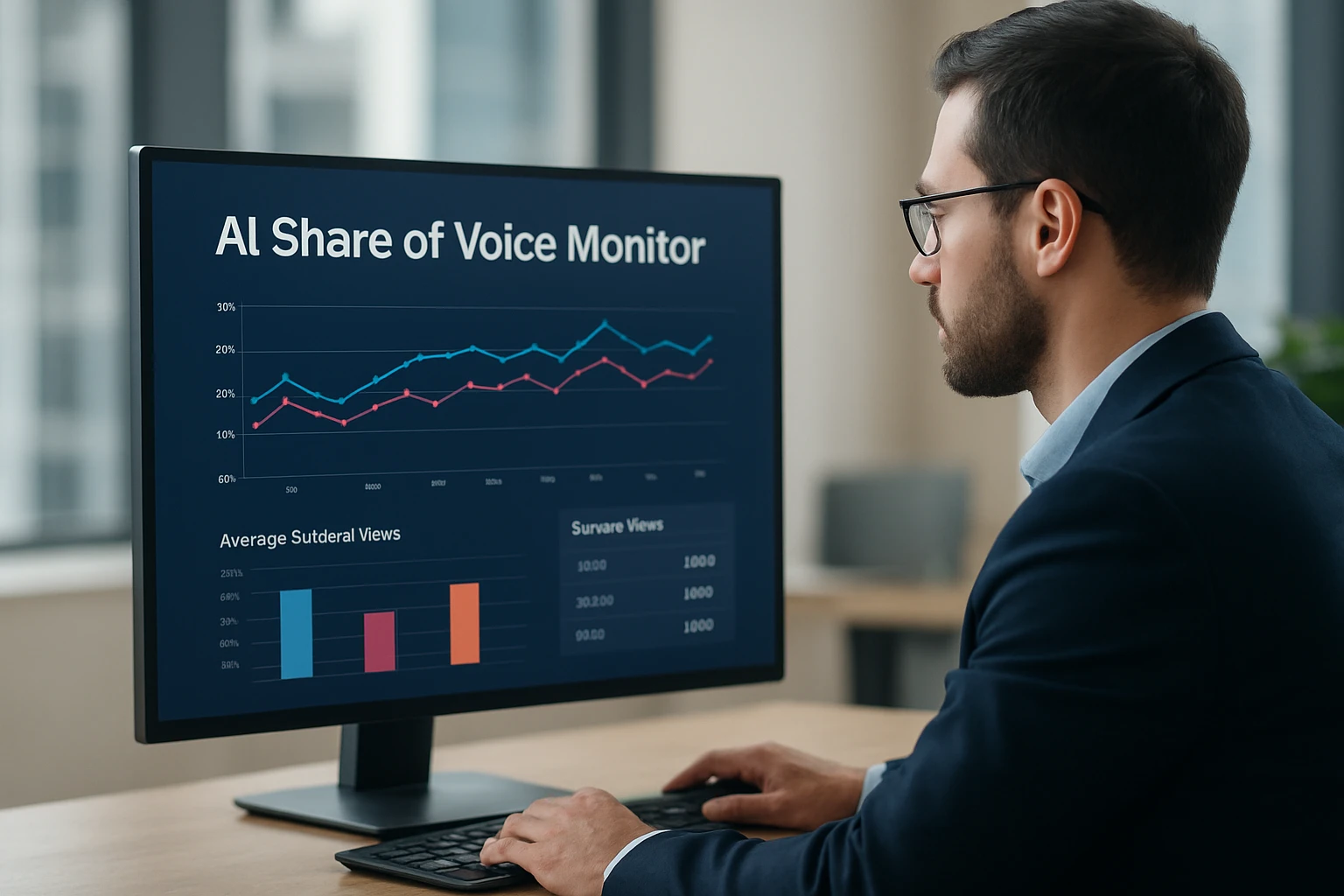
Summary: This is the fastest way to see whether your brand is gaining or losing visibility against direct competitors in AI answers.
Best for: Teams that need an executive-friendly benchmark before they invest in deeper analysis.
What share of voice tells you
AI Share of Voice Monitor is part of the broader AI search intelligence workflow, alongside citation analysis, prompt analysis, and sentiment analysis. That is a strong hint about its role: this is your top-line scorecard. It shows presence, relative strength, and movement over time.
If you sell project management software and your competitors are Asana, Monday.com, and ClickUp, share of voice tells you whether your brand enters the conversation at all when AI systems answer category questions. You do not need perfect diagnostic detail on day one. You need to know whether you are on the board.
How to benchmark against competitors
Start with a clean competitor set. Keep it tight. Mix direct rivals with one aspirational player if needed, but do not compare a niche B2B brand against every giant in software. Then segment prompts by intent: category queries, comparison queries, problem-solution queries, and branded queries. That will give you a much more truthful benchmark than one blended percentage.
If you can only track one metric first, start with share of voice before optimizing anything else.
What to review week over week
Look for directional changes, not random daily noise. Review whether visibility gains came from a broader prompt set or a single cluster. Check whether a competitor suddenly dominates one intent type. Then connect that shift back to recent content launches, digital PR coverage, product announcements, or documentation updates.
That weekly rhythm is where share of voice earns its keep. It helps you decide whether to dig into citations, prompts, or sentiment next.
#3 AI Citation Analysis — best for source tracking
Summary: This is the most actionable layer for understanding which pages and domains are shaping AI answers.
Best for: Teams that need clear evidence of what influenced a mention, omission, or mischaracterization.
Why citations are more useful than raw mentions
AI Citation Analysis belongs in the same broader AI search intelligence stack as share of voice, prompt, and sentiment analysis. That matters because citations are where visibility turns operational. A brand mention without a source trail is interesting. A brand mention tied to a specific help article, comparison page, or third-party review is fixable.
No citation map, no fix.
If an AI answer keeps citing a two-year-old review, a stale pricing page, or a Reddit thread that no longer reflects your product, you now know where the narrative is coming from. That is the start of an actual response plan.
How citation patterns inform SEO and PR
Citation analysis is where SEO and PR finally stop talking past each other. SEO can improve the pages most likely to be cited — buying guides, comparison pages, docs, glossaries, and category explainers. PR can focus on third-party sources that repeatedly influence answers. If G2, Gartner, TechCrunch, or a niche industry publication shows up again and again, you have a clear outreach and content alignment target.
Which pages or domains to monitor
Monitor three buckets. First, your own pages: product pages, docs, pricing, thought leadership, and customer stories. Second, controlled third-party pages like app marketplaces or review profiles. Third, independent publications and forums. In practice, the mix varies by sector. A developer tool may depend heavily on GitHub and docs. A DTC brand may be shaped more by publisher reviews and Reddit threads.
#4 AI Prompt Analysis — best for intent research
Summary: This is the layer that shows how users phrase questions when AI systems mention your brand — or fail to.
Best for: Content teams building briefs, editorial calendars, and AI-informed topic maps.
Prompt clusters and user intent
AI Prompt Analysis helps you understand not just whether a brand appears, but under which phrasing patterns it appears. The difference between “best CRM for startups,” “HubSpot vs Salesforce for SMB,” and “how to track sales pipeline” is not cosmetic. It is intent.
Group prompts into clusters instead of reading them one by one. Decision-stage prompts often behave differently from educational prompts. Comparison prompts behave differently from “how do I” prompts. The cluster view is where content strategy becomes repeatable.
What gaps in content briefs it reveals
This is one of the most useful tools for editors. It exposes missing angles in briefs that looked complete on paper. Maybe your team wrote a feature page, but missed the evaluator questions that trigger AI mentions. Maybe you covered “best payroll software” but not “payroll software for 50-person teams” or “payroll software with contractor support.”
Those gaps are rarely visible in a standard keyword list. They become obvious when you inspect the prompts that actually surface answers.
How to turn prompts into page ideas
Use prompt clusters to create new comparison pages, FAQ sections, glossary entries, implementation guides, and persona-specific landing pages. Then align those with your internal linking and schema work. A good prompt dataset does not just improve AI visibility. It sharpens your editorial roadmap for the next quarter.
#5 AI Sentiment Analysis — best for reputation monitoring
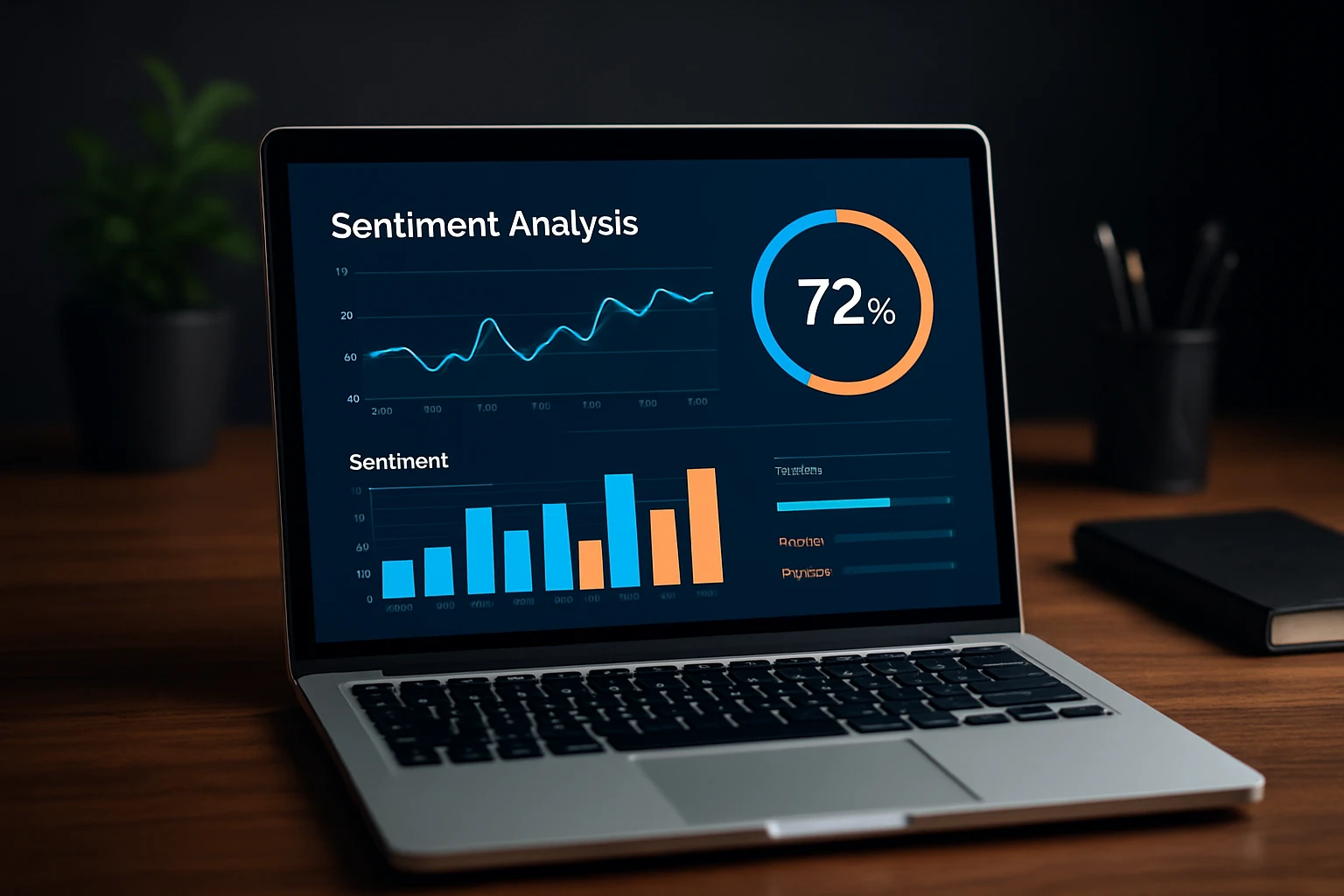
Summary: This is the tool for spotting whether AI systems frame your brand positively, neutrally, or negatively over time.
Best for: Brand, PR, and product marketing teams that need early warning before a weak narrative hardens.
Positive vs. neutral vs. negative framing
AI Sentiment Analysis sits alongside share of voice, citation analysis, and prompt analysis in the broader AI visibility workflow. That grouping is sensible. Visibility without narrative quality is incomplete. A brand can appear often and still lose trust if the framing skews negative or faintly dismissive.
Visibility without sentiment is only half the story.
Positive framing might emphasize reliability, innovation, or strong support. Neutral framing often reduces you to a category participant. Negative framing can center on price, accuracy, security, or missing features. Those are very different problems, and they require different fixes.
Brand risk signals to watch
Look for repeated language patterns, not one-off quirks. If answers keep pairing your name with “expensive,” “limited,” or “hard to use,” treat that as a signal. If neutral summaries omit your strongest differentiators, that is a softer but still meaningful risk. Over a month, repeated neutral omission can be as damaging as direct criticism because it makes you forgettable.
How sentiment should change messaging
Sentiment data should shape both content and messaging. Negative price framing may call for clearer packaging pages, stronger ROI proof, or comparison content. Weak reliability perception may point to customer evidence, uptime proof, or documentation improvements. For many teams, sentiment analysis becomes the bridge between SEO reporting and message strategy.
#6 ChatGPT, Perplexity, Claude, Grok, Gemini, and Deepseek Traffic Trackers — best for model-by-model monitoring
Summary: These trackers help you isolate visibility differences across major AI systems instead of blending everything into one average.
Best for: Teams whose audience behavior differs by model, region, or use case.
Which assistant each tracker covers
ChatGPT, Perplexity, Claude, Grok, Gemini, and Deepseek trackers help treat model behavior as something worth analyzing separately, not as a single undifferentiated AI channel.
It is also worth noting that these work best as part of a broader AI search intelligence workflow, not as isolated standalone tools. That makes sense if you want model-level checks without abandoning the rest of the workflow.
When model-level data matters more than blended reporting
Blended reporting is fine for executive summaries. It is weak for diagnosis. If your audience skews technical, Claude and ChatGPT may matter more. If your audience uses answer engines for fast sourcing, Perplexity may deserve special attention. If your brand is global, Gemini behavior may differ from what you see elsewhere. Model-level reporting matters most when performance diverges and you need to know where that divergence starts.
If you only track one model, you will optimize for one answer engine and miss the rest of the market.
How to use the results in reporting and optimization
Use assistant-specific tracking to explain outliers. If share of voice falls overall, check whether one model drove the drop. If citations improve but sentiment worsens, look at which assistant changed its framing. Then feed those findings back into content briefs, page updates, PR targeting, and stakeholder reporting.
| Tracker | Best use | What it helps answer |
|---|---|---|
| ChatGPT Traffic Tracker | Broad monitoring for mainstream AI discovery | Are we visible where general users ask the most common questions? |
| Perplexity Traffic Tracker | Source-heavy answer monitoring | Which citation-driven experiences are shaping our brand story? |
| Claude, Grok, Gemini, Deepseek Trackers | Segmented audience and regional analysis | Where do model-specific differences create risk or opportunity? |
How to choose the right option
Most teams do not need every layer on day one. They need the right first layer. Start with the channel your audience already uses, then add diagnostic depth as your reporting matures and the organization learns how to act on the data.
Choose by audience channel and model coverage
If you know your audience lives in one assistant more than the others, start there. A publisher seeing referrer changes from ChatGPT has a different first step than a B2B team hearing more Perplexity mentions in sales calls. Once you confirm the core channel, add broader model coverage to avoid blind spots.
Start with the model your audience already uses, then expand into citations, prompts, and sentiment once the baseline is in place.
Choose by reporting depth and automation needs
If leadership wants one headline number, start with share of voice. If editors need to know what to publish next, add prompt analysis. If your brand team worries about narrative risk, add sentiment. If the question is “what source caused this,” citation analysis usually becomes the next buy.
For broader SEO operations, AI search intelligence platforms often also include rank tracking, backlink analytics, site audits, keyword research, trend analysis, and AI SEO strategy workflows. That wider context matters when you want to connect AI visibility findings to classic SEO execution instead of keeping them in a separate box.
Choose by your existing stack
If your organization already uses other analytics or SEO suites, integration and reporting consistency may matter as much as the feature list. API access is relevant for BI teams, agencies, or in-house analysts who want data pipes rather than manual screenshots.
And if your business already works across multiple intelligence or reporting systems, the practical win is not just visibility. It is shared context.
| If your main need is... | Start with | Add next |
|---|---|---|
| Executive benchmarking | AI Share of Voice Monitor | AI Citation Analysis |
| Content planning | AI Prompt Analysis | AI Share of Voice Monitor |
| Brand reputation control | AI Sentiment Analysis | AI Citation Analysis |
| Channel-specific monitoring | Assistant traffic trackers | AI Share of Voice Monitor |
| One broad starting point | AI Search Intelligence | Whichever diagnostic layer answers your first recurring question |
This stack makes AI visibility measurable instead of mysterious.
For most teams, AI brand visibility works best as a modular system: begin with coverage, then layer share of voice, citations, prompts, and sentiment as the team gets sharper.
If your brand looks different across ChatGPT, Perplexity, and Gemini this month, which layer would give you the first answer you can actually act on?
Scale Visibility With SEOPro AI
SEOPro AI pairs an AI brand mention platform with automated content creation, publishing, schema, and monitoring workflows to scale organic traffic, SERP features, and AI mentions.
Explore Platform