7 Best Topical Authority Tools for 2026

Monday, 8:17 a.m. An SEO lead drops one seed keyword onto the whiteboard, stares at a blank content calendar, and starts moving sticky notes into clusters. One note becomes three. Three become twelve. Soon you can see the outline of a real content system taking shape — pillar page in the middle, support articles around it, internal links penciled in on the edges. That is the moment a topical authority tool proves whether it is useful or just noisy.
If you run SEO for a SaaS brand, publisher, agency, or growth team, you already know the problem. A spreadsheet with 400 keywords is not a strategy. You need a way to turn one subject into connected pages, identify what your competitors cover that you do not, brief writers quickly, and keep expanding the cluster without publishing filler.
That is what this guide is built for. It is for teams trying to move from raw keyword research to durable topic coverage — the kind that helps you earn trust from readers and stronger visibility from search engines.
In plain language, topical authority means your site is seen as deeply credible on a specific subject. That is different from domain authority, which speaks to overall site strength across many subjects. A niche pet publisher can be highly trusted on dog training without being authoritative on, say, tax law. When you are choosing a topical authority tool, that distinction matters.
Selection criteria: what makes a topical authority tool worth using
I do not judge these tools by how many graphs they throw at you. I judge them by whether they help you move from a seed keyword to a cluster, from a cluster to better briefs, and from briefs to pages that deserve to rank. A practical benchmark is whether the tool saves time with keyword clustering, helps you discover content gaps, analyze competitors, strengthen internal linking, and improve ranking potential.
Watch This Helpful Video
To help you better understand topical authority tool, we've included this informative video from Gen AI University. It provides valuable insights and visual demonstrations that complement the written content.
There is also a bigger SEO truth behind the feature list. Search engines reward trusted experts with comprehensive, in-depth content and intelligent keyword mapping. That means the best tool is rarely the one with the broadest data set alone. It is the one that helps you organize coverage into something publishable.
| Criterion | What Good Looks Like | Why It Matters |
|---|---|---|
| Clustering | Turns one seed term into related subtopics and page groups | Helps you build real topic maps instead of isolated articles |
| Gap finding | Shows missing subtopics, weak pages, and competitor openings | Keeps content plans grounded in actual opportunity |
| Workflow fit | Exports, briefs, reporting, and handoff options that match your team | Reduces friction between research and publishing |
| Internal linking support | Makes relationships between pages visible | Strengthens cluster structure and discoverability |
Cluster topics, don’t just list keywords
A real topical authority workflow starts with relationships, not volume columns. If your seed term is “dog training,” you should quickly see supporting topics like crate training, leash walking, puppy biting, recall, and behavior problems. If your seed term is “payroll software,” you should be branching into compliance, onboarding, tax filing, integrations, and pricing models. That is strategic clustering.
Tools that only surface adjacent phrases leave you doing the hard part by hand. They give you ingredients, not a recipe. And if you are still rebuilding the cluster in Google Sheets after the tool has done its work, you are paying for research while still doing planning manually.
Practical rule: if a tool cannot help you move from seed keyword to topic cluster, it is not really a topical authority tool.
Find content gaps and competitor opportunities
Good tools also show you where your coverage is thin. That may be an entire missing subtopic, like “customer onboarding checklist” inside a broader onboarding software cluster. Or it may be a weak page that covers implementation but ignores pricing, templates, or common failure points. Either way, the opportunity is not in the keyword alone. It is in the missing context around the topic.
This is where topical authority becomes more useful than old-school keyword targeting. You stop asking, “What can I rank for next?” and start asking, “What does a trusted source on this subject still need to cover?” For agencies working across five or ten client categories, that is a far more durable planning lens.
Match the tool to your publishing workflow
Workflow fit is where good buying decisions usually happen. A strategist may love a tool’s clustering output, but if your writers live in Google Docs, your editors live in Notion, and your publishing happens in WordPress, the tool has to cooperate with that rhythm. If it does not, the content plan slows down before the first draft ships.
I would also look for signs that the tool respects how modern teams work: clear briefs, usable exports, simple reporting, and enough structure to support internal linking as the cluster expands. Topical authority is not just research. It is an operating model.
Planning and clustering tools for building topic maps
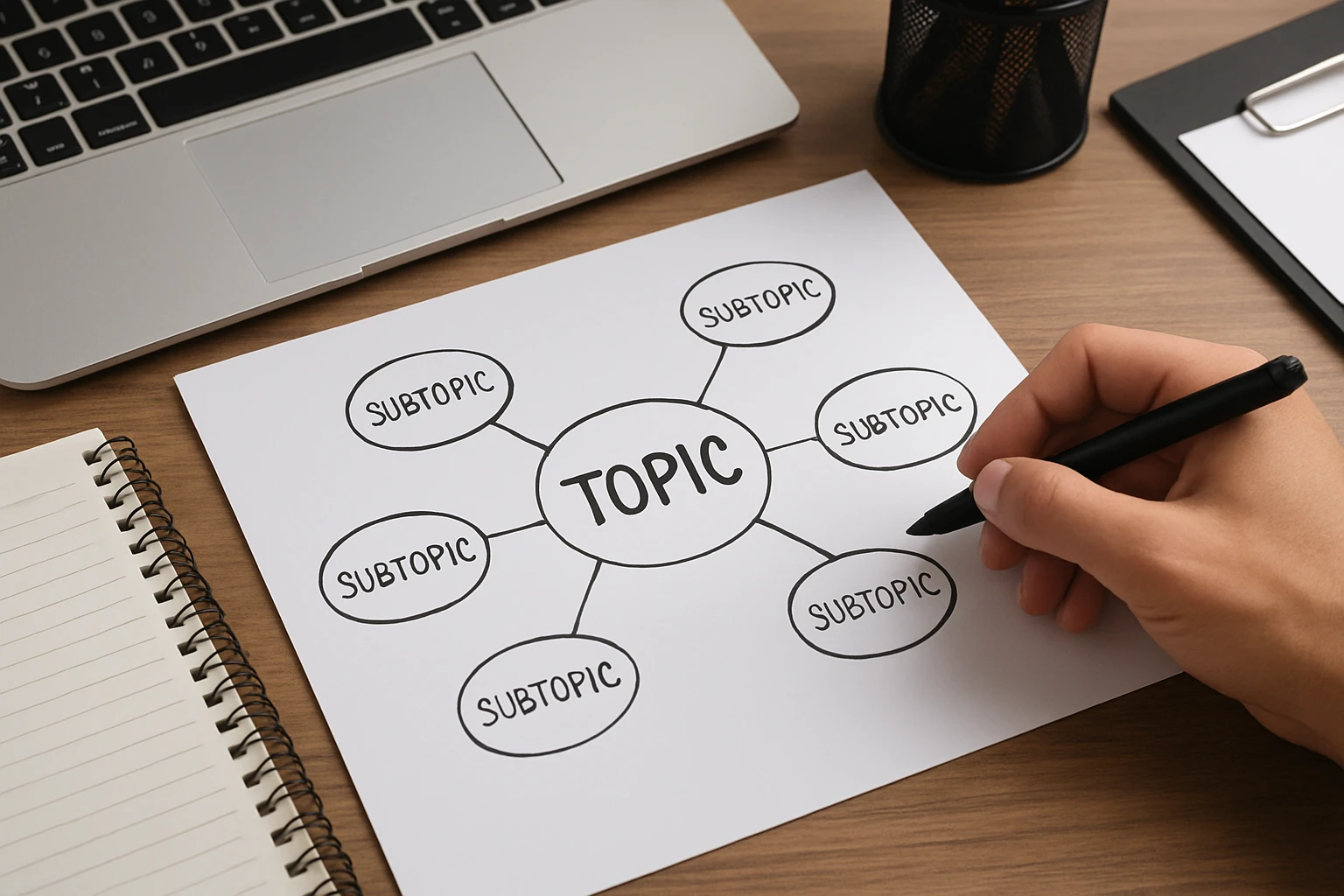
If your first job is turning one keyword into a structured content plan, this is where I would start. The tools often cited in this category address the planning stage from a different angle, and that grouping makes sense. They all help with topic discovery, cluster building, and related planning workflows.
Search Atlas describes the ideal workflow well: give a tool a seed keyword, let it map the subject, find supporting topics, group related keywords, and turn that into publish-ready pages. That is exactly what good cluster planning should feel like. Before you brief anyone, the architecture should already be visible.
Fastest win: build the cluster before you brief the writer.
Rank Tracker by SEO PowerSuite
Summary: Rank Tracker is a strong starting point when you want hands-on control over research and clustering inside a classic SEO workflow. It fits the operator who wants to start with a seed keyword, expand it into subtopics, group terms logically, and keep one eye on rankings while the cluster grows.
What stands out is the research-first feel. It is useful when your planning process is still driven by SEO leads rather than a large editorial team. For example, if you are mapping “B2B email deliverability” into setup guides, authentication pages, warm-up advice, and monitoring topics, this kind of tool gives you a workable planning spine without forcing you into an editorial-only view.
Best for: SEO specialists and agencies that want keyword depth, cluster control, and follow-through into ranking performance.
RankDots
Summary: RankDots appeals to teams that want a more focused path from topic discovery to cluster building. Rather than acting like a giant multi-department suite, it feels better suited to the operator who wants to see topical relationships quickly and make decisions without wading through layers of unrelated tooling.
That focus can be a strength. Lean teams often do not need five overlapping dashboards; they need a clear map. If your content lead is building clusters in the morning and assigning drafts by the afternoon, a tighter topical workflow is often faster than a broader platform with more moving parts.
Best for: consultants, lean content teams, and in-house marketers who want straightforward clustering without enterprise sprawl.
MarketMuse
Summary: MarketMuse has long been useful for planning depth, content inventories, and identifying where a site’s coverage is shallow. Once you know the category you want to own — say “HR software,” “construction estimating,” or “pet nutrition” — it helps you think in terms of breadth and depth, not just article count.
Its real strength shows up when a site already has dozens or hundreds of URLs. In that case, the challenge is not finding any topic; it is deciding which page deserves a refresh, which gap deserves a new article, and where internal coverage is too thin to signal expertise. That is a more editorial planning problem, and MarketMuse fits it well.
Best for: publishers, larger content programs, and teams that need prioritization as much as discovery.
Content optimization tools for briefs, drafts, and on-page coverage
Once the topic map exists, the work changes. Now you need every page in the cluster to be more complete, more relevant, and easier to publish. This is where many teams slip. They create pages just to “cover the topic,” but the pages are thin, repetitive, or too shallow to build trust.
That is a mistake. Topical authority is built through high-quality, comprehensive content, not by filling a calendar with near-duplicate pages. Google rewards trusted experts with in-depth coverage, and that means optimization tools should help you improve substance, not just chase a score.
Contrarian take: optimization tools should sharpen a topic map, not replace one.
Surfer SEO
Summary: Surfer SEO works best in the messy middle — after research, before publishing. It helps turn a topical plan into usable briefs, page structures, and coverage checks so writers do not miss obvious subtopics. If you already know the article belongs in the cluster, Surfer helps you make that article more complete.
In practice, that matters most when you publish at volume. A team producing 15 or 20 articles a month cannot afford endless revision cycles because the brief missed “setup steps,” “pricing factors,” or “common mistakes.” Surfer helps reduce that editorial drag. Just do not ask it to invent the cluster for you. It performs best when the topic architecture already exists.
Best for: content ops teams, agencies, and growth programs that need repeatable briefs and smoother writer handoffs.
Clearscope
Summary: Clearscope is often the cleaner editorial choice when you want optimization without overwhelming the writer. It helps improve topical coverage and clarity in a way that usually feels less like a technical audit and more like an informed editorial brief.
That difference matters. Writers do better work when the tool supports judgment rather than replacing it. If you are trying to build authority in a category like fintech compliance or customer success onboarding, readability and completeness carry real weight. Clearscope tends to fit teams that want structure, but still care deeply about voice, clarity, and human trust signals.
Best for: editorially minded SaaS teams, publishers, and agencies that want better briefs without turning every draft into a spreadsheet exercise.
Research and ecosystem tools for competitive visibility

Some teams do not need a standalone planner or optimizer first. They need a bigger research layer — something that helps them see who owns a topic, where competitors are strong, and which subjects deserve investment before the next quarter’s content plan gets locked.
That is where Ahrefs and Semrush earn their place. Both are broader platforms, but both can play an essential role in topical authority work when the goal is competitive visibility as much as content production.
Remember: a site can be strong on one subject even if it is not broadly authoritative everywhere.
| Tool | Strongest Use in Topical Authority Work | Best For |
|---|---|---|
| Ahrefs | Reverse-engineering competitor clusters and spotting topic gaps | Agencies and in-house SEO teams |
| Semrush | Combining topic research, competitor visibility, and broader SEO reporting | Cross-functional teams that need one shared platform |
Ahrefs
Summary: Ahrefs remains one of the best tools for seeing how a topic behaves in the wild. It is especially useful when you want to understand which pages support a competitor’s rankings, how their cluster is structured, and where you can publish something meaningfully better or more complete.
I like Ahrefs most when the assignment starts with a rival, not a blank slate. If a competitor suddenly dominates “zero trust security” or “warehouse management software,” you can inspect the supporting articles, related keyword patterns, and overall content architecture behind that visibility. That makes it easier to plan a cluster that responds to the market rather than guessing from the inside out.
Best for: teams that make competitor analysis a regular planning habit and want topic opportunity grounded in real SERP behavior.
Semrush
Summary: Semrush is the broad ecosystem pick. It brings together topic research, competitor analysis, and a visible topical authority angle, which makes it attractive for teams that want research, planning context, and reporting in one place.
The Spruce Pets example in Semrush’s own guidance is a useful illustration. The site is shown as having high topical authority for “dog training,” not because it published one standout page, but because it consistently covers pet care subtopics in a way that builds trust over time. That is the point many teams miss. Topical authority compounds through connected coverage.
Best for: brand and agency teams that want a broad SEO platform with enough topical visibility to inform both strategy and reporting.
How to choose the right option for your team
This is where shiny demos usually lose to operational reality. The right decision factors are data quality, clustering depth, integration with your workflow, reporting and usability, and budget and scalability. I would add one more filter from experience — does the tool actually help your team ship better pages every week?
Best-fit rule: pick the platform that matches how your team ships content, not the one with the longest feature list.
| Team Situation | What to Prioritize | Good Starting Fits |
|---|---|---|
| Solo SEO or lean content team | Fast clustering, simple briefs, low friction | RankDots, Surfer SEO, Ahrefs |
| Agency managing multiple clients | Research depth, reporting, competitor views | Rank Tracker, Ahrefs, Semrush |
| Publisher or large content operation | Inventory analysis, refresh prioritization, editorial control | MarketMuse, Clearscope, Semrush |
| Cross-functional brand team | Shared dashboards and integrated workflow | Semrush, Surfer SEO |
Choose by team size and publishing volume
If you publish four articles a month, you probably do not need an enormous enterprise setup. You need clean clustering, clear gaps, and briefs writers can act on. If you publish 40 pieces a month across several categories, then workflow consistency becomes far more valuable. A tool that saves each editor 20 minutes per brief adds up fast.
Start with the cadence you can sustain. Then build clusters around your main themes, not every keyword you can scrape. The same best-practice advice points the same way: start with seed keywords, build clusters around core subjects, regularly update and expand content, and strengthen internal linking as the cluster matures.
Choose by integrations and reporting needs
Some teams buy a research tool and only later realize the output dies in a CSV export. That is a workflow tax. If your writers work in Google Docs, your project manager lives in Asana, and your publisher uses WordPress, ask how the tool supports those handoffs before you buy.
Reporting matters too, especially in agencies and multi-stakeholder teams. You want enough visibility to show progress at the topic level, not just at the single-keyword level. And do not forget trust signals. If a tool pushes you toward shallow article variants that ignore author credibility, firsthand insight, or page quality, it is pulling you away from the E-E-A-T signals that matter.
Choose by budget and scalability
Buy for the next two quarters, not just this month. A cheap tool that cannot support refresh cycles, gap expansion, or internal linking across 100 pages becomes expensive later. The opposite mistake is just as common: paying for a broad platform when your immediate bottleneck is simply creating solid topic clusters from a handful of seed terms.
I would ask four blunt questions before signing anything:
- Can this tool move me from one seed keyword to a defensible cluster?
- Can it show real content gaps against competitors, not just more topic ideas?
- Can writers and editors act on the output without rebuilding it from scratch?
- Can the system scale as we refresh, expand, and internally link the cluster over time?
If the answer to two of those is no, keep looking. The biggest mistakes are still the old ones: over-focusing on keywords instead of intent, creating thin pages just to fill a gap, and treating authority like a score instead of an earned pattern of coverage.
A strong topical authority tool turns a seed keyword into a defensible cluster, then helps you keep deepening that subject with pages readers can actually trust.
Start with your bottleneck — planning, briefing, or competitive research — and the right choice gets clearer fast. Which topical authority tool would remove the most friction from your next 20 pages?
Grow Topic Coverage With SEOPro AI
LLM SEO tools for ChatGPT, Gemini, and other AI agents plus automated publishing, clustering, linking, schema guidance, and drift monitoring for faster organic growth.
Explore Platform