Top 7 Brand Visibility Tactics for 2026

At 8:17 on a Monday, you open three tabs before the coffee cools: a Google result, a chatbot answer, and a competitor mention dashboard. Your brand appears in only one. A rival owns the snippet, shows up in the AI summary, and gets quoted by a trade publication your buyers actually read.
That is what brand visibility feels like now. Brand awareness is broader — whether people know you exist at all. Brand visibility is narrower and more operational: where you show up, how often you appear, and whether your presence holds up against competitors across search, AI answers, and third-party citations.
If you run SEO, content, growth, an agency account team, or a publishing operation, this is for you. Discovery no longer happens in one place. A prospect might see a featured snippet at 9:00, a Gemini or ChatGPT answer at 9:03, and a peer recommendation in a newsletter before lunch. If your brand only owns one surface, you are easier to miss than your analytics report suggests.
Selection criteria for brand visibility
Built for search and AI surfaces
Watch This Helpful Video
To help you better understand brand visibility, we've included this informative video from The Futur. It provides valuable insights and visual demonstrations that complement the written content.
At Adobe Summit in Las Vegas in April 2026, Adobe said AI interfaces and agents are becoming a primary way customers discover, evaluate, and engage brands. That shifts the bar. A tactic has to help on classic search pages and on AI-driven discovery surfaces, not just bring a short spike in clicks from one channel.
In practice, that means your content has to be easy to retrieve, easy to quote, and easy to trust. A page that ranks but never earns a snippet, citation, or answer-box mention is doing only part of the job.
Scalable for lean content and SEO teams
Most teams are not working with Adobe-sized budgets. You may have one in-house SEO, a content marketer, a freelance writer, and a developer who is already buried in Jira tickets. So the tactics here had to be repeatable. They had to fit a team that needs templates, refresh cycles, and a sane editorial workflow.
That is why you will see tactics like structured answer blocks, profile standardization, repurposing systems, and alert-based refreshes. They compound. A splashy one-off campaign might win applause in Q2, but it rarely fixes visibility drift by November.
Comparable against competitors, not just against last month
Semrush defines brand visibility as the proportion of exposure a brand enjoys in relation to its competitors and industry, and frames it as one part of brand awareness. RTB House comes from a broader branding angle, but reaches a compatible conclusion: improving visibility and awareness strengthens market position and can help performance over the long run. The labels vary a little. The useful part is the same — visibility has to be measured comparatively.
You need tactics that let you ask a hard question: are you more visible than the three brands buyers compare you with, or are you simply improving from your own weak baseline?
If a tactic only boosts traffic but not visibility, trust, or citations, it didn't make the list.
| Criterion | Why it mattered in 2026 | What got excluded |
|---|---|---|
| Search and AI fit | Discovery now happens on SERPs, chat interfaces, browsers, and owned pages | Tactics tied to one channel with no citation or answer-surface upside |
| Operational scale | Lean teams need repeatable systems, not heroics | Ideas that depend on large PR budgets or custom builds every month |
| Competitive measurability | Brand visibility only makes sense relative to rivals and category norms | Vanity metrics with no competitor benchmark |
#1-#3: Win the surfaces searchers actually see
This is the fastest path for most teams. If your brand can become the clearest answer, the cleanest entity, and the easiest page for machines to extract, you can improve visibility before you launch a big campaign. Semrush makes the buyer psychology plain: people tend to choose what feels familiar, even unconsciously. That old line about IBM — updated by Semrush to Salesforce — still captures the same habit.
1. Optimize for featured snippets and direct answers
Summary: Start with questions where you already rank near the top, often positions 2 through 10 in Google Search Console. Rewrite the answer block so it leads with a crisp definition, a short process list, or a direct comparison. Put the answer immediately under the heading, then expand with examples, FAQs, or a table. Search engines and AI systems both reward pages that answer first and decorate second.
Best for: SaaS explainers, agency service pages, category guides, help centers, and publisher glossaries. If you have a page answering “what is revenue attribution” or “how does zero-party data work,” this is usually the quickest visibility lift available.
2. Standardize entity names, bios, and profile data
Summary: Make your brand name, one-sentence description, executive titles, author bios, and key profile fields match everywhere they appear — homepage, About page, LinkedIn, Crunchbase, author pages, press boilerplate, and schema. Adobe says brands now need to be visible, accurate, and trusted across AI discovery surfaces. Accuracy starts with consistency. If one page calls you “Northstar Analytics,” another says “Northstar AI,” and a third says “Northstar Labs,” machines start guessing.
Best for: companies with acronyms, recent rebrands, multi-author sites, or names that overlap with common industry terms. This is unglamorous work, but it often fixes wrong summaries faster than another round of content production.
3. Build pages AI agents can extract without guessing
Summary: Structure pages so a parser does not have to infer your meaning. Use descriptive headings, short paragraphs, explicit definitions, bullet lists, comparison tables, clear bylines, “last updated” dates, and relevant structured data. This is common-sense technical publishing: concise headings and clean schema make pages easier for search engines and AI systems to parse. If your proof point is buried after 900 words of scene-setting, you are asking a machine to improvise.
Best for: documentation libraries, comparison pages, policy pages, original research, and product detail pages. We have seen this matter most when a brand wants its exact phrasing reused in summaries instead of a loose paraphrase from a competitor.
Familiarity lowers perceived risk, so consistency across every surface matters more than a single perfect page.
#4-#5: Expand reach beyond your site

Once your owned pages are clear, you need repeat exposure elsewhere. This is where visibility starts to compound. RTB House is right to connect visibility and awareness with long-term market position — because third-party proof changes how both buyers and machines interpret your brand.
4. Earn mentions in authoritative publications and expert roundups
Summary: Pursue placements where your buyers already borrow judgment. That might mean a quote in Search Engine Land, a bylined perspective in CMSWire, a benchmark stat in an industry newsletter, or a strong line in an expert roundup. Humans treat those mentions as credibility. AI systems often treat them as corroboration. The win is not just referral traffic; it is repeated external proof that teaches the market how to describe you.
Best for: founder-led brands, agencies with niche expertise, SaaS teams with original data, and publishers with proprietary reporting. Pitch observations, data cuts, or lessons from real operations — not generic thought pieces that could have come from anyone.
5. Repurpose high-performing insights into multiple discoverable formats
Summary: When one insight lands, do not leave it trapped in a single URL. Turn it into a newsletter blurb, a webinar segment, a LinkedIn post, a short video transcript, a FAQ entry, and a sales-enablement one-pager. Adobe says AI-powered chat services and browsers have become a primary discovery channel, and that AI visibility is now a C-suite issue. More formats create more surfaces, more phrasings, and more chances for your idea to be found.
Best for: lean teams with a few proven topics, publishers that already have an editorial engine, and growth teams that need distribution without writing a brand-new asset every week. Adobe’s April 2026 announcement also bundled commerce, LLM optimization, and concierge-style experiences around the same reality: discovery and direct engagement now have to work together.
Owned media gives control; earned media gives credibility.
#6-#7: Make visibility measurable
This is where brand visibility stops being a fuzzy ambition and turns into something a team can manage on a Wednesday afternoon. Semrush’s definition is useful because it forces the comparison: your exposure relative to competitors and category, not your own feelings about how often you publish.
6. Track share of voice and citations against competitors
Summary: Build one dashboard for branded search visibility, another for non-brand topic coverage, and another for citations and mentions. Include featured snippets, high-intent category terms, comparison keywords, authoritative publication mentions, and sampled AI-answer appearances when you can collect them consistently. Semrush also points out that it matters how and where you measure brand visibility. A mention in a buying-guide result is not the same as a mention in a low-intent informational query.
Best for: agencies managing several competitive sets, SaaS teams with executive scrutiny, and publishers defending topic ownership. Start with three to five direct rivals. If you benchmark against the whole internet, the signal gets muddy fast.
7. Automate monitoring, refreshes, and content workflows
Summary: Visibility drifts. A competitor updates a definition page on Tuesday. Your schema breaks on Thursday. A stat goes stale next month. Set alerts for rank shifts, snippet losses, crawl issues, broken internal links, and sudden changes in branded mentions. Then pair each alert with a refresh playbook: improve the answer block, update citations, tighten internal links, refresh metadata, and republish if necessary. RTB House raises the right question here — how do you measure branding effectiveness and progress? The answer is not one report; it is a recurring operating rhythm.
Best for: any team managing more URLs than it can manually review, especially SaaS documentation teams, agencies with service pages across clients, and publishers with evergreen libraries. The larger your archive, the less optional this becomes.
If you can't compare it, you can't improve it.
How to choose the right option
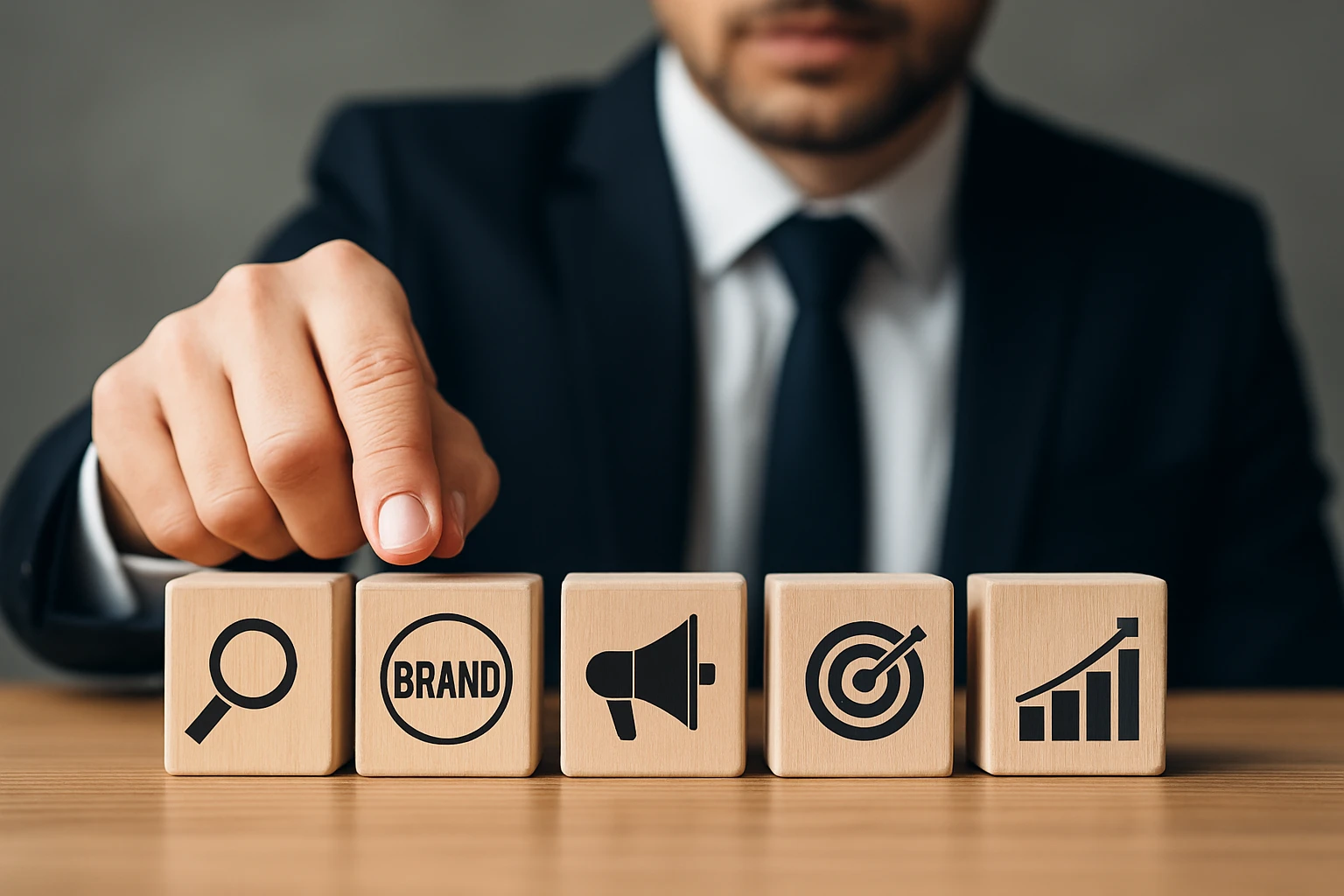
You do not need all seven tactics in motion by Friday. You need the right mix for your constraints, channel mix, and urgency.
Start with the surfaces you can control fastest
Begin where your team has direct control: top landing pages, glossary entries, FAQ sections, author bios, and company profile data. Adobe says businesses need to optimize digital channels for both humans and AI. Owned surfaces let you act on that today, without waiting for a journalist reply or a conference slot in October.
Then work outward. A practical sequence for many teams is simple: fix the pages already ranking on page one, standardize your entity data, and only then push harder on third-party mentions and broader repurposing.
Match the tactic to your team size and workflow maturity
Common operating rule: if resources are tight, prioritize the work you can repeat. A solo marketer should not start with an elaborate earned-media machine if the site still has mismatched bios, weak answer blocks, and no competitor dashboard.
| Team situation | Start here | Add next | Metric to watch |
|---|---|---|---|
| Solo marketer or startup | 1, 2, and 6 | 3 | Snippet wins, branded impressions, competitor overlap |
| Small in-house content team | 1, 2, and 3 | 5, then 6 | Answer-surface coverage, AI citations, organic CTR |
| Agency or growth hub team | 1, 3, and 6 | 4 and 7 | Share of voice, mention velocity, refresh turnaround |
| Publisher or media brand | 1, 5, and 7 | 4 and 6 | Content reuse output, citation pickup, SERP feature ownership |
Balance quick wins with compounding bets
Quick wins matter because they build internal trust. RTB House is equally right to emphasize the long view: visibility and awareness support stronger market position over time. A rewritten FAQ can win a snippet this month. A disciplined earned-mentions program changes category perception over several quarters.
That is why the best plan is rarely seven tactics at once. It is usually a three-part mix: one fast tactic, one trust-building tactic, and one measurement tactic. For many teams, that means direct-answer optimization, authoritative mentions, and a competitor citation dashboard.
The best mix is usually one fast tactic, one trust-building tactic, and one measurement tactic.
Conclusion: visibility is now a system, not a single channel
The shortlist for week one
Brand visibility in 2026 rewards teams that own the answer, spread the proof, and measure the gap. This week, clean up your top answer pages, standardize your brand data, and start tracking one real competitor set.
What to watch as the year unfolds
Search and AI are no longer separate lanes; Adobe points to both AI discovery and owned properties, while Semrush and RTB House keep the focus on measurable exposure over time. When buyers ask search, chat tools, and industry peers who matters in your category, where will your brand appear next?
Grow Smarter Visibility With SEOPro AI
Hidden prompts embedded in content trigger AI/LLM brand mentions while automated creation, publishing, and monitoring help teams scale organic growth.
Grow Visibility