7 Ways to Boost Brand Visibility in AI Search
At 8:17 on a Tuesday, you update the short bio in your site header, tighten the company description on LinkedIn, and fix a Google Business Profile that has been using an old phone number since last summer. By Friday, a cluster of fresh Google reviews lands. A week later, your company name starts showing up in AI answers where a competitor had been parked for months.
If you want to boost brand visibility in AI search, that sequence should feel familiar. The lift usually comes from cleaner signals, fresher proof, and pages that answer quickly — not from a vague brand-awareness campaign.
That is the real shift. ChatGPT, Gemini, Google Overviews, and similar systems do not discover your brand the way a person does. They piece you together from your site, third-party mentions, review text, internal links, and machine-readable clues. When those pieces line up, you become easier to cite.
#1 Lock down your brand entity everywhere
What it is
Make your company look like one company everywhere it appears. Use one official brand name, one canonical URL, one concise description, and matching contact details across your homepage, footer, LinkedIn page, Google Business Profile, Crunchbase listing, directory profiles, and author bios. Consistent naming, URLs, and profile details help search systems connect mentions of the same brand across the web. Topical visibility starts with clear brand signals before any content can be associated with your company.
If your brand name varies by platform, AI may treat you like three different companies.
Why it matters for AI search
Before an answer engine can trust your expertise, it needs to resolve your identity. That sounds obvious, yet rebrands break this constantly. Your site says “Northstar Analytics,” a partner page still says “Northstar Data,” and your reviews mention “Northstar Software Inc.” Humans can infer the overlap. Machines can too — but only up to a point. If the entity is fuzzy, every other signal becomes weaker.
Quick example
Run a five-row audit first: homepage header, footer, Organization details, Google Business Profile, and LinkedIn company page. Align the exact name, URL, short description, logo treatment, and phone number in all five places. Then move to high-visibility third-party pages like G2 or Capterra. It is boring work. It also fixes a surprising number of visibility issues before you publish a single new page.
#2 Publish answer-first pages that AI can quote
What it is
Build pages so the first useful answer appears fast. Lead with the direct response to a specific question in the opening lines, then expand with context, steps, comparisons, examples, and related links below. Answer-style content usually works best when it resolves a narrow question early and adds detail afterward. Pages built around clear definitions, steps, and comparisons are easier for language models to summarize than pages that take 400 words to warm up.
Write for extraction first, explanation second.
Why it matters for AI search
AI systems love clean structure. A direct paragraph under a clear heading is easier to quote than a brand essay full of throat-clearing. If your page answers “What is SOC 2 continuous monitoring?” in 45 sharp words, the model has something reusable. If your answer starts with “Businesses today face increasing complexity,” you have already lost the first battle. This is one place where plain writing beats clever writing.
Quick example
Say you sell ecommerce analytics software. Instead of publishing a thought-piece called “Modern Data Challenges for Retail Teams,” create a page titled “What Is Cart Abandonment Rate?” Open with the formula, explain why it matters, list three common causes, and compare it with checkout completion rate. That page gives Google Overviews, ChatGPT, or Gemini a crisp block to quote — and gives the reader exactly what they came for.
#3 Build topical clusters around your core brand themes
What it is

A topic cluster is a hub-and-spoke structure: one central page on a core theme, supported by related articles that answer adjacent questions and link back to the hub. A topic cluster helps search engines understand which subjects your brand is most associated with. Related pages should link back to a central hub page to reinforce your authority on that topic, not float around as isolated posts that never reinforce one another.
One strong page rarely wins AI visibility on its own; clusters do the heavy lifting.
Why it matters for AI search
AI search tends to reward depth, not just a single lucky page. If your site has one excellent article on “customer data platforms” and nothing else on identity resolution, event streams, consent management, or warehouse activation, your expertise looks thin. A cluster creates context. It tells the model, “This brand keeps showing up around the same subject.” That repeated proximity is how brand-topic association gets stronger over time.
Quick example
Imagine a cybersecurity company that wants to own “endpoint security.” The hub page targets the main concept. Supporting pages cover device isolation, EDR vs. XDR, endpoint hardening checklists, and remote-work policy risks. Each article links back to the hub and to related spokes. Now, when someone asks an AI tool for endpoint security vendors or definitions, your brand appears in a richer neighborhood instead of beside a single orphan post.
#4 Earn mentions on authoritative third-party sites
What it is
Your site is not enough. You need independent mentions on places that already carry trust: trade publications, partner directories, review platforms, conference speaker pages, association memberships, expert roundups, and integration marketplaces. Independent mentions from industry publications, partner pages, and directories can strengthen brand recognition across search systems. AI tools often surface brands that appear repeatedly in trusted third-party sources because those mentions act like corroboration, not self-description.
Your own site is proof; outside mentions are corroboration.
Why it matters for AI search
Answer engines do not just ask, “What does this brand say about itself?” They also ask, “Where else does this brand appear, and in what context?” That is why a modest company that gets cited by an industry publication can outperform a louder company that only talks about itself. We often overrate backlinks as a ranking signal and underrate citations as an identity signal. In AI search, the second piece matters a lot.
Quick example
A B2B payments vendor might appear in a fintech newsletter, on a Stripe partner directory page, and in a comparison post on G2. None of those mentions has to be huge. What matters is repetition with consistency: same brand name, same product category, same core value proposition. Three credible mentions on external sites can sometimes do more for AI recall than ten polished landing pages on your own domain.
#5 Turn reviews and ratings into visibility assets
What it is
Treat reviews as discoverability inputs, not just reputation management. Podium groups Google Reviews and Facebook Reviews under its Review Management offering, which is a useful reminder that reviews sit at the center of trust and visibility work. The star rating matters, yes. The language inside the review matters too — service names, location references, turnaround time, and product specifics all become fresh, structured proof that real customers still choose you.
Fresh reviews can do what static brand copy cannot: prove people still choose you now.
Why it matters for AI search
Podium also places Review Management alongside Get Leads, Convert Leads, and Drive Repeat Business. That framing is worth stealing. Reviews are not a side task. They shape whether your brand looks current, credible, and relevant. For local businesses, review velocity and recency can be especially visible. For SaaS, detailed reviews on G2 or Capterra can surface use cases your homepage never states clearly enough. Static copy ages fast; review language renews itself.
Quick example
A dental practice with 200 old generic reviews may still struggle to surface for “same-day crown” or “Invisalign consultation.” Then 15 recent Google reviews mention those exact services, a neighborhood name, and the speed of scheduling. That is not just social proof. It is searchable, machine-readable context. The same pattern shows up in home services, med spas, and local retail, where recency often says more than polished brand language ever will.
#6 Add structured data and technical signals AI can read
What it is

Give machines a clean map. Use structured data that matches the page, keep navigation obvious, make key pages easy to crawl, and maintain strong internal links between your hubs, spokes, service pages, and brand pages. Structured data helps search engines understand page type, organization details, and content relationships. Clear navigation and internal linking make it easier for crawlers to reach important brand pages instead of wasting time in dead ends or thin archives.
| Signal | What it clarifies |
|---|---|
| Organization details | Who your brand is, what URL represents it, and how name variations should resolve. |
| Breadcrumbs | Where a page sits in the site hierarchy and how it relates to nearby topics. |
| Internal links | Which pages support a hub, which concepts belong together, and what deserves priority. |
| Fast, crawlable templates | Whether systems can reliably reach, render, and reuse the content at all. |
If humans can find it but machines can’t parse it, it won’t help your visibility enough.
Why it matters for AI search
AI systems are not guessing from scratch, but they still benefit from explicit signals. A page with messy navigation, buried copy, weak internal linking, and inconsistent templates forces unnecessary inference. Clean architecture reduces that drag. You do not need every schema type under the sun. You do need the right details in the right places — especially on your homepage, service pages, authors, breadcrumbs, and major comparison or definition pages.
Quick example
Start with your homepage and top commercial pages. Make sure your main brand page is linked from the primary navigation, your topic hubs link to supporting content, and your supporting content links back up. Then review structured details page by page: brand identity on the homepage, service or product context on key landing pages, and breadcrumb trails across the site. For many teams, fixing architecture produces faster gains than writing yet another generic blog post.
#7 Monitor AI mentions and refresh content for gaps
What it is
Set up a recurring process to check whether your brand appears in AI answers, what pages get cited, and where competitors still own the conversation. Track a stable set of prompts in ChatGPT, Gemini, Google Overviews, and other answer surfaces. Because AI-generated answers can change quickly, visibility work needs ongoing monitoring rather than one-time optimization. Think of this less like a ranking report and more like a living citation audit.
The brands that win in AI search are the ones that keep updating the proof.
Why it matters for AI search
What works for a med spa in Phoenix will not match what works for a B2B SaaS company selling developer tools. Podium’s 2025 guide spans auto, aesthetic & wellness, home services, retail, and enterprise, which underlines a practical point: visibility tactics vary by category. Some brands need review freshness first. Others need expert citations, comparison pages, or cleaner technical signals. If you do not monitor the outputs, you cannot tell which missing proof is costing you the mention.
Quick example
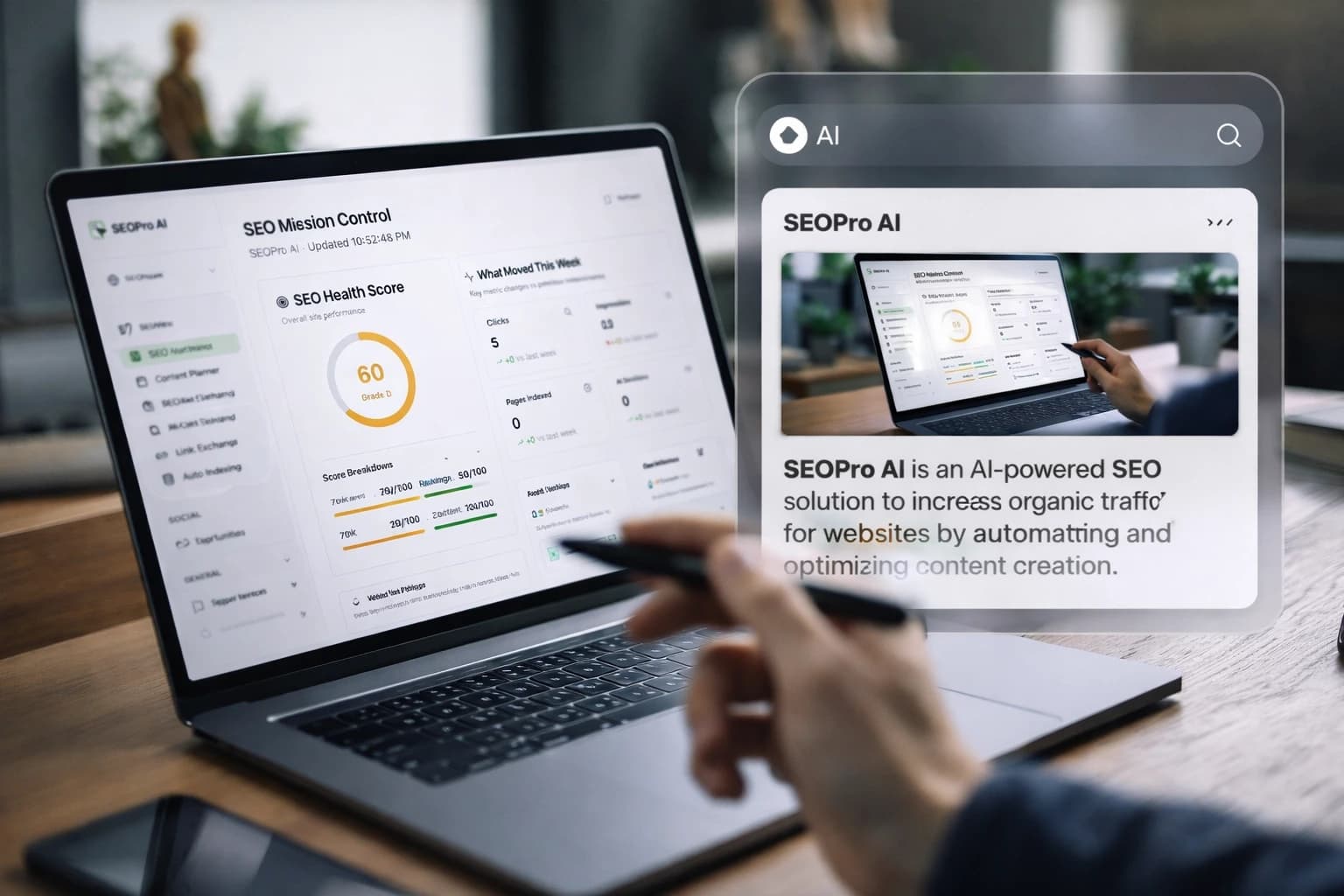
Create a simple monthly worksheet. For ten high-value prompts, record whether your brand appears, which competitors appear, what source pages get cited, and what proof is missing. Maybe your site ranks for “best invoicing software for agencies,” but AI answers skip you because your comparison page is stale, your reviews do not mention agencies, and your third-party citations are thin. That is a refresh brief, not a mystery. Tools such as SEOPro AI can shorten that monitor-to-update loop, but the discipline matters more than the software.
How to choose the right mix of tactics to boost brand visibility
Most teams do not need all seven moves at once. They need the right first move. Use your current bottleneck to decide whether to prioritize entity cleanup, content depth, off-site proof, reviews, or technical clarity.
Start with the weakest signal, not the most exciting tactic.
If your brand is inconsistent
Fix naming, URLs, profile details, and your main brand page before you invest heavily in new content. A brand with weak naming consistency should clean up entity signals first. Otherwise, every new article adds more surface area to a problem you have not solved. If the core identity is shaky, scale only makes the confusion bigger.
If you have content but no citations
Shift effort toward independent proof. That means review generation, partner pages, directories, trade publications, expert commentary, and integration listings. A brand with strong pages but weak off-site proof should focus on reviews, mentions, and third-party coverage. Many teams publish 50 solid articles and wonder why AI answers still mention better-known rivals. The missing ingredient is often corroboration, not content volume.
If you already rank but need more AI mentions
Look at extractability, freshness, and evidence. You may already have authority, but your pages may be hard to quote or too stale to trust. Tighten intros, add direct definitions, refresh examples, bring review language into the mix, and make sure the page is connected to a broader cluster. In mature sites, the jump from “ranked” to “cited” often comes from format and proof, not from another keyword target.
| Current bottleneck | Start here | Then do this next |
|---|---|---|
| Inconsistent brand naming | Align site, profiles, directories, and core brand details | Build or refresh hub pages around your core themes |
| Strong content, weak outside proof | Earn reviews, partner mentions, and industry citations | Refresh pages so those citations have strong destinations |
| Good rankings, few AI mentions | Rewrite pages into answer-first formats | Add supporting proof, comparisons, and recent updates |
| Complex site, thin internal structure | Clean up navigation, links, and page hierarchy | Layer in structured signals and monitor citation changes |
That framework keeps you from chasing shiny tactics out of order. We all like publishing new pages. Very often, the better move is to make your existing brand easier to recognize, easier to verify, and easier to quote.
AI search rewards brands that are easy to identify, easy to quote, and easy to verify.
If you want to boost brand visibility, clean up the entity first, publish answer-first pages, earn outside proof, and keep refreshing what answer engines actually cite.
When you audit your presence next week, which signal looks weakest right now — identity, depth, corroboration, reviews, technical clarity, or freshness?
Increase AI Search Reach With SEOPro AI
SEOPro AI embeds hidden prompts in content to spur AI-brand mentions while automating publishing, clustering, schema, and monitoring for bigger organic reach.
Grow Visibility